THE CLASSIC COLLECTION✦An outlaw’s diary: the CommuneCLASSIC FREE BOOKS
An outlaw’s diary: the Commune
Cécile Tormay
THE CLASSIC COLLECTION · 1894
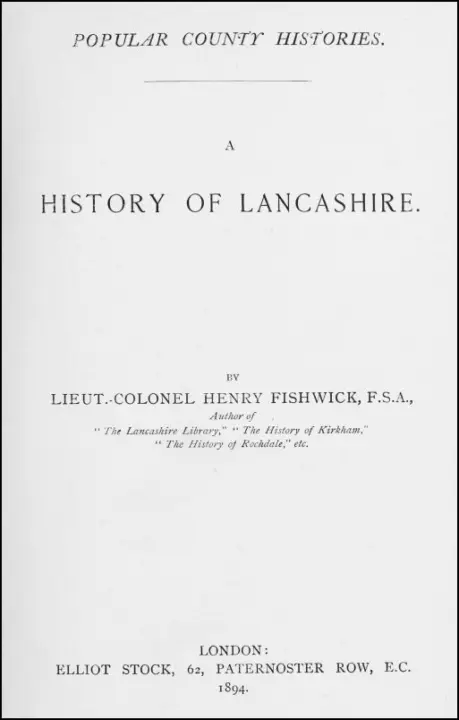
"A History of Lancashire" by Lieut.-Colonel Henry Fishwick is a historical account written in the late 19th century. This work explores the rich and diverse history of the English county of Lancashire, tracing its development from pre-Roman times through various significant historical periods, including the influence of the Romans, Saxons, and Normans. Fishwick aims to provide a comprehensive overview while selecting the most important events and figures that shaped the county. The opening of the book lays the groundwork for understanding Lancashire's geographical boundaries and significant divisions, such as its hundreds and parishes. Fishwick discusses the challenges he faced in condensing a vast amount of research material into a single volume, emphasizing the importance of authenticity and reliability in the historical facts presented. The introduction not only outlines the physical layout of the county but also sets the stage for a deeper exploration of its history, promising to delve into various eras and notable events that have defined Lancashire's identity over the centuries.
Introduction adapted from the source catalogue; source summaries may be automatically generated.
Free to read · English · 93,916 words · No account needed
MAKE TIME FOR A GOOD BOOK
On by default. Untick to stop anonymous reading totals. Each page counts after 10 seconds in view. How this works.
Anonymous counting is on unless you have switched it off.
The stirring events which led up to the battle of Hastings, which took place on October 14, 1066, and the subsequent complete conquest of England by William of Normandy, did not perhaps immediately affect the Northern part of the kingdom so much as they did those counties lying nearer the scene of action.
We have now arrived at a period when we have more definite and reliable evidence as to the actual position of Lancashire.
At the end of the year 1084 the King summoned his Great Council to meet at Gloucester, with the object of devising means whereby a full account could be obtained as to the state of the country, especially as to the land--how much was cultivated, and by whom and on what authority it was held. This is not the place more fully to describe the modus operandi of preparing the Domesday Book, but it may be mentioned that by some singular arrangement Lancashire as a county is not named, the southern portion being included in Cheshire, the hundred of Amounderness in Yorkshire, and the two northern hundreds in Westmorland, Cumberland, and Yorkshire. The value of the information contained in the return is threefold, as it records the state of the country in Edward the Confessor's time, the way each manor, etc., was dealt with by William on his taking possession, and the rateable value on the taking of the Survey.
Unfortunately, we do not get from it anything like a census of the whole country, but it will be useful for comparison to note that Yorkshire had about 10,000 inhabitants, London some 30,000, and that of the other counties Lincoln and Norfolk had the largest population. The Survey was taken in A.D. 1085.
In West Derby Hundred the following places are named[56] as places where there was land under such cultivation or occupation as to render it rateable: Roby, Knowsley, Kirkby, Maghull, Aughton, Huyton, Torbock, Toxteth, Sefton, Kirkdale, Walton-on-the-Hill, Litherland, Ince Blundell, Thornton, Meols, Little Woolton, Smithdown (now Liverpool), Allerton, Speke, Childwall,[57] Windle, Much Woolton, Wavertree, Bootle, Formby, Ainsley, Down Hollard, Dalton, Skelmersdale, Raven's Meols, Orrell, Lathom, Hurleston (in Scarisbrick), Melling, Lydiate, Altcar,[58] Barton, Halsall. At this time Lancashire between the Ribble and the Mersey was divided into six hundreds, viz., West Derby, Newton, Walintone (i.e., Warrington), Blackburn, Salford, and Leyland. The places just named, with the addition of Newton and Warrington, are all that were recognised in the Great Survey, and many of these were manors held in the time of Edward by Thanes whose names are not given; others were doubtless in the hands of Saxons, Danes or Anglo-Saxons, who had stuck to their holdings through all changes. Some of the surnames at once suggest this; for example, we find Godiva, the widow of Leofric, Earl of Mercia, returned as having three carucates of land in Melling. Amongst the other tenants in capite are Dot, Uetred, Chetel, Wibert, etc. Edward the Confessor had in West Derby one manor and six berewicks (sub-manors), a forest 3 miles long and 1½ miles wide,[59] and an aerie of hawks. The whole of the land between the Ribble and the Mersey had been given to Roger de Poictou as a reward for his services to the Conqueror, but was forfeited to the Crown shortly before this date. All the manors were rateable to the danegeld, but fifteen of them paid nothing to the royal exchequer except that geld. The customary tribute for the manors was two hora or ores of pennies for each carucate of land;[60] the owners of the manors had also to assist in making and keeping up the King's houses, fisheries, hays, and stations in the forest; they were also to find mowers to reap the King's corn, to attend the hundred court, and do other small services, under certain fixed penalties for omission.
Your reading position is saved on this browser. Take it to another device with a library code. Reading pages adapt to text, rather than matching a printed edition.
BEHIND THE BOOK
This eBook is for the use of anyone anywhere in the United States and most other parts of the world at no cost and with almost no restrictions whatsoever. You may copy it, give it away or re-use it under the terms of the Project Gutenberg License included with this eBook or online at www.gutenberg.org. If you are not located in the United States, you will have to check the laws of the country where you are located before using this eBook. Read the source licence.
The original source file, including credits and licence, is retained by this library. Request an original-format copy at no charge. Please include the book title and Project Gutenberg identifier #49369.
KEEP YOUR CURIOSITY GOING
Cécile Tormay

Moritz Busch
John L. Ransom
Frances Wright
Cécile Tormay

Mabel Potter Daggett