THE CLASSIC COLLECTION✦An outlaw’s diary: the CommuneCLASSIC FREE BOOKS
An outlaw’s diary: the Commune
Cécile Tormay
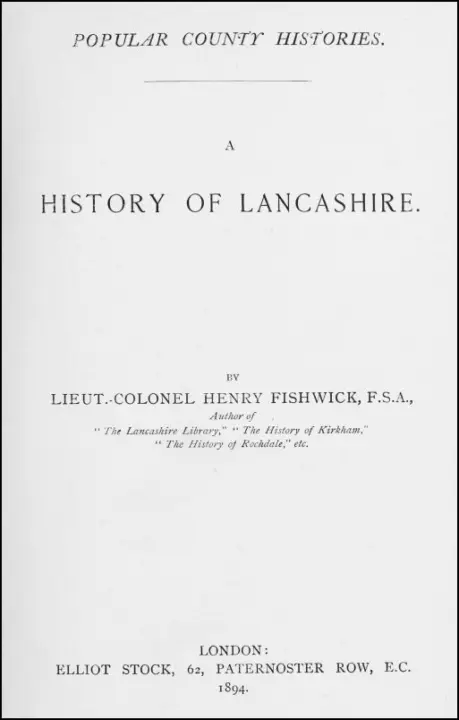
THE CLASSIC COLLECTION · 1894
"A History of Lancashire" by Lieut.-Colonel Henry Fishwick is a historical account written in the late 19th century. This work explores the rich and diverse history of the English county of Lancashire, tracing its development from pre-Roman times through various significant historical periods, including the influence of the Romans, Saxons, and Normans. Fishwick aims to provide a comprehensive overview while selecting the most important events and figures that shaped the county. The opening of the book lays the groundwork for understanding Lancashire's geographical boundaries and significant divisions, such as its hundreds and parishes. Fishwick discusses the challenges he faced in condensing a vast amount of research material into a single volume, emphasizing the importance of authenticity and reliability in the historical facts presented. The introduction not only outlines the physical layout of the county but also sets the stage for a deeper exploration of its history, promising to delve into various eras and notable events that have defined Lancashire's identity over the centuries.
Introduction adapted from the source catalogue; source summaries may be automatically generated.
Free to read · English · 93,916 words · No account needed
MAKE TIME FOR A GOOD BOOK
On by default. Untick to stop anonymous reading totals. Each page counts after 10 seconds in view. How this works.
Anonymous counting is on unless you have switched it off.
In the time which immediately preceded the coming of the Norman Conqueror, Lancashire must have been very sparsely populated; in every part of it there were vast forests, and great stretches of moss and fern; agriculture was everywhere neglected; towns, in the modern sense, there were none; but here and there, clustering as if for protection round some Saxon Thane's castle or fortified dwelling-place, were groups of wooden houses and rude huts, and scattered sparsely over the county were the clearings (assarts or rods) and the tons of the primitive settlers, with, in some districts, a wooden building doing duty as a church. Except where the old Roman roads were still in use, the means of passage from one place to another was difficult and dangerous; the people were of many tribes and nations--remnants of ancient British families, Angles, Saxons, Danes, Scandinavians, and even Normans contributed to the general stock--and as there were many tribes, so were there various religions, although Christianity had now become the general accepted faith. But for all this, much had been accomplished by time and experience to prepare the mind of the people to accept the tenet that union is strength, and that only by an undivided kingdom could come peace, wealth, and prosperity.
[Footnote 39: Authorities differ as to this locality: one writer places it on the Firth of Forth, another in Worcestershire.]
[Footnote 40: Pp. 36, 39.]
[Footnote 41: Sanderson's "History of England," p. 44.]
[Footnote 42: A.D. 923.]
[Footnote 43: After the death of Cnut, in 1035, the kingdom was again divided, and Mercia and Northumbria fell to Harold. Harthacnut was (in 1039), however, King of all England.]
[Footnote 44: Vol. i., p. 12, 2nd edit.]
[Footnote 45: Coucher Book, Duchy Office, No. 78.]
[Footnote 46: Originally a tax paid to the Danes, but afterwards appropriated to the King. It was always a very unpopular tax.]
[Footnote 47: Plan of this in Fishwick's "History of Rochdale," p. 66.]
[Footnote 48: "Eccles. Hist.," lib. iii., cap. 8.]
[Footnote 49: Baines' "Hist. of Lanc.," ii. 205, 2nd edit.]
[Footnote 50: The following account of it is compiled from an article in Archæologia, vol. liii., part iii., by H. Swainson Cowper, Esq., F.S.A.]
[Footnote 51: See Lanc. and Ches. Arch. Soc., v. 1 et seq.]
[Footnote 52: See Lanc. and Ches. Arch. Soc., v. 227.]
[Footnote 53: Saxon Chronicle and the Chronicle of Simon of Durham.]
[Footnote 54: Arch. Journal, vi. 74; and "History of Garstang,"
Chetham Soc., civ. 5.]
[Footnote 55: Fishwick's "History of St. Michael's-on-Wyre," Chetham Soc., xxv. (new series), p. 2.]
Your reading position is saved on this browser. Take it to another device with a library code. Reading pages adapt to text, rather than matching a printed edition.
BEHIND THE BOOK
This eBook is for the use of anyone anywhere in the United States and most other parts of the world at no cost and with almost no restrictions whatsoever. You may copy it, give it away or re-use it under the terms of the Project Gutenberg License included with this eBook or online at www.gutenberg.org. If you are not located in the United States, you will have to check the laws of the country where you are located before using this eBook. Read the source licence.
The original source file, including credits and licence, is retained by this library. Request an original-format copy at no charge. Please include the book title and Project Gutenberg identifier #49369.
KEEP YOUR CURIOSITY GOING
Cécile Tormay

Moritz Busch
John L. Ransom
Frances Wright
Cécile Tormay

Mabel Potter Daggett