THE CLASSIC COLLECTION✦An outlaw’s diary: the CommuneCLASSIC FREE BOOKS
An outlaw’s diary: the Commune
Cécile Tormay
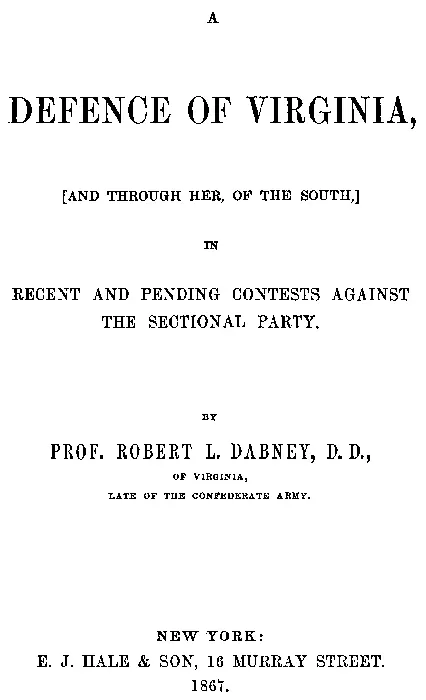
THE CLASSIC COLLECTION · 1867
"A Defence of Virginia" by Robert Lewis Dabney is a historical account written in the late 19th century. The book serves as a justification for the institution of slavery and the Southern cause during and after the American Civil War, arguing that the principles of slavery are both moral and historically valid. Dabney presents a defense of Virginia and through it, the Southern states, against what he perceives as a misrepresentation by abolitionists and their sympathizers. The opening of the text introduces the author's intent to defend Virginia, whom he views as slandered by the Northern anti-slavery sentiments that emerged during and after the Civil War. Dabney critiques the moral and social judgments placed upon Southern slavery, asserting that such judgments are rooted in a misunderstanding of history and human rights. He emphasizes that while other nations and regions continued the practice of slavery, the Southern states were unfairly targeted for disdain. Dabney sets the tone for a thorough examination of the ethical and scriptural justifications for slavery, asserting the need for a historical perspective that acknowledges Virginia's significance and the complexities surrounding the institution of slavery in America. This summary covers only the opening portion of the book.
Introduction adapted from the source catalogue; source summaries may be automatically generated.
Free to read · English · 98,110 words · No account needed
MAKE TIME FOR A GOOD BOOK
On by default. Untick to stop anonymous reading totals. Each page counts after 10 seconds in view. How this works.
Anonymous counting is on unless you have switched it off.
It may be well, in concluding this point, to notice the plea that Christians were required by the apostles to render not only patience and submission to the Emperor Nero, but also allegiance and hearty obedience. Yet none will say that Nero was a righteous ruler. We reply, the case is precisely in our favour: for it proves the proposition exactly parallel to ours, that civil government is a lawful institution, notwithstanding it is abused. The government of the Cæsars was providentially the de facto one, and Nero, bad as he was, its recognized head. As such, all his magisterial acts which were not specifically contrary to God's law, were legitimate, and were the proper objects of the civic obedience of the Christian subject. Otherwise, the apostles would never have exacted it for him. The instance does imply, therefore, that civil government is a lawful relation; and this is precisely what we infer from the parallel instances of obedience enjoined on servants to masters. If Abolitionists are not willing to argue that the relation of ruler and subject is sin per se, notwithstanding the obedience required to Nero, they cannot argue from their proposed analogy between Nero's cruelties and slaveholding. But an equally conclusive reply is, that apostles never admitted a Nero, with his barbarities in full sway, to the same communion-table with his patient Christian victims, commanding the latter to forbear as towards a wrongdoer, and yet failing to give him the correlative command, to cease the wrong-doing.
§ 8. Philemon and Onesimus.
The Epistle to Philemon is peculiarly instructive and convincing as to the moral character of slavery. This Abolitionists betray, by the distressing wrigglings and contortions of logic, to which they resort, in the vain attempt to evade its inferences. The whole Epistle need not be recited. The apostle, after saluting Philemon as a brother and fellow-minister, and commending him in terms of peculiar beauty, warmth, and affection, for his eminent piety, and his hospitalities and charities to Christians, proceeds thus, v. 8 to 19: "Though I might be much bold in Christ to enjoin thee that which is convenient, yet, for love's sake, I rather beseech thee, being such an one as Paul the aged, and now also a prisoner of Jesus Christ. I beseech thee for my son Onesimus, whom I have begotten in my bonds; which in time past was to thee unprofitable, but now profitable to thee and to me; whom I have sent again: thou, therefore, receive him, that is, mine own bowels: Whom I would have retained with me, that in thy stead he might have ministered unto me in the bonds of the Gospel. But without thy mind would I do nothing: that thy benefit should not be as it were of necessity, but willingly. For perhaps he therefore departed for a season, that thou shouldst receive him forever; not now as a servant, but above a servant, a brother beloved, especially to me, but how much more unto thee, both in the flesh, and in the Lord. If thou count me therefore, a partner, receive him as myself. If he hath wronged thee, or oweth thee aught, put that on mine account; I Paul have written it with mine own hand, I will repay it," &c. That it may not be supposed we give an explanation of these words warped to suit our own views, we will copy the very words of the judicious Dr. Thomas Scott, one of the most fair and reasonable of expositors, and a declared enemy of slavery. In his introduction to the Epistle, he says: "Philemon seems to have been a Christian of some eminence, residing at Colosse, (Col. iv. 9, or 17,) who had been converted under St. Paul's ministry, (19,) perhaps during his abode at Ephesus, (Acts xix. 10.) When the apostle was imprisoned at Rome, Onesimus, a slave of Philemon, having, as it is generally thought, been guilty of some dishonesty, left his master and fled to that city, though at the distance of several hundred miles. When he came thither, curiosity or some such motive induced him to attend on St. Paul's ministry, which it pleased God to bless for his conversion. After he had given satisfactory proof of a real change, and manifested an excellent disposition, by suitable behaviour, which had greatly endeared him to Paul, he judged it proper to send him back to his master, to whom he wrote this epistle, that he might procure Onesimus a more favourable reception than he could otherwise have expected." Notes on v. 12 to 16: "Onesimus was Philemon's legal property, and St. Paul had required, and prevailed with him, to return to him, having made sufficient trial of his sincerity: and he requested Philemon to receive him with the same kindness as he would the aged apostle's own son according to the flesh, being equally dear to him, as his spiritual child. He would gladly have kept him at Rome, to minister to him in his confinement, which Onesimus would willingly have done in the bonds of the Gospel, being attached to him from Christian love and gratitude; and as he knew that Philemon would gladly have done him any service in person, if he had been at Rome, so he would have considered Onesimus as ministering to him in his master's stead. But he would not do any thing of this kind without his consent, lest he should seem to extort the benefit, and Philemon should appear to act from necessity, rather than from a willing mind. And though he had hopes of deriving benefit from Onesimus' faithful service, at some future period, by Philemon's free consent, yet he was not sure that this was the Lord's purpose concerning him; for perhaps he permitted him to leave his master for a season in so improper a manner, in order that, being converted, he might be received on his return with such affection, and might abide with Philemon with such faithfulness and diligence, that they should choose to live together the rest of their lives as fellow-heirs of eternal felicity. In this case he knew that Philemon would no longer consider Onesimus merely as a slave, but view him as 'above a slave, even a brother beloved.' This he was become to Paul in an especial manner, who had before been entirely a stranger to him; how much more, then, might it be supposed that he would be endeared to Philemon, when he became well acquainted with his excellency! seeing he would be near to him both in the flesh as one of his domestics, and in the Lord, as one with him in Christ by faith."
Your reading position is saved on this browser. Take it to another device with a library code. Reading pages adapt to text, rather than matching a printed edition.
BEHIND THE BOOK
This eBook is for the use of anyone anywhere in the United States and most other parts of the world at no cost and with almost no restrictions whatsoever. You may copy it, give it away or re-use it under the terms of the Project Gutenberg License included with this eBook or online at www.gutenberg.org. If you are not located in the United States, you will have to check the laws of the country where you are located before using this eBook. Read the source licence.
The original source file, including credits and licence, is retained by this library. Request an original-format copy at no charge. Please include the book title and Project Gutenberg identifier #47422.
KEEP YOUR CURIOSITY GOING
Cécile Tormay

Moritz Busch
John L. Ransom
Frances Wright
Cécile Tormay

Mabel Potter Daggett