THE CLASSIC COLLECTION✦An outlaw’s diary: the CommuneCLASSIC FREE BOOKS
An outlaw’s diary: the Commune
Cécile Tormay
THE CLASSIC COLLECTION · 1867
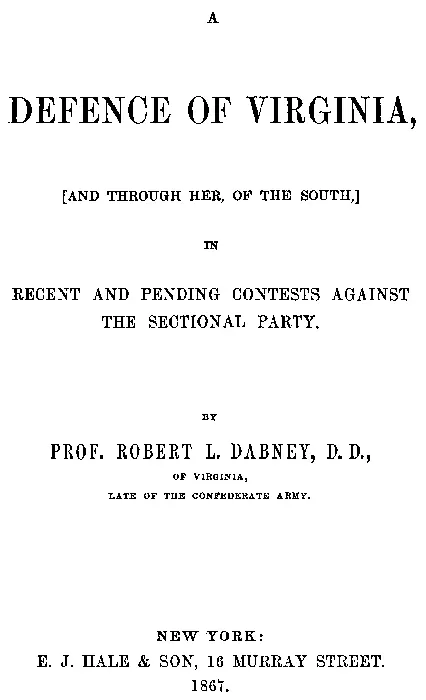
"A Defence of Virginia" by Robert Lewis Dabney is a historical account written in the late 19th century. The book serves as a justification for the institution of slavery and the Southern cause during and after the American Civil War, arguing that the principles of slavery are both moral and historically valid. Dabney presents a defense of Virginia and through it, the Southern states, against what he perceives as a misrepresentation by abolitionists and their sympathizers. The opening of the text introduces the author's intent to defend Virginia, whom he views as slandered by the Northern anti-slavery sentiments that emerged during and after the Civil War. Dabney critiques the moral and social judgments placed upon Southern slavery, asserting that such judgments are rooted in a misunderstanding of history and human rights. He emphasizes that while other nations and regions continued the practice of slavery, the Southern states were unfairly targeted for disdain. Dabney sets the tone for a thorough examination of the ethical and scriptural justifications for slavery, asserting the need for a historical perspective that acknowledges Virginia's significance and the complexities surrounding the institution of slavery in America. This summary covers only the opening portion of the book.
Introduction adapted from the source catalogue; source summaries may be automatically generated.
Free to read · English · 98,110 words · No account needed
MAKE TIME FOR A GOOD BOOK
On by default. Untick to stop anonymous reading totals. Each page counts after 10 seconds in view. How this works.
Anonymous counting is on unless you have switched it off.
The attempt is made to argue, that if this were correct, then the holy apostles would be implicated in a connivance at the excesses and barbarities which, the history of the times tells us, often attached to the servile condition. The answer is: that they condemn and prohibit all the wrongs, as criminal, and leave the relation itself as lawful. No other defence can be set up for their treatment of the conjugal and parental relations. Antiquarians tell us they also were then deformed by great abuses. The wife and child were no better than slaves. Over the latter the father had the power of life and death, and of selling into bondage. From the former he divorced himself at pleasure, and often visited her with corporal punishment. How do the apostles treat these facts? They recognize the relation and forbid its abuses. Shall any one say that because these abuses were current, therefore they should have denounced the domestic relations, and invented some new-fangled communism? Or shall it be said that, because they have not done this, they wink at the wife-beatings, the child-murders, and the other barbarities so common in Greek and Oriental families? We trow not. Why then should these absurd inferences be attached to their treatment of domestic slavery?
But the favourite evasion of these Scriptures is that of Dr. Wayland: "The scope of these instructions to servants is only to teach patience, fidelity, meekness, and charity, duties which Christians owe to all men, even their enemies." In like strain, Mr. Albert Barnes, in his 'Notes on Ephesians,' vi. 7, writes: "But let not a master think, because a pious slave shows this spirit, that therefore the slave feels the master is right in withholding his freedom; nor let him suppose, because religion requires the slave to be submissive and obedient, that therefore it approves of what the master does. It does this no more than it sanctions the conduct of Mary and Nero, because religion required the martyrs to be unresisting, and to allow themselves to be led to the stake. A conscientious slave may find happiness in submitting to God, and doing His will, just as a conscientious martyr may. But this does not sanction the wrong, either of the slave-owner or of the persecutor." It is difficult to restrain the expression of natural indignation at so shameless a sophism as this, which outrages at once the understanding of the reader and the honour of Christ. It represents the pure and benign genius of Christianity as walking abroad, and finding oppressor and oppressed together, the oppressor avowedly within her reach, as well as his victim, as a subject of her spiritual jurisdiction and instruction. To the one she is represented as saying: "Oh, injured slave! glorify thy meek and lowly Saviour under this unrighteous oppression, by imitating His patience." Turning then to the other, who is present, and equally subject to her authority, must she not, of course, give the correlative injunction: "Oh, master! since thy yoke is wicked, cease instantly to persecute Christ in the person of his follower." But no: abolitionism represents her as saying nothing at all on this point; but merely dismissing his side of the case with the injunction to oppress equitably! The honest mind meets such a statement, not only with the 'Incredulus sum,' but with the 'Incredulus odi,' of the Latin satirist. And the suffering victim of oppression could not but feel, while he recognized the duty of patience, that the counterpart treatment of his oppressor by Christianity was a foul injustice. The fact that Christ and apostles admitted these masters, with these slaves, to the same communion, proves that the comment of Mr. Barnes is preposterous. The fact that these Christian slaves are commanded to treat these pretended oppressors as "brethren, faithful and beloved, partakers of the benefit," proves it. Do the apostles, while enjoining patience under the persecutions of a bloody Nero, admit that Nero, with his brutality, to the same Christian communion with the peaceful and holy victims, address him as "saint and faithful in Christ Jesus," and instruct him to burn and tear the Christians for their faith, in a godly manner? The comment is disproved by Peter, when he says that there were slave-owners who were "good and gentle," as well as others who were "froward." Does truth or common sense distinguish "good and gentle" persecutors? It is disproved farther, by the fact that the apostles do not enjoin patience only, on these servants, as on Christians forbearing under an injury; but they enjoin duty, obedience, and fidelity also, as upon Christians paying reciprocal obligations. It is not patience under ruthless force, which they require, as a tribute to Christ's honour; but it is obedience due to the master's legitimate authority, and that, a tribute due to the master also. Servants must "show all good fidelity." This implies an obligation to which to be faithful. Fidelity does not exist where there is no debt. To unrighteous exaction we may be submissive; but fidelity has no place. But the crowning refutation is, that St. Paul sent back an escaped slave to his master Philemon, from Rome to Colosse, hundreds of miles away. Will any one say that the duty of Christian submission and patience under wrongs extends so far as to require an injured Christian to go back several hundred miles, and hunt up his oppressor in order to be maltreated again, after Providence had enabled him to escape from his injuries? If Mr. Barnes is correct, Onesimus should have claimed that he had now availed himself of Christ's own command: "When they persecute you in one city, flee ye into another;" and was rightfully concealed in the midst of the vast metropolis. This was requiring him to "turn the other cheek" with a vengeance: to waive the right of peaceable escape which his Divine Lord had given him, and go all the way to Asia to be unjustly smitten again! There is this farther absurdity: the pious servant is required to stretch his forbearance to so Quixotic a degree, as to waive, not only the claim of forcible self-defence, but that of legal protection. (Oh that the holy Abolitionists had practised towards the injured South a little tythe of this forbearance which their learned scribe so consistently inculcates!) Is it Christ's requirement, that the Christian under oppression must refuse the shield of legal protection? Did Paul think thus, when, prosecuted at the bar of Porcius Festus by unscrupulous enemies, he claimed the rights of his citizenship with so admirable a union of forbearance and courage? Now, if Messrs. Wayland and Barnes are right, these oppressed slaves possessed a tribunal in common with their oppressors, to which they could lawfully, peacefully, forgivingly, yet righteously summon them: the church court. They could have demanded of these authorities, with the strictest Christian propriety, to use all their spiritual powers, so far as they went, to induce the masters, their fellow-members, to give them that liberty which was their due. But, so exceedingly forbearing are they, that they not only forego forcible resistance, but the peaceable claim of their ecclesiastical right, for fear they might be thought to act in an impatient manner! A highwayman meets me in a wood, and begins to beat me and rob me: I have a weapon, but I forbear to use violence against him. Meantime, the legal authorities pass by, and I also forbear to claim their protection under the law, lest it should scandalize the amiable highwayman, and make him think less favourably of my religion!
Your reading position is saved on this browser. Take it to another device with a library code. Reading pages adapt to text, rather than matching a printed edition.
BEHIND THE BOOK
This eBook is for the use of anyone anywhere in the United States and most other parts of the world at no cost and with almost no restrictions whatsoever. You may copy it, give it away or re-use it under the terms of the Project Gutenberg License included with this eBook or online at www.gutenberg.org. If you are not located in the United States, you will have to check the laws of the country where you are located before using this eBook. Read the source licence.
The original source file, including credits and licence, is retained by this library. Request an original-format copy at no charge. Please include the book title and Project Gutenberg identifier #47422.
KEEP YOUR CURIOSITY GOING
Cécile Tormay

Moritz Busch
John L. Ransom
Frances Wright
Cécile Tormay

Mabel Potter Daggett