THE CLASSIC COLLECTION✦An outlaw’s diary: the CommuneCLASSIC FREE BOOKS
An outlaw’s diary: the Commune
Cécile Tormay
THE CLASSIC COLLECTION · 1867
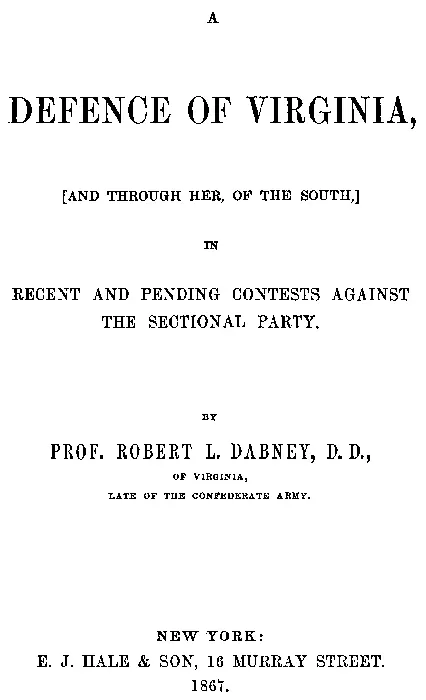
"A Defence of Virginia" by Robert Lewis Dabney is a historical account written in the late 19th century. The book serves as a justification for the institution of slavery and the Southern cause during and after the American Civil War, arguing that the principles of slavery are both moral and historically valid. Dabney presents a defense of Virginia and through it, the Southern states, against what he perceives as a misrepresentation by abolitionists and their sympathizers. The opening of the text introduces the author's intent to defend Virginia, whom he views as slandered by the Northern anti-slavery sentiments that emerged during and after the Civil War. Dabney critiques the moral and social judgments placed upon Southern slavery, asserting that such judgments are rooted in a misunderstanding of history and human rights. He emphasizes that while other nations and regions continued the practice of slavery, the Southern states were unfairly targeted for disdain. Dabney sets the tone for a thorough examination of the ethical and scriptural justifications for slavery, asserting the need for a historical perspective that acknowledges Virginia's significance and the complexities surrounding the institution of slavery in America. This summary covers only the opening portion of the book.
Introduction adapted from the source catalogue; source summaries may be automatically generated.
Free to read · English · 98,110 words · No account needed
MAKE TIME FOR A GOOD BOOK
On by default. Untick to stop anonymous reading totals. Each page counts after 10 seconds in view. How this works.
Anonymous counting is on unless you have switched it off.
§ 1. Let us appeal, then, to the Bible, to learn the moral character of Domestic Slavery. It will be well for both writer and readers, if they recall the reverence and honesty with which such a book should be approached; if the one is cautious to permit no party zeal, pride of opinion, or love of hypothesis, to tempt him to warp the sacred text to any thing inconsistent with its own truth and purity; and if the others are equally careful to receive its teachings with impartiality and docility.
That no misunderstanding may attend the discussion, we must define at the outset, what we mean by that domestic slavery which we defend. By this relation we understand the obligations of the slave to labour for life, without his own consent, for the master. The thing, therefore, in which the master has property or ownership, is the involuntary labour of the slave, and not his personality, or his soul. A certain right of control over the person of the slave is incidentally given to the master by his property in the bondsman's labour; that is, so much control as is necessary to enable him to secure the labour which belongs to him. But we repeat, it is not the person, but the labour of the slave, which is the master's property. This is substantially the definition of Paley, an enemy of slavery; and it is obviously correct; it expresses the general result of the laws of all modern nations which have had slaves, touching that relation.
The abolitionists clamorously insist upon a different definition, which makes the master claim property in the very personality of the slave, in his soul, in the highest capacities which connect him with his God, and in his very being. According to this description, slavery converts the responsible, rational being, into a mere thing, a chattel, a commodity, by converting him into mere property of another man. The motive of this preposterous definition is obvious enough. One of the most astute of American Abolitionists has been candid enough to avow it, saying that if our definition be adopted, there is an end of the discussion; for every logician must see that it is absurd to declare the mere ownership of one man's labour by another, an essential and necessary moral wrong; which is the character it suits them to ascribe to slavery. Their object is so to represent it, that it shall appear a self-evident injustice, and the apologist shall be overwhelmed and silenced by a foregone prejudice. For, if it gave a literal ownership in the person and being of the slave, which can belong to none but the Creator; if it made not only his labour, but his conscience, the property of the master, destroying his moral responsibility, it would indeed dehumanize him, and would be an iniquity indefensible by any fair mind. The trick of securing the victory before the contest begins, by raising a false issue, is not very novel. The utter absurdity of applying such a definition to African slavery in America, appears from this: that it is contrary to the whole tenour of the legislation which establishes and regulates the institution among us. These laws, first, legislate for the slave, as to his own conduct, as a responsible human being, govern him by precepts sanctioned by rewards and punishments, and require of him intelligent obedience to the same moral rules which are enforced on his master. Second, the laws assign to the master precisely that amount of control over his slave's person which they suppose (whether correctly or not is no concern to us in this argument) to be incidental to his property in the servant's labour; and no more. Third, they protect the person, being, and moral responsibility of the slave against his own master. If the master kills him, it is murder, by the law. The slave's Sabbath is secured to him by the law. If the master force him to commit a crime, the former is held by the law guilty therefor, as accessory before the fact: and the latter is also held to his personal responsibility for it. And last, the law treats the slave so fully as a rational and responsible human, that it even bestows on him the right of litigation against his own master, in one case. Any African setting up a plea of unlawful detention in bondage, against his master, is allowed to sue in forma pauperis, in the courts of law. How could the fact be more clearly defined, that the institution of slavery treats the slave as a rational human being, and gives the master property in nothing but his labour?
Your reading position is saved on this browser. Take it to another device with a library code. Reading pages adapt to text, rather than matching a printed edition.
BEHIND THE BOOK
This eBook is for the use of anyone anywhere in the United States and most other parts of the world at no cost and with almost no restrictions whatsoever. You may copy it, give it away or re-use it under the terms of the Project Gutenberg License included with this eBook or online at www.gutenberg.org. If you are not located in the United States, you will have to check the laws of the country where you are located before using this eBook. Read the source licence.
The original source file, including credits and licence, is retained by this library. Request an original-format copy at no charge. Please include the book title and Project Gutenberg identifier #47422.
KEEP YOUR CURIOSITY GOING
Cécile Tormay

Moritz Busch
John L. Ransom
Frances Wright
Cécile Tormay

Mabel Potter Daggett