THE CLASSIC COLLECTION✦An outlaw’s diary: the CommuneCLASSIC FREE BOOKS
An outlaw’s diary: the Commune
Cécile Tormay
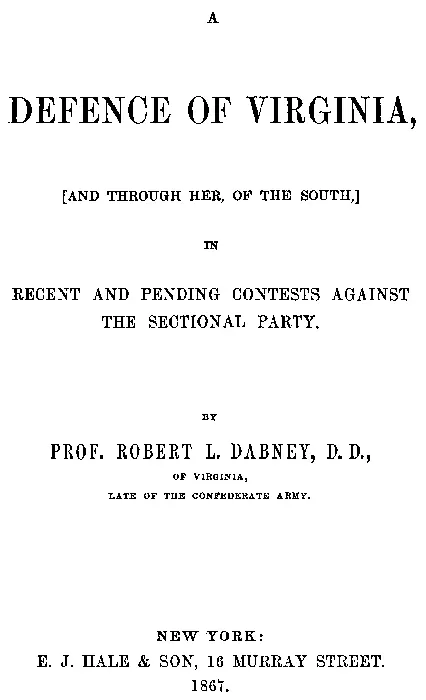
THE CLASSIC COLLECTION · 1867
"A Defence of Virginia" by Robert Lewis Dabney is a historical account written in the late 19th century. The book serves as a justification for the institution of slavery and the Southern cause during and after the American Civil War, arguing that the principles of slavery are both moral and historically valid. Dabney presents a defense of Virginia and through it, the Southern states, against what he perceives as a misrepresentation by abolitionists and their sympathizers. The opening of the text introduces the author's intent to defend Virginia, whom he views as slandered by the Northern anti-slavery sentiments that emerged during and after the Civil War. Dabney critiques the moral and social judgments placed upon Southern slavery, asserting that such judgments are rooted in a misunderstanding of history and human rights. He emphasizes that while other nations and regions continued the practice of slavery, the Southern states were unfairly targeted for disdain. Dabney sets the tone for a thorough examination of the ethical and scriptural justifications for slavery, asserting the need for a historical perspective that acknowledges Virginia's significance and the complexities surrounding the institution of slavery in America. This summary covers only the opening portion of the book.
Introduction adapted from the source catalogue; source summaries may be automatically generated.
Free to read · English · 98,110 words · No account needed
MAKE TIME FOR A GOOD BOOK
On by default. Untick to stop anonymous reading totals. Each page counts after 10 seconds in view. How this works.
Anonymous counting is on unless you have switched it off.
Now, we are entitled to claim, that this silence of the later and final revelation leaves the lawfulness of slaveholding in full force, as expressly established in the earlier. On that allowance we plant ourselves, and defy our accusers to bring the evidence of its repeal. On them lies the burden of proof. And we have indicated by the circumstances detailed above, how crushing that burden will be to them.
This is the most appropriate place to notice the evasion attempted from the above demonstration. They plead that slavery is not specially forbidden in the New Testament, because the plan of the Bible is to give us a rule of morals, not by special enactments for every case, but by general principles of right, which we must apply to special cases as they arise. "Inspiration has not," say they, "specially condemned every possible sin which may occur in the boundless varieties of human affairs, because then the whole world would not contain the books that should be written; and the voluminous character of the rule of duty would disappoint its whole utility; and if any sin were omitted in order to abridge it, this would be taken as a sanction. Hence, God gives us a set of plain general principles, of obvious application under the law of love." Therefore, it is argued, we are not to expect that the sin of slaveholding should be singled out. Enough that general principles given exclude it.
There is a portion of truth in this statement of the matter, and in the grounds assigned for it. But waiving for the present the exposure of the groundless assertion that there are any general principles in the New Testament condemnatory of slaveholding, we deny that this book teaches morals only by general rules. It also does it, in a multitude of cases, by special precepts. A multitude of special sins prevalent in that and all ages are singled out. This being so--the lists of particular sins being so full and specific as they are--we assert it would have been an unaccountable anomaly to pass over a thing so important, open, prevalent, had it been intrinsically wrong. But why does Revelation omit a number of particulars, and state general principles? For the lack of room, it is said. The other plan would have made the Bible too large. Now we ask, as the case actually stands in the New Testament, would not a good deal of room have been saved as to slavery, by simply specifying it as wrong? It is a queer way to economize space, thus to take up a subject, define it at large, limit, modify it, retrench its abuses, lay down in considerable detail a part of its duties and relations; and then provide by some general principle for its utter prohibition! Would not the obvious way have been, to say in three plain words, what was the only fundamental thing, after all, which, on this supposition, needed to be taught, "Slavery is sinful?" This would have settled the matter, and also have saved space and ambiguity, and made an end of definitions, limitations, abuses, inferences and all, in the only honest way. But farther, we admit that the Bible has left a multitude of new questions, emerging in novel cases, to be settled by the fair application of general principles, (which are usually illustrated in Scripture by application to some specific case.) Now must not an honest mind argue, that since the human understanding is so fallible in inferential reasonings, especially on social ethics, where the premises are so numerous and vague, and prejudices and interests so blinding, a special precept, where one is found applicable, is better than an inference probably doubtful? Will it not follow a 'thus saith the Lord,' if it has one, rather than its own deduction which may be a blunder? Well, then, if God intended us to understand that he had implicitly condemned slavery in some general principles given, it was most unlucky that He said any thing specific about it, which was not a specific condemnation. For what He has specifically said about it must lead His most honest servants to conclude that He did not intend to leave it to be settled by general inference, that He exempted it from that class of subjects. Had God not alluded to it by name, then we should have been more free to apply general principles to settle its moral character, as we do to the modern duel, not mentioned in Scripture, because it is wholly a modern usage. But since God has particularized so much about slaveholding, therefore, honesty, humility, piety, require us to study his specific teachings in preference to our supposed inferences, and even in opposition to them. Here, then, we stand: Inspiration has once expressly authorized slaveholding. Until a repeal is found equally express, it must be innocent.
Your reading position is saved on this browser. Take it to another device with a library code. Reading pages adapt to text, rather than matching a printed edition.
BEHIND THE BOOK
This eBook is for the use of anyone anywhere in the United States and most other parts of the world at no cost and with almost no restrictions whatsoever. You may copy it, give it away or re-use it under the terms of the Project Gutenberg License included with this eBook or online at www.gutenberg.org. If you are not located in the United States, you will have to check the laws of the country where you are located before using this eBook. Read the source licence.
The original source file, including credits and licence, is retained by this library. Request an original-format copy at no charge. Please include the book title and Project Gutenberg identifier #47422.
KEEP YOUR CURIOSITY GOING
Cécile Tormay

Moritz Busch
John L. Ransom
Frances Wright
Cécile Tormay

Mabel Potter Daggett