THE CLASSIC COLLECTION✦An outlaw’s diary: the CommuneCLASSIC FREE BOOKS
An outlaw’s diary: the Commune
Cécile Tormay
THE CLASSIC COLLECTION · 1867
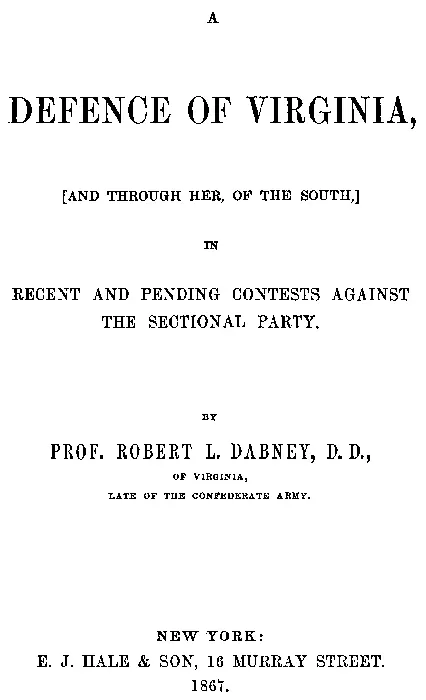
"A Defence of Virginia" by Robert Lewis Dabney is a historical account written in the late 19th century. The book serves as a justification for the institution of slavery and the Southern cause during and after the American Civil War, arguing that the principles of slavery are both moral and historically valid. Dabney presents a defense of Virginia and through it, the Southern states, against what he perceives as a misrepresentation by abolitionists and their sympathizers. The opening of the text introduces the author's intent to defend Virginia, whom he views as slandered by the Northern anti-slavery sentiments that emerged during and after the Civil War. Dabney critiques the moral and social judgments placed upon Southern slavery, asserting that such judgments are rooted in a misunderstanding of history and human rights. He emphasizes that while other nations and regions continued the practice of slavery, the Southern states were unfairly targeted for disdain. Dabney sets the tone for a thorough examination of the ethical and scriptural justifications for slavery, asserting the need for a historical perspective that acknowledges Virginia's significance and the complexities surrounding the institution of slavery in America. This summary covers only the opening portion of the book.
Introduction adapted from the source catalogue; source summaries may be automatically generated.
Free to read · English · 98,110 words · No account needed
MAKE TIME FOR A GOOD BOOK
On by default. Untick to stop anonymous reading totals. Each page counts after 10 seconds in view. How this works.
Anonymous counting is on unless you have switched it off.
"Δουλος ου.δ = (subst. fr. δεω,) a bondsman, a slave, servant, properly by birth, diff. from ανδροποδον, 'one enslaved in war.' Compare Xen. Anab. iv. 1, 12, αιχμαλωτα αυδραποδα. Hell. i. 6, 15; Thuc. viii. 28, τα ανδραποδα παντα, και δουλα και ελευθερα. But such a captive is sometimes called δουλος, Xen. Cyr. 3, 1, 11, 19, ib., 4, 4, 12. Different also from ὁ διακονος, see that art. No. 1. In a family, the δουλος was one bound to serve, a slave, the property of his master, a 'living possession,' as Aristotle calls him, Pol. 1, 4. ὁ δουλος κτημα τι εμψυχον. Compare Gen. xvii. 12, 27; Exod. xii. 44. According to the same writer, a complete household consisted of slaves and freemen, Polit. 1, 3. οικια δε τελειος εκ δουλων και ελευθερον. The δουλος, therefore, was never a hired servant, the latter being called μισθιος, μισθωτος, q. v. Dr. Robinson then proceeds to define δουλος in detail as meaning, "1, Properly of involuntary service, a slave, servant, as opposed to ελευθερος. 2, Tropically, of voluntary service, a servant, implying obligation, obedience, devotedness. 3, Tropically, a minister, attendant, spoken of the officers and attendants of an Oriental court, who are often strictly slaves."
§ 2. Slavery often mentioned; yet not condemned.
The mere absence of a condemnation of slaveholding in the New Testament is proof that it is not unlawful. In showing that there is no such condemnation, we are doing more than we could be held bound to do by any logical obligation: we might very properly throw the burden of proof here upon our accusers, and claim to be held innocent until we can be proved to be guilty by some positive testimony of holy writ. But our cause is so strong, that we can afford to argue ex abundantia; to assert more than we are bound to show. We claim then the significant fact, that there is nowhere any rebuke of slaveholding, in express terms, in the New Testament. Of the truth of this assertion it is sufficient proof, that Abolitionists, with all their malignant zeal, have been unable to find a single instance, and are compelled to assail us only with inferences. The express permission to hold slaves given by Moses to God's people, is nowhere repealed by the 'greater than Moses,' the Divine Prophet of the new dispensation. Let the reader consider how this fact is strengthened by the attendant circumstances. Christ and his apostles preached in the midst of slaves and slaveholders. The institution was exceedingly prevalent in many parts of the world. Potter tells us that in Athens, (a place where Paul preached,) the freemen citizens, possessed of franchises, were twenty-one thousand, and the slaves four hundred thousand. The congregations to which Christ and his apostles preached, were composed of masters and their slaves. The slavery of that day, as defined by the Roman civil law, was harsh and oppressive, treating the slave as a legal nonentity, without property, rights, or legal remedy; without marriage, subject, even as to his life, to the caprice of his master, and in every respect a human beast of burden. Again: to this institution Christ and his apostles make many allusions, for illustration of other subjects; and upon the institution itself they often speak didactically. Yet, while often condemning the abuses and oppressions incident to it, they never condemn the relation. Several times the apostles give formal enumerations of the prevalent sins of their times; as in Romans i. 29, 31; Galatians v. 19 to 21; Matthew xv. 19; Colossians iii. 8, 9; 2 Timothy iii. 2 to 4. These catalogues of sins are often full and minute; but the owning of slaves never appears among them.
Your reading position is saved on this browser. Take it to another device with a library code. Reading pages adapt to text, rather than matching a printed edition.
BEHIND THE BOOK
This eBook is for the use of anyone anywhere in the United States and most other parts of the world at no cost and with almost no restrictions whatsoever. You may copy it, give it away or re-use it under the terms of the Project Gutenberg License included with this eBook or online at www.gutenberg.org. If you are not located in the United States, you will have to check the laws of the country where you are located before using this eBook. Read the source licence.
The original source file, including credits and licence, is retained by this library. Request an original-format copy at no charge. Please include the book title and Project Gutenberg identifier #47422.
KEEP YOUR CURIOSITY GOING
Cécile Tormay

Moritz Busch
John L. Ransom
Frances Wright
Cécile Tormay

Mabel Potter Daggett