
The World of Chance
William Dean Howells
THE CLASSIC COLLECTION · 1877
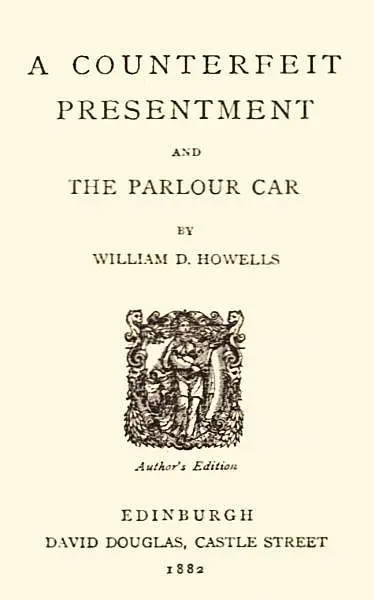
"A Counterfeit Presentment; and The Parlour Car" by William Dean Howells is a play written in the late 19th century. The story unfolds primarily through the interactions of two young men, Bartlett and Cummings, in the parlour of the Ponkwasset Hotel on a beautiful September day. Central to the drama is Bartlett's personality and the implications of a striking resemblance to a man who has caused great emotional pain to a family associated with the hotel. The opening of the narrative introduces two young artists, Bartlett and Cummings, as they arrive at the hotel, laden with painting supplies. The dialogue quickly reveals Bartlett's brusque demeanor and longing for solitude away from the bustling city, juxtaposed with Cummings' more sensitive disposition. Their discussion touches upon beauty, artistic aspirations, and the contrasting fates of women when faced with betrayal, a theme that becomes pivotal as they discover a lady's belongings in the room, hinting at impending complications. Soon, the tension escalates when General Wyatt enters, mistaking Bartlett for the man who devastated his daughter, leading to a series of misunderstandings that set the stage for exploring themes of identity, guilt, and social facades.
Introduction adapted from the source catalogue; source summaries may be automatically generated.
Free to read · English · 38,576 words · No account needed
MAKE TIME FOR A GOOD BOOK
On by default. Untick to stop anonymous reading totals. Each page counts after 10 seconds in view. How this works.
Anonymous counting is on unless you have switched it off.
BARTLETT and CUMMINGS.
Bartlett, harshly, after a certain silence which his friend is apparently resolved not to break.--"Sail in, Cummings!"
Cummings.--"Oh, I've got nothing to say."
Bartlett.--"Yes, you have. You think I'm a greater fool and a greater brute than you ever supposed in your most sanguine moments. Well, I am! What then?"
Cummings, turning about from the music at which he has been pretending to look, and facing Bartlett, with a slight shrug.--"If you choose to characterise your own behaviour in that way, I shall not dispute you at any rate."
Bartlett.--"Go on!"
Cummings.--"Go on? You saw yourself, I suppose, how she hung upon every syllable you spoke, every look, every gesture?"
Bartlett.--"Yes, I saw it."
Cummings.--"You saw how completely crushed she was by your tone and manner. You're not blind. Upon my word, Bartlett, if I didn't know what a good, kind-hearted fellow you are, I should say you were the greatest ruffian alive."
Bartlett, with a groan.--"Go on! That's something like."
Cummings.--"I couldn't hear what was going on--I'll own I tried--but I could see; and to see the delicate amende she was trying to offer you, in such a way that it should not seem an amende,--a perfect study of a woman's gracious, unconscious art,--and then to see your sour refusal of it all, it made me sick."
Bartlett, with a desperate clutch at his face, like a man oppressed with some stifling vapour.--"Yes, yes! I saw it all, too! And if it had been for me, I would have given anything for such happiness. Oh, gracious powers! How dear she is! I would rather have suffered any anguish than give her pain, and yet I gave her pain! I knew how it entered her heart: I felt it in my own. But what could I do? If I am to be myself, if I am not to steal the tenderness meant for another man, the love she shows to me because I'm like somebody else, I must play the brute. But have a little mercy on me. At least, I'm a baited brute. I don't know which way to turn, I don't know what to do. She's so dear to me,--so dear in every tone of her voice, every look of her eyes, every aspiration or desire of her transparent soul, that it seems to me my whole being is nothing but a thought of her. I loved her helplessness, her pallor, her sorrow; judge how I adore her return to something like life! Oh, you blame me! You simplify this infernal perplexity of mine and label it brutality, and scold me for it. Great heaven! And yet you saw, you heard how she entered this room. In that instant the old illusion was back on her, and I was nothing. All that I had been striving and longing to be to her, and hoping and despairing to seem, was swept out of existence; I was reduced to a body without a soul, to a shadow, a counterfeit! You think I resented it? Poor girl, I pitied her so; and my own heart all the time like lead in my breast,--a dull lump of ache! I swear, I wonder I don't go mad. I suppose--why, I suppose I am insane. No man in his senses was ever bedevilled by such a maniacal hallucination. Look here, Cummings: tell me that this damnable coil isn't simply a matter of my own fancy. It'll be some little relief to know that it's real."
Your reading position is saved on this browser. Take it to another device with a library code. Reading pages adapt to text, rather than matching a printed edition.
William Dean Howells

William Dean Howells

William Dean Howells

William Dean Howells
BEHIND THE BOOK
This eBook is for the use of anyone anywhere in the United States and most other parts of the world at no cost and with almost no restrictions whatsoever. You may copy it, give it away or re-use it under the terms of the Project Gutenberg License included with this eBook or online at www.gutenberg.org. If you are not located in the United States, you will have to check the laws of the country where you are located before using this eBook. Read the source licence.
The original source file, including credits and licence, is retained by this library. Request an original-format copy at no charge. Please include the book title and Project Gutenberg identifier #43469.
KEEP YOUR CURIOSITY GOING
Maurice Baring
W. B. (William Butler) Yeats
Edward Martyn

John Brougham & Charlotte Brontë
Marguerite Merington
Leonid Andreyev