
The World of Chance
William Dean Howells
THE CLASSIC COLLECTION · 1877
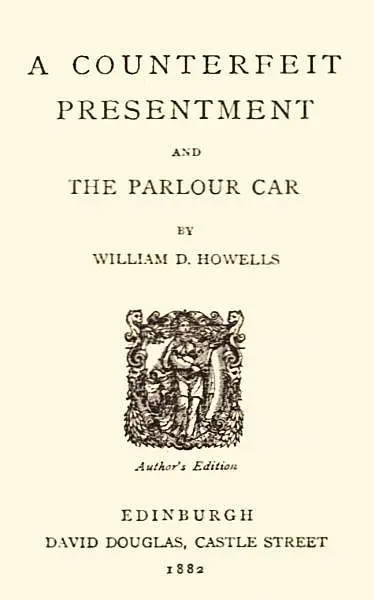
"A Counterfeit Presentment; and The Parlour Car" by William Dean Howells is a play written in the late 19th century. The story unfolds primarily through the interactions of two young men, Bartlett and Cummings, in the parlour of the Ponkwasset Hotel on a beautiful September day. Central to the drama is Bartlett's personality and the implications of a striking resemblance to a man who has caused great emotional pain to a family associated with the hotel. The opening of the narrative introduces two young artists, Bartlett and Cummings, as they arrive at the hotel, laden with painting supplies. The dialogue quickly reveals Bartlett's brusque demeanor and longing for solitude away from the bustling city, juxtaposed with Cummings' more sensitive disposition. Their discussion touches upon beauty, artistic aspirations, and the contrasting fates of women when faced with betrayal, a theme that becomes pivotal as they discover a lady's belongings in the room, hinting at impending complications. Soon, the tension escalates when General Wyatt enters, mistaking Bartlett for the man who devastated his daughter, leading to a series of misunderstandings that set the stage for exploring themes of identity, guilt, and social facades.
Introduction adapted from the source catalogue; source summaries may be automatically generated.
Free to read · English · 38,576 words · No account needed
MAKE TIME FOR A GOOD BOOK
On by default. Untick to stop anonymous reading totals. Each page counts after 10 seconds in view. How this works.
Anonymous counting is on unless you have switched it off.
CONSTANCE, MRS. WYATT, BARTLETT, and CUMMINGS.
Constance, with a quick violent arrest.--"Ah! Oh!"
Mrs. Wyatt.--"Constance, Constance, darling! What's the matter?"
Constance.--"Oh, nothing--nothing." She laughs, nervously. "I thought there was nobody--here; and it--startled me. How do you do, Mr. Cummings?" She goes quickly up to that gentleman, and gives him her hand. "Don't you think it wonderful to find such a day as this, up here, at this time of year?" She struggles to control the panting breath in which she speaks.
Cummings.--"Yes, I supposed I had come quite too late for anything of the sort. You must make haste with your Ponkwasset, Miss Wyatt, or you'll have to paint him with his winter cap on."
Constance.--"Ah, yes! My picture. Mr. Bartlett has been telling you." Her eyes have already wandered away from Cummings, and they now dwell, with a furtive light of reparation and imploring upon Bartlett's disheartened patience: "Good morning." It is a delicately tentative salutation, in a low voice, still fluttered by her nervous agitation.
Bartlett, in dull despair: "Good morning."
Constance.--"How is the light on the mountain this morning?" She drifts deprecatingly up to the picture, near which Bartlett has stolidly kept his place.
Bartlett, in apathetic inattention.--"Oh, very well, very well indeed,
thank you."
Constance, after a hesitating glance at him.--"Did you like what I had
done on it yesterday?"
Bartlett, very much as before.--"Oh, yes; why not?"
Constance, with a meek subtlety.--"I was afraid I had vexed you--by it." She bends an appealing glance upon him, to which Bartlett remains impervious, and she drops her eyes with a faint sigh. Then she lifts them again: "I was afraid I had--made the distance too blue."
Bartlett.--"Oh, no; not at all."
Constance.--"Do you think I had better try to finish it?"
Bartlett.--"Oh, certainly. Why not? If it amuses you!"
Constance, perplexedly.--"Of course." Then with a sad significance: "But I know I am trying your patience too far. You have been so kind, so good, I can't forgive myself for annoying you."
Bartlett.--"It doesn't annoy me. I'm very glad to be useful to you."
Constance, demurely.--"I didn't mean painting; I meant--screaming." She lifts her eyes to Bartlett's face, with a pathetic, inquiring attempt at lightness, the slightest imaginable experimental archness in her self-reproach, which dies out as Bartlett frowns and bites the corner of his moustache in unresponsive silence. "I ought to be well enough now to stop it: I'm quite well enough to be ashamed of it." She breaks off a miserable little laugh.
Your reading position is saved on this browser. Take it to another device with a library code. Reading pages adapt to text, rather than matching a printed edition.
William Dean Howells

William Dean Howells

William Dean Howells

William Dean Howells
BEHIND THE BOOK
This eBook is for the use of anyone anywhere in the United States and most other parts of the world at no cost and with almost no restrictions whatsoever. You may copy it, give it away or re-use it under the terms of the Project Gutenberg License included with this eBook or online at www.gutenberg.org. If you are not located in the United States, you will have to check the laws of the country where you are located before using this eBook. Read the source licence.
The original source file, including credits and licence, is retained by this library. Request an original-format copy at no charge. Please include the book title and Project Gutenberg identifier #43469.
KEEP YOUR CURIOSITY GOING
Maurice Baring
W. B. (William Butler) Yeats
Edward Martyn

John Brougham & Charlotte Brontë
Marguerite Merington
Leonid Andreyev