
The World of Chance
William Dean Howells
THE CLASSIC COLLECTION · 1877
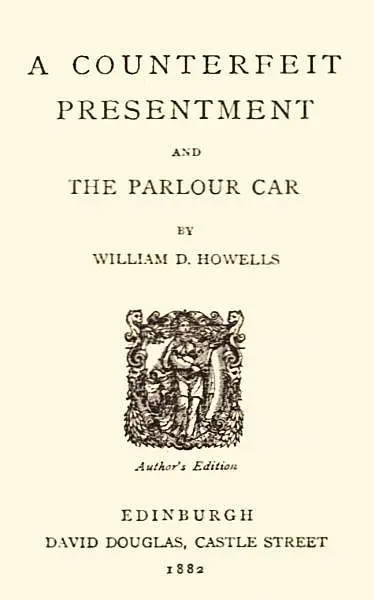
"A Counterfeit Presentment; and The Parlour Car" by William Dean Howells is a play written in the late 19th century. The story unfolds primarily through the interactions of two young men, Bartlett and Cummings, in the parlour of the Ponkwasset Hotel on a beautiful September day. Central to the drama is Bartlett's personality and the implications of a striking resemblance to a man who has caused great emotional pain to a family associated with the hotel. The opening of the narrative introduces two young artists, Bartlett and Cummings, as they arrive at the hotel, laden with painting supplies. The dialogue quickly reveals Bartlett's brusque demeanor and longing for solitude away from the bustling city, juxtaposed with Cummings' more sensitive disposition. Their discussion touches upon beauty, artistic aspirations, and the contrasting fates of women when faced with betrayal, a theme that becomes pivotal as they discover a lady's belongings in the room, hinting at impending complications. Soon, the tension escalates when General Wyatt enters, mistaking Bartlett for the man who devastated his daughter, leading to a series of misunderstandings that set the stage for exploring themes of identity, guilt, and social facades.
Introduction adapted from the source catalogue; source summaries may be automatically generated.
Free to read · English · 38,576 words · No account needed
MAKE TIME FOR A GOOD BOOK
On by default. Untick to stop anonymous reading totals. Each page counts after 10 seconds in view. How this works.
Anonymous counting is on unless you have switched it off.
Bartlett, in deep emotion.--"No, no; I can't do it--I mustn't--it would be outrageous--I--I"-- Regaining his self-possession at sight of Constance's astonished face: "You said yourself just now that I had drawn everything in the picture. I can't do any more. You must do the clinging vine!"
Constance, innocently.--"Very well, I'll try. If you'll do the oak for me. I'll let you do that much more." They regard each other, she with her innocent smile, he with a wild rapture of hope, doubt, and fear. Then Bartlett draws a long, despairing sigh, and turns away.
Bartlett.--"To-morrow, to-morrow!" He walks away, and returns to her. "Have you read--have you ever read The Talking Oak, Miss Wyatt?"
Constance.--"Tennyson's? A thousand times. Isn't it charming?"
Bartlett.--"It's absurd, I think. Do you remember where he makes the oak say of the young lady,--
'And in a fit of frolic, mirth
She strove to span my waist:....
I wish'd myself the fair young beech
That here beside me stands,
That round me, clasping each in each,
She might have lock'd her hands'?"
Constance.--"Why, that's lovely,--that attribution of human feeling to the tree. Don't you think so?"
Bartlett, absently.--"Yes, yes; beautiful. But it's terrible, too; terrible. Supposing the oak really had human feeling; or supposing that a man had been meant in the figure of an oak"-- He has drawn near Constance again; but now he retreats. "Ah, I can't work out the idea."
Constance.--"What idea? I can't imagine what you mean."
Bartlett.--"Ah! I can. My trouble is, I can't say what I mean! This
was sometime a paradox."
Constance.--"Oh! I should think, a riddle."
Bartlett.--"Some day I hope you'll let me read it to you."
Constance.--"Why not now?"
Bartlett, impetuously.--"If you only meant what you said, it would be--so much better than if I said what I meant!"
Constance.--"You are dealing in mysteries to-day."
Bartlett.--"Oh, the greatest of them! But don't mind. Wait! I'll try to tell you what I mean. I won't make you stand, while I talk. Here!" He wheels up in front of the picture one of the haircloth sofas; Constance mechanically sinks down upon it, and he takes his place at her side; she bends upon him a look of smiling amusement. "I can put my meaning best, I think, in the form of allegory. Do you like allegory, Miss Wyatt?"
Constance.--"Yes. That is, not very much."
Your reading position is saved on this browser. Take it to another device with a library code. Reading pages adapt to text, rather than matching a printed edition.
William Dean Howells

William Dean Howells

William Dean Howells

William Dean Howells
BEHIND THE BOOK
This eBook is for the use of anyone anywhere in the United States and most other parts of the world at no cost and with almost no restrictions whatsoever. You may copy it, give it away or re-use it under the terms of the Project Gutenberg License included with this eBook or online at www.gutenberg.org. If you are not located in the United States, you will have to check the laws of the country where you are located before using this eBook. Read the source licence.
The original source file, including credits and licence, is retained by this library. Request an original-format copy at no charge. Please include the book title and Project Gutenberg identifier #43469.
KEEP YOUR CURIOSITY GOING
Maurice Baring
W. B. (William Butler) Yeats
Edward Martyn

John Brougham & Charlotte Brontë
Marguerite Merington
Leonid Andreyev