THE CLASSIC COLLECTION✦An outlaw’s diary: the CommuneCLASSIC FREE BOOKS
An outlaw’s diary: the Commune
Cécile Tormay
THE CLASSIC COLLECTION · 1920
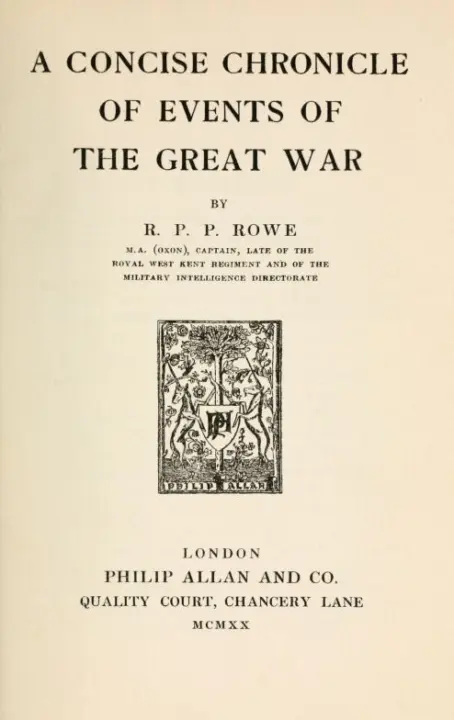
"A Concise Chronicle of Events of the Great War" by R. P. P. Rowe is a historical account written in the early 20th century. The book presents a detailed timeline of key events that transpired during World War I, beginning with the assassination of Archduke Franz Ferdinand and extending through various consequential military actions and diplomatic developments. It aims to serve as a concise and informative record of the war, utilizing authoritative sources to outline the battles and strategies involved. The opening of the chronicle establishes the groundwork for what follows, emphasizing the author's intent to provide a straightforward historical reference. Rowe clarifies the omission of maps due to practical limitations, but assures readers that the locations of key battles and events are accurately indicated. As the text transitions into the year-by-year chronology, it begins with pivotal incidents from 1914, starting with the assassination in Sarajevo, and then detailing the escalating tensions, declarations of war, and significant military engagements through a series of dates and events that create a comprehensive overview of the Great War's complex timeline.
Introduction adapted from the source catalogue; source summaries may be automatically generated.
Free to read · English · 67,463 words · No account needed
MAKE TIME FOR A GOOD BOOK
On by default. Untick to stop anonymous reading totals. Each page counts after 10 seconds in view. How this works.
Anonymous counting is on unless you have switched it off.
The German Government is informed through President Wilson that application for an Armistice must be made to Marshal Foch in the usual military form.
The French advance between the Oise and the Aisne towards Hirson.
The Aisne--Meuse Front:--The French cross the Ardennes Canal; the
Americans capture Beaumont.
Nov. 6 (Wed.)
German delegates start for the Western Front to receive the terms of Armistice from Marshal Foch and Admiral Sir R. Wemyss.
The German retreat becomes general from the Scheldt north of
Valenciennes to the Meuse at Sedan.
The British 1st, 3rd, and 4th Armies pursue the enemy towards Mons,
Maubeuge, and Avesnes.
The French capture Vervins and Rethel.
The Americans enter Sedan.
Nov. 7 (Thur.)
The Bavarian Republic is proclaimed. Kiel and Hamburg fall into the
hands of revolutionaries.
The British 1st Army makes a formal entry into Valenciennes.
The British capture Bavai and reach Haumont (in the valley of the
Sambre).
Nov. 8 (Fri.)
The German delegates receive the terms of Armistice of the Allies.
Prince Max of Baden, the German Imperial Chancellor, resigns.
The revolutionary movement spreads rapidly through Germany.
The British capture Maubeuge, enter Tournai, cross the Scheldt south of it, capture Condé and Avesnes, and advance on Mons.
The French advance towards Mézières and Charleville.
Nov. 9 (Sat.)
The Kaiser abdicates and flies to Holland.
Herr Ebert succeeds Prince Max as Chancellor (see Oct. 3).
The pursuit of the enemy by the Allies continues.
H.M.S. Britannia (battleship) is sunk by a submarine off Cape
Trafalgar.
Nov. 10 (Sun.)
The French occupy Hirson, surround Mézières, and cross the Meuse.
The Americans advance towards Montmédy and the Briey basin.
Nov. 11 (Mon.)
The Belgians enter Ghent; the British (3rd Canadian Division) enter
Mons at dawn.
The Armistice with Germany (see Appendix VI. (iv)) is signed in the Forest of Compiègne, near the Chateau Francport (in the train of Marshal Foch), at 5 A.M. Fighting ceases at 11 A.M.
Note.--The Battle of the Sambre struck at and broke the enemy's last important lateral communications, turned his positions on the Scheldt, and forced him to retreat rapidly from Courtrai. This victory completed the great strategical aim of the Allies, viz. to divide the enemy's forces into two parts, one on each side of the great natural barrier of the Ardennes. The pursuit of the beaten enemy all along the Allied line was only stopped by the Armistice.
THE CHIEF EVENTS CONNECTED WITH THE WAR, BETWEEN THE SIGNING OF THE ARMISTICE ON THE 11TH NOVEMBER 1918 AND THE SIGNATURE ON THE 28TH JUNE 1919 OF THE TREATY OF PEACE WITH GERMANY.
Nov. 12 (Tues.)
The Emperor Karl of Austria abdicates.
Your reading position is saved on this browser. Take it to another device with a library code. Reading pages adapt to text, rather than matching a printed edition.
BEHIND THE BOOK
This eBook is for the use of anyone anywhere in the United States and most other parts of the world at no cost and with almost no restrictions whatsoever. You may copy it, give it away or re-use it under the terms of the Project Gutenberg License included with this eBook or online at www.gutenberg.org. If you are not located in the United States, you will have to check the laws of the country where you are located before using this eBook. Read the source licence.
The original source file, including credits and licence, is retained by this library. Request an original-format copy at no charge. Please include the book title and Project Gutenberg identifier #48525.
KEEP YOUR CURIOSITY GOING
Cécile Tormay

Moritz Busch
John L. Ransom
Frances Wright
Cécile Tormay

Mabel Potter Daggett