THE CLASSIC COLLECTION✦An outlaw’s diary: the CommuneCLASSIC FREE BOOKS
An outlaw’s diary: the Commune
Cécile Tormay
THE CLASSIC COLLECTION · 1920
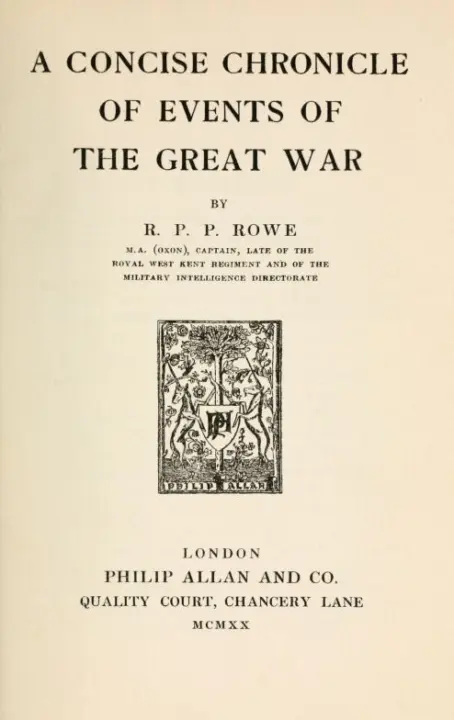
"A Concise Chronicle of Events of the Great War" by R. P. P. Rowe is a historical account written in the early 20th century. The book presents a detailed timeline of key events that transpired during World War I, beginning with the assassination of Archduke Franz Ferdinand and extending through various consequential military actions and diplomatic developments. It aims to serve as a concise and informative record of the war, utilizing authoritative sources to outline the battles and strategies involved. The opening of the chronicle establishes the groundwork for what follows, emphasizing the author's intent to provide a straightforward historical reference. Rowe clarifies the omission of maps due to practical limitations, but assures readers that the locations of key battles and events are accurately indicated. As the text transitions into the year-by-year chronology, it begins with pivotal incidents from 1914, starting with the assassination in Sarajevo, and then detailing the escalating tensions, declarations of war, and significant military engagements through a series of dates and events that create a comprehensive overview of the Great War's complex timeline.
Introduction adapted from the source catalogue; source summaries may be automatically generated.
Free to read · English · 67,463 words · No account needed
MAKE TIME FOR A GOOD BOOK
On by default. Untick to stop anonymous reading totals. Each page counts after 10 seconds in view. How this works.
Anonymous counting is on unless you have switched it off.
British naval forces (Vice-Admiral Sir Roger Keyes in chief command) raid Zeebrugge and Ostend in the early morning with a view to blocking the entrances to the harbours. Storming parties land on the Mole at Zeebrugge, while three obsolete cruisers, the Intrepid, Thetis, and Iphigenia, filled with concrete enter the harbour; these are sunk at the entrance of the Bruges Canal. Two other block ships, the Brilliant and Sirius, are sunk near the entrance to the harbour at Ostend. In the action at Zeebrugge the British destroyer North Star is sunk.
The famous German airman, Baron von Richthoven, is shot down in the
Somme Valley.
April 24 (Wed.)
On the Amiens Front the British recapture Villers-Bréttoneux.
Syria:--Arab forces seize 53 miles of the Hedjaz railway south of
Maan.
April 25 (Thur.)
The Germans capture Kemmel Hill.
H.M.S. Cowslip (sloop) is sunk by a submarine off Cape Spartel.
April 26 (Fri.)
German attacks at Locre and Voormezeele are repulsed.
April 27 (Sat.)
Mesopotamia:--General Marshall captures Kifri.
April 29 (Mon.)
The Germans attack in strength the British and French positions on a ten-mile front between Météren and Voormezeele and are severely defeated; this ends the Battle of the Lys (see April 9).
Mesopotamia:--General Marshall defeats the Turks at Tuz Khartmatli, half-way between Baghdad and Mosul, taking 300 prisoners and 6 guns.
April 30 (Tues.)
Palestine:--General Allenby again advances towards the Hedjaz railway, and recaptures Es Salt (see April 1).
Mesopotamia:--General Marshall reaches the Tank River and captures 12 more guns and many more prisoners.
May 1 (Wed.)
The Germans create a military dictatorship in the Ukraine; Field Marshal von Eichhorn breaks up the Ukranian Rada and establishes a German military Government at Kieff.
Palestine:--The British suffer a reverse between Jisr-ed-Damieh and
Es Salt and lose 9 guns.
May 2 (Thur.)
The French make progress on the Avre.
British airmen bomb the lock-gates at Zeebrugge.
May 3 (Fri.)
Palestine:--General Allenby is compelled to withdraw his forces to
the west bank of the Jordan.
May 5 (Sun.)
Lord French is appointed Lord-Lieutenant of Ireland.
The British gain ground in the angle between the Ancre and the Somme.
East Africa:--A British success near Manunga (160 miles south of
Lake Nyassa).
H.M.S. Rhododendron (sloop) is sunk by a submarine in the North
Sea.
May 7 (Tues.)
The Peace of Bucharest is signed between the Central Powers and
Roumania.
Mesopotamia:--General Marshall occupies Kirkuk (110 miles south-east
of Mosul) (see May 24).
May 8 (Wed.)
Nicaragua declares war on Germany.
May 10 (Fri.)
H.M.S. Vindictive (obsolete cruiser), damaged in the raid on
Zeebrugge, is successfully sunk across the entrance to Ostend
harbour.
May 11 (Sat.)
Mesopotamia:--The British, advancing along the Baghdad-Mosul road, drive the Turks across the Lesser Zab (70 miles from Mosul).
Your reading position is saved on this browser. Take it to another device with a library code. Reading pages adapt to text, rather than matching a printed edition.
BEHIND THE BOOK
This eBook is for the use of anyone anywhere in the United States and most other parts of the world at no cost and with almost no restrictions whatsoever. You may copy it, give it away or re-use it under the terms of the Project Gutenberg License included with this eBook or online at www.gutenberg.org. If you are not located in the United States, you will have to check the laws of the country where you are located before using this eBook. Read the source licence.
The original source file, including credits and licence, is retained by this library. Request an original-format copy at no charge. Please include the book title and Project Gutenberg identifier #48525.
KEEP YOUR CURIOSITY GOING
Cécile Tormay

Moritz Busch
John L. Ransom
Frances Wright
Cécile Tormay

Mabel Potter Daggett