THE CLASSIC COLLECTION✦An outlaw’s diary: the CommuneCLASSIC FREE BOOKS
An outlaw’s diary: the Commune
Cécile Tormay
THE CLASSIC COLLECTION · 1920
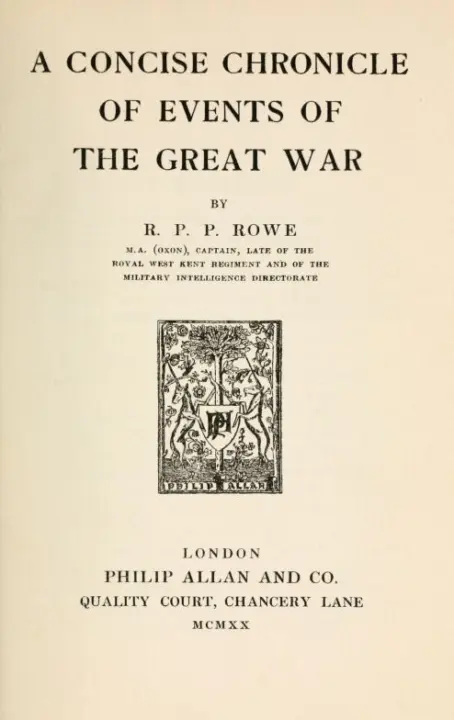
"A Concise Chronicle of Events of the Great War" by R. P. P. Rowe is a historical account written in the early 20th century. The book presents a detailed timeline of key events that transpired during World War I, beginning with the assassination of Archduke Franz Ferdinand and extending through various consequential military actions and diplomatic developments. It aims to serve as a concise and informative record of the war, utilizing authoritative sources to outline the battles and strategies involved. The opening of the chronicle establishes the groundwork for what follows, emphasizing the author's intent to provide a straightforward historical reference. Rowe clarifies the omission of maps due to practical limitations, but assures readers that the locations of key battles and events are accurately indicated. As the text transitions into the year-by-year chronology, it begins with pivotal incidents from 1914, starting with the assassination in Sarajevo, and then detailing the escalating tensions, declarations of war, and significant military engagements through a series of dates and events that create a comprehensive overview of the Great War's complex timeline.
Introduction adapted from the source catalogue; source summaries may be automatically generated.
Free to read · English · 67,463 words · No account needed
MAKE TIME FOR A GOOD BOOK
On by default. Untick to stop anonymous reading totals. Each page counts after 10 seconds in view. How this works.
Anonymous counting is on unless you have switched it off.
The French reach the Ailette on the whole front between Corbeny and
the Oise-Aisne Canal.
French troops arrive in Italy.
Nov. 4 (Sun.)
British troops arrive in Italy.
The Austro-Germans force the passage of the Tagliamento north of
Pinzano.
Nov. 5 (Mon.)
The Italians retreat from the Tagliamento towards the Piave.
Mesopotamia:--General Maude defeats the Turks before Tekrit (100
miles beyond Baghdad).
Nov. 6 (Tues.)
The British capture Passchendaele (this ends the Third Battle of
Ypres: see July 31).
Palestine:--The British capture important positions eleven miles
north of Beersheba.
Mesopotamia:--The British capture Tekrit.
Nov. 7 (Wed.)
A coup d'état in Petrograd by the Bolshevists under Lenin: Kerenski and the Provisional Government are overthrown; Lenin and Trotsky become masters of the situation.
The Italians reach the Livenza, the passage of which is forced by the Austro-Germans; 250,000 prisoners and 2300 guns are claimed by the enemy to date.
Palestine:--General Allenby captures Gaza.
Nov. 9 (Fri.)
It is announced that the Allied War Conference at Rapallo has decided to create a Supreme Council to ensure unity of command.
General Diaz succeeds General Cadorna as Italian Generalissimo.
The Austro-Germans advance in the Trentino and capture Asiago.
Palestine:--The Turks retreat on Hebron and Jerusalem with heavy loss in guns, prisoners, and other casualties.
Nov. 10 (Sat.)
The arrests of M. Kerenski and General Korniloff are ordered by the Petrograd Soviet; troops loyal to M. Kerenski occupy Tsarskoe Selo.
Italy:--The Austro-Germans attack on the Upper Piave and capture
Belluno.
Nov. 11 (Sun.)
Italy:--Austro-German attacks in the Trentino (designed to turn the line of the Piave) are defeated.
The British monitor M 15 and the destroyer Staunch are sunk by submarine off the coast of Palestine.
Nov. 12 (Mon.)
Mr. Lloyd George makes his 'Paris speech' declaring for an Allied War Council to ensure unity of command.
The Italians evacuate Fonzano and a part of the Val Sugano.
Nov. 13 (Tues.)
M. Kerenski's forces are defeated by the Bolshevists at Tsarskoe
Selo; flight of M. Kerenski.
M. Painlevé's Government is defeated in the French Chamber (see
Sept. 12).
Italy:--The Austro-Germans force the passage of the Lower Piave at
Zenson.
Palestine:--General Allenby drives the Turks from strong positions north of Ascalon; the junction of the Beersheba-Damascus railway with the line from Jerusalem is occupied by the British.
Nov. 14 (Wed.)
Mr. Lloyd George announces to the House of Commons the terms of agreement between the Western Allies for a Supreme War Council.
Italy:--Austro-German attacks on a twenty-mile front, designed to turn the line of the Piave from the north, are repulsed.
Nov. 15 (Thur.)
The Italians retreat in the Val Sugano and the Austro-Germans occupy
Cismon.
Palestine:--The British approach Jaffa (Joppa).
East Africa:--British troops occupy Chivata.
Nov. 16 (Fri.)
Your reading position is saved on this browser. Take it to another device with a library code. Reading pages adapt to text, rather than matching a printed edition.
BEHIND THE BOOK
This eBook is for the use of anyone anywhere in the United States and most other parts of the world at no cost and with almost no restrictions whatsoever. You may copy it, give it away or re-use it under the terms of the Project Gutenberg License included with this eBook or online at www.gutenberg.org. If you are not located in the United States, you will have to check the laws of the country where you are located before using this eBook. Read the source licence.
The original source file, including credits and licence, is retained by this library. Request an original-format copy at no charge. Please include the book title and Project Gutenberg identifier #48525.
KEEP YOUR CURIOSITY GOING
Cécile Tormay

Moritz Busch
John L. Ransom
Frances Wright
Cécile Tormay

Mabel Potter Daggett