THE CLASSIC COLLECTION✦An outlaw’s diary: the CommuneCLASSIC FREE BOOKS
An outlaw’s diary: the Commune
Cécile Tormay
THE CLASSIC COLLECTION · 1920
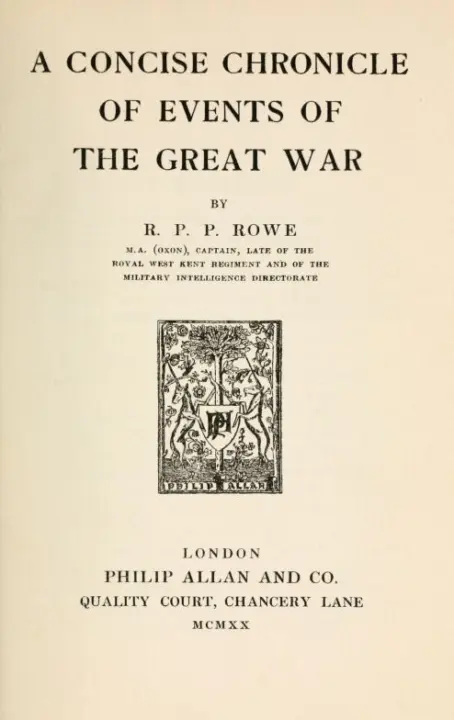
"A Concise Chronicle of Events of the Great War" by R. P. P. Rowe is a historical account written in the early 20th century. The book presents a detailed timeline of key events that transpired during World War I, beginning with the assassination of Archduke Franz Ferdinand and extending through various consequential military actions and diplomatic developments. It aims to serve as a concise and informative record of the war, utilizing authoritative sources to outline the battles and strategies involved. The opening of the chronicle establishes the groundwork for what follows, emphasizing the author's intent to provide a straightforward historical reference. Rowe clarifies the omission of maps due to practical limitations, but assures readers that the locations of key battles and events are accurately indicated. As the text transitions into the year-by-year chronology, it begins with pivotal incidents from 1914, starting with the assassination in Sarajevo, and then detailing the escalating tensions, declarations of war, and significant military engagements through a series of dates and events that create a comprehensive overview of the Great War's complex timeline.
Introduction adapted from the source catalogue; source summaries may be automatically generated.
Free to read · English · 67,463 words · No account needed
MAKE TIME FOR A GOOD BOOK
On by default. Untick to stop anonymous reading totals. Each page counts after 10 seconds in view. How this works.
Anonymous counting is on unless you have switched it off.
A fierce German attack on the British positions near the mouth of the Yser (the Battle of Nieuport): two British battalions are cut off and overwhelmed; the Germans win the right bank of the river at the mouth.
The Russians capture Halicz (see July 23).
July 11 (Wed.)
The Russians capture Kalusz (17 miles from Stanislau).
Mesopotamia:--The British defeat a Turkish force on the Euphrates.
July 12 (Thur.)
Great Britain:--Resignation of Mr. Austen Chamberlain, Secretary of
State for India.
The Russians cross the Lomnica (Galicia).
July 13 (Fri.)
The Russians advance south-west of Kalusz (Galicia).
July 14 (Sat.)
The German Imperial Chancellor, von Bethmann-Hollweg, is dismissed by the Kaiser; Herr Michaelis is appointed to succeed him.
A fierce German attack on the Chemin-des-Dames meets with partial success; on the Moronvilliers Ridge (east of Rheims) the French capture an important enemy position.
Palestine:--The British raid the Turkish lines before Gaza.
July 16 (Mon.)
Disorders arise in Petrograd, and among Russian regiments, owing to
Bolshevist intrigues.
The Russians fall back across the Lomnica (Galicia).
British light naval forces intercept and capture four German
steamers off the Dutch coast.
July 17 (Tues.)
Great Britain:--The name of the Royal Family is altered to 'Windsor'
by Royal Proclamation.
Ministerial changes:--Sir E. Carson enters the War Cabinet (see Jan. 21, 1918); Sir Eric Geddes becomes First Lord of the Admiralty; Mr. Churchill becomes Minister of Munitions; Mr. Montagu succeeds Mr. Austen Chamberlain as Secretary of State for India (see Dec. 10, 1916).
Mutineers from Kronstadt arrive in Petrograd.
Verdun:--The French win back on Hill 304 all ground lost since June 29 and capture 425 prisoners.
July 18 (Wed.)
The disorders in Petrograd are quelled by troops loyal to the
Provisional Government.
July 19 (Thur.)
Herr Michaelis, the new German Chancellor, declares in the Reichstag
for 'a victor's peace.'
The Germans attack in north-eastern Galicia and pierce the Russian Front; here and elsewhere mutinous Russian units refuse to fight.
East Africa:--The main German forces are defeated at Norongombe and driven in retreat to the Mbemkuru Valley.
July 20 (Fri.)
Galicia:--The Germans advance rapidly towards Tarnopol.
July 21 (Sat.)
Galicia:--The Russian retreat develops into a rout.
July 22 (Sun.)
Siam declares war on Germany and Austria.
Resignation of the Russian Premier, Prince Lvoff; he is succeeded by
M. Kerenski.
The French repulse German attacks on the Chemin-des-Dames but lose
ground at some points.
Loyal Russian units make a temporary stand near Krevo, east of Vilna.
A German aeroplane raid on Harwich and Felixstowe (11 killed).
July 23 (Mon.)
The Germans occupy Halicz and cross the Sereth south of Tarnopol; the Russians also retreat near Dvinsk and Smorgon; there are wholesale desertions in the Russian Army.
Your reading position is saved on this browser. Take it to another device with a library code. Reading pages adapt to text, rather than matching a printed edition.
BEHIND THE BOOK
This eBook is for the use of anyone anywhere in the United States and most other parts of the world at no cost and with almost no restrictions whatsoever. You may copy it, give it away or re-use it under the terms of the Project Gutenberg License included with this eBook or online at www.gutenberg.org. If you are not located in the United States, you will have to check the laws of the country where you are located before using this eBook. Read the source licence.
The original source file, including credits and licence, is retained by this library. Request an original-format copy at no charge. Please include the book title and Project Gutenberg identifier #48525.
KEEP YOUR CURIOSITY GOING
Cécile Tormay

Moritz Busch
John L. Ransom
Frances Wright
Cécile Tormay

Mabel Potter Daggett