THE CLASSIC COLLECTION✦An outlaw’s diary: the CommuneCLASSIC FREE BOOKS
An outlaw’s diary: the Commune
Cécile Tormay
THE CLASSIC COLLECTION · 1920
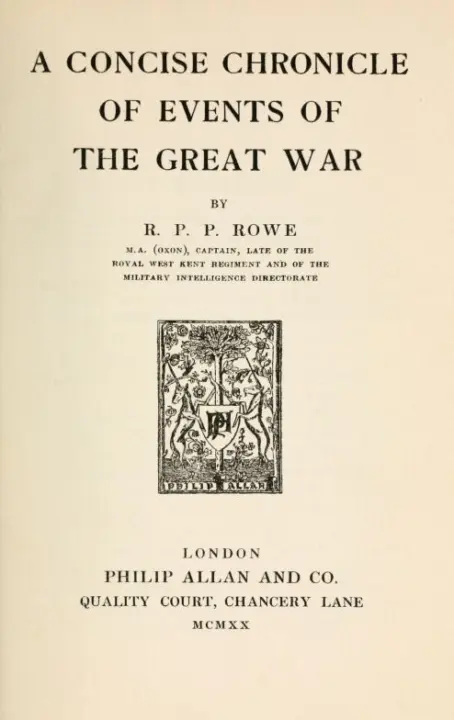
"A Concise Chronicle of Events of the Great War" by R. P. P. Rowe is a historical account written in the early 20th century. The book presents a detailed timeline of key events that transpired during World War I, beginning with the assassination of Archduke Franz Ferdinand and extending through various consequential military actions and diplomatic developments. It aims to serve as a concise and informative record of the war, utilizing authoritative sources to outline the battles and strategies involved. The opening of the chronicle establishes the groundwork for what follows, emphasizing the author's intent to provide a straightforward historical reference. Rowe clarifies the omission of maps due to practical limitations, but assures readers that the locations of key battles and events are accurately indicated. As the text transitions into the year-by-year chronology, it begins with pivotal incidents from 1914, starting with the assassination in Sarajevo, and then detailing the escalating tensions, declarations of war, and significant military engagements through a series of dates and events that create a comprehensive overview of the Great War's complex timeline.
Introduction adapted from the source catalogue; source summaries may be automatically generated.
Free to read · English · 67,463 words · No account needed
MAKE TIME FOR A GOOD BOOK
On by default. Untick to stop anonymous reading totals. Each page counts after 10 seconds in view. How this works.
Anonymous counting is on unless you have switched it off.
The French Government addresses to Neutrals a protest against the devastation and barbarities committed by the Germans in the evacuated territories.
German torpedo-boats bombard Dunkirk.
Mar. 26 (Mon.)
The British capture Lagnicourt (north-east of Bapaume), the French Coucy-le-Château and Folembray.
Macedonia:--The French advance west of Monastir: 2000 prisoners are
taken.
The British destroyer Myrmidon is sunk by a mine in the English
Channel.
Mar. 27 (Tues.)
The British occupy Longavines, Lièrmont, Villiers, Equancourt, and Saulcourt; the French capture the forest of Lower Coucy.
Palestine:--The British forces under Sir A. Murray defeat the Turks near Gaza (the First Battle of Gaza): 900 prisoners are captured, including the General of a Division and his Staff.
Mar. 28 (Wed.)
Verdun:--The French recapture Hill 304.
Mar. 29 (Thur.)
The British make progress south-east of Bapaume.
Mar. 30 (Fri.)
The British advance towards Cambrai and capture Sorel, Heudicourt,
Soyécourt, and other places; the French advance north-east of
Soissons.
The British hospital ship Gloucester Castle is torpedoed and sunk in mid-Channel, but without loss of life.
Mar. 31 (Sat.)
The British advance north-west of St. Quentin and capture Jeancourt, Hervilly, Herbecourt, and Vendelles.
Mesopotamia:--The British occupy Deli Abbas.
April 1 (Sun.)
The British capture Savy Wood and Savy, near St. Quentin, and Epéhy and Peizières, on the Bapaume Railway; the French advance towards Laon on the Margival-Vrégny Front.
The Russians occupy Khanikin (north-east of Baghdad).
April 2 (Mon.)
President Wilson asks Congress for a declaration that 'a state of
war exists.'
The British take Holnon Wood (two miles from St. Quentin) and Francilly-Selency and Selency; they also advance on a ten-mile front between Bapaume and Arras and capture Croissilles and Doignies.
The American armed liner Aztec is torpedoed off the French coast.
April 3 (Tues.)
The British gain ground south-east of Arras; the French advance between St. Quentin and La Fère.
The Germans defeat the Russians on the Stokhod; they win a
bridge-head and take many prisoners.
April 4 (Wed.)
The U.S.A. Senate resolves that a state of war with Germany exists by a majority of 82 votes to 6.
April 5 (Thur.)
The U.S.A. House of Representatives resolves that a state of war with Germany exists by a majority of 373 votes to 50. The sanction of Congress having thus been obtained, President Wilson subsequently declares the United States of America to be at war with Germany.
April 7 (Sat.)
Cuba declares war against Germany.
Two German destroyers are torpedoed off Zeebrugge, one of them being
sunk.
The British torpedo gunboat Jason is sunk by a mine off the west
coast of Scotland.
April 8 (Easter Sunday)
Austria breaks off diplomatic relations with the United States.
Your reading position is saved on this browser. Take it to another device with a library code. Reading pages adapt to text, rather than matching a printed edition.
BEHIND THE BOOK
This eBook is for the use of anyone anywhere in the United States and most other parts of the world at no cost and with almost no restrictions whatsoever. You may copy it, give it away or re-use it under the terms of the Project Gutenberg License included with this eBook or online at www.gutenberg.org. If you are not located in the United States, you will have to check the laws of the country where you are located before using this eBook. Read the source licence.
The original source file, including credits and licence, is retained by this library. Request an original-format copy at no charge. Please include the book title and Project Gutenberg identifier #48525.
KEEP YOUR CURIOSITY GOING
Cécile Tormay

Moritz Busch
John L. Ransom
Frances Wright
Cécile Tormay

Mabel Potter Daggett