THE CLASSIC COLLECTION✦An outlaw’s diary: the CommuneCLASSIC FREE BOOKS
An outlaw’s diary: the Commune
Cécile Tormay
THE CLASSIC COLLECTION · 1920
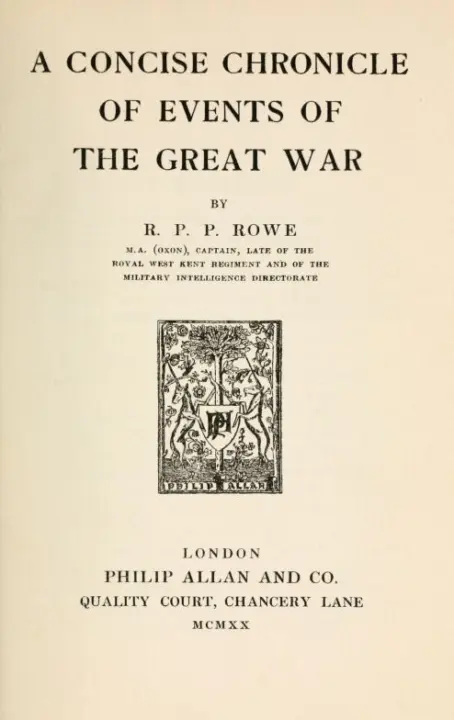
"A Concise Chronicle of Events of the Great War" by R. P. P. Rowe is a historical account written in the early 20th century. The book presents a detailed timeline of key events that transpired during World War I, beginning with the assassination of Archduke Franz Ferdinand and extending through various consequential military actions and diplomatic developments. It aims to serve as a concise and informative record of the war, utilizing authoritative sources to outline the battles and strategies involved. The opening of the chronicle establishes the groundwork for what follows, emphasizing the author's intent to provide a straightforward historical reference. Rowe clarifies the omission of maps due to practical limitations, but assures readers that the locations of key battles and events are accurately indicated. As the text transitions into the year-by-year chronology, it begins with pivotal incidents from 1914, starting with the assassination in Sarajevo, and then detailing the escalating tensions, declarations of war, and significant military engagements through a series of dates and events that create a comprehensive overview of the Great War's complex timeline.
Introduction adapted from the source catalogue; source summaries may be automatically generated.
Free to read · English · 67,463 words · No account needed
MAKE TIME FOR A GOOD BOOK
On by default. Untick to stop anonymous reading totals. Each page counts after 10 seconds in view. How this works.
Anonymous counting is on unless you have switched it off.
The British hospital ship Britannic is sunk by a mine or submarine
in the Ægean Sea.
Nov. 23 (Thur.)
Orsova is recaptured by the Austro-Germans (see Sept. 7).
Nov. 24 (Fri.)
The Germans and Bulgarians under Mackensen cross the Danube at
several points from the Dobrudja.
The British hospital ship Braemar Castle is torpedoed in the Mediterranean; the vessel is subsequently salved and repaired.
Nov. 25 (Sat.)
Roumania:--The armies of Falkenhayn and Mackensen effect a junction
north of the Danube.
The French battleship Suffren is sunk by a submarine in the
Atlantic.
Nov. 26 (Sun.)
The Allies demand of the Greek Government the surrender of ten
mountain batteries.
The Roumanians are in full retreat.
A Serbian success north of Monastir: Hill 105 is captured.
A German naval raid on Lowestoft.
Nov. 27 (Mon.)
The Roumanian retreat continues: the line of the Aluta is abandoned; Giurgevo, on the Danube, is captured by the enemy.
A Zeppelin raid on England: two Zeppelins are destroyed.
Nov. 28 (Tues.)
A daylight raid on London by one German aeroplane.
A British air-raid on the harbour at Zeebrugge.
Nov. 29 (Wed.)
The appointments of Sir John Jellicoe to the office of First Sea Lord (see May 28, 1915, and Dec. 26, 1917) and of Sir David Beatty to the command of the Grand Fleet are announced in Parliament.
Dec. 1 (Fri.)
Mr. Lloyd George makes proposals to Mr. Asquith for the reform of war administration in Great Britain.
The Allies' demands are rejected by the Greek Government; an Allied force which is landed at the Piræus is attacked by Greek troops.
Dec. 3 (Sun.)
Roumania:--A German victory in the Arges Valley; the Roumanian armies are driven back all along the line. The Serbians advance and carry high ground north-east of Monastir.
A German submarine bombards Funchal (Madeira).
Dec. 4 (Mon.)
The Serbians continue to advance north-east of Monastir; they
capture Stravina.
The British liner Caledonia is sunk by a submarine in the
Mediterranean.
Dec. 5 (Tues.)
Resignation of Mr. Asquith, British Prime Minister.
Dec. 6 (Wed.)
Roumania:--Bucharest and Ploesti are captured by the Germans.
Greece:--The Royalist party in Athens regains control of the posts
and telegraphs.
Dec. 7 (Thur.)
Mr. Lloyd George becomes British Prime Minister.
Roumania:--The German successes continue; many prisoners are
captured.
Dec. 8 (Fri.)
A blockade of Greece is proclaimed by the Allies, as from this date, until adequate reparation shall be made for recent outrages.
Dec. 10 (Sun.)
The formation of the new British Cabinet is announced. Mr. Balfour becomes Foreign Secretary, Lord Derby Secretary for War, Sir E. Carson First Lord of the Admiralty, Mr. Chamberlain Secretary for India, Lord Devonport Food Controller; Minister of Munitions, Dr. Addison; Minister of Blockade, Lord R. Cecil (see May 26, 1915, and July 17, 1917).
Dec. 11 (Mon.)
Your reading position is saved on this browser. Take it to another device with a library code. Reading pages adapt to text, rather than matching a printed edition.
BEHIND THE BOOK
This eBook is for the use of anyone anywhere in the United States and most other parts of the world at no cost and with almost no restrictions whatsoever. You may copy it, give it away or re-use it under the terms of the Project Gutenberg License included with this eBook or online at www.gutenberg.org. If you are not located in the United States, you will have to check the laws of the country where you are located before using this eBook. Read the source licence.
The original source file, including credits and licence, is retained by this library. Request an original-format copy at no charge. Please include the book title and Project Gutenberg identifier #48525.
KEEP YOUR CURIOSITY GOING
Cécile Tormay

Moritz Busch
John L. Ransom
Frances Wright
Cécile Tormay

Mabel Potter Daggett