THE CLASSIC COLLECTION✦An outlaw’s diary: the CommuneCLASSIC FREE BOOKS
An outlaw’s diary: the Commune
Cécile Tormay
THE CLASSIC COLLECTION · 1920
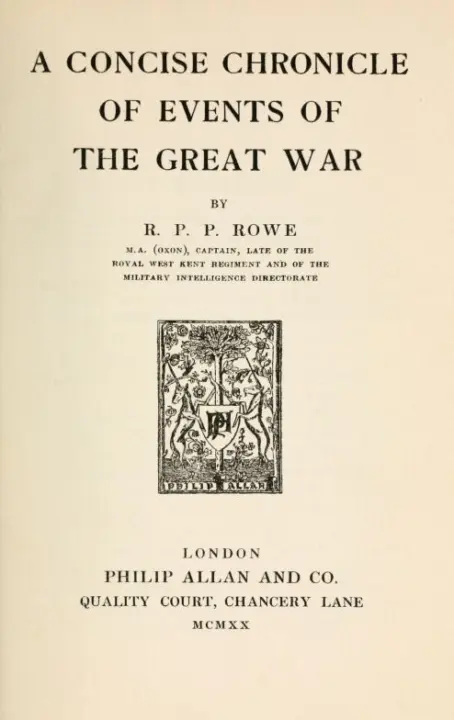
"A Concise Chronicle of Events of the Great War" by R. P. P. Rowe is a historical account written in the early 20th century. The book presents a detailed timeline of key events that transpired during World War I, beginning with the assassination of Archduke Franz Ferdinand and extending through various consequential military actions and diplomatic developments. It aims to serve as a concise and informative record of the war, utilizing authoritative sources to outline the battles and strategies involved. The opening of the chronicle establishes the groundwork for what follows, emphasizing the author's intent to provide a straightforward historical reference. Rowe clarifies the omission of maps due to practical limitations, but assures readers that the locations of key battles and events are accurately indicated. As the text transitions into the year-by-year chronology, it begins with pivotal incidents from 1914, starting with the assassination in Sarajevo, and then detailing the escalating tensions, declarations of war, and significant military engagements through a series of dates and events that create a comprehensive overview of the Great War's complex timeline.
Introduction adapted from the source catalogue; source summaries may be automatically generated.
Free to read · English · 67,463 words · No account needed
MAKE TIME FOR A GOOD BOOK
On by default. Untick to stop anonymous reading totals. Each page counts after 10 seconds in view. How this works.
Anonymous counting is on unless you have switched it off.
Italy:--The Alpini gain a success on the Adamello glacier.
April 12 (Wed.)
Mesopotamia:--The British make a second attack on the Sanna-i-Yat position: some ground is gained.
April 13 (Thur.)
Egypt:--Australian troops destroy a Turkish camp at Jifjaffa on the
Egyptian frontier.
April 14 (Fri.)
The end of the First Battle of Lake Narotch (see March 18); it leads to little change of position.
British naval aeroplanes bomb Constantinople and Adrianople.
April 15 (Sat.)
A Russian success in the Caucasus.
April 16 (Sun.)
Verdun:--The French attack at Douaumont and regain ground.
April 17 (Mon.)
Fresh German attacks at Verdun, which gain ground.
The Italians capture the Col di Lana (Trentino).
Mesopotamia:--A Turkish counter-attack on the Tigris is partially
successful.
April 18 (Tues.)
The Caucasus:--Trebizond is captured by the Russians (see April 8).
April 19 (Wed.)
Verdun:--German attacks at Les Eparges are repulsed.
A Note from the U.S.A. is presented to Germany demanding modification of her submarine policy (see May 4).
The Caucasus:--The Russians carry a strong enemy position west of
Erzerum.
April 20 (Thur.)
The rebellion breaks out in Ireland (see May 1).
Verdun:--The French gain ground near Fort Vaux.
Russian troops reach Marseilles.
April 21 (Good Friday)
Sir Roger Casement is captured on the coast of Kerry, near Tralee
(see June 26, Aug. 3).
April 22 (Sat.)
Mesopotamia:--A third British attack on the Sanna-i-Yat position is
repulsed.
A British success in German East Africa, by which the occupation of the northern half of the colony is made secure.
April 23 (Easter Sunday)
An engagement at Katia on the Egyptian frontier.
April 24 (Mon.)
Riots in Dublin: the Sinn Feiners occupy the Post Office and St.
Stephen's Green.
Mesopotamia (night of the 24th-25th):--An unsuccessful attempt is made to run a supply ship into Kut.
April 25 (Tues.)
German battle-cruisers bombard Lowestoft and Great Yarmouth; they are pursued home but escape in safety.
A Zeppelin raid on the eastern counties of England.
April 26 (Wed.)
Fighting in Dublin.
A Zeppelin raid on Kent.
April 27 (Thur.)
Martial law is proclaimed throughout Ireland.
H.M.S. Russell (battleship) is sunk by a mine off Malta.
H.M.S. Nasturtium (sloop) is sunk by a mine in the Mediterranean.
The German submarine UC5 is captured in the North Sea.
April 28 (Fri.)
The Second Battle of Lake Narotch: a Russian reverse.
April 29 (Sat.)
Italy:--The Austrians are driven from the Adamello glacier by Alpini.
Mesopotamia:--Kut-el-Amara capitulates, after a siege of 144 days, owing to failure of supplies (see Dec. 7, 1915).
May 1 (Mon.)
The Irish rebellion is crushed (see April 20).
A Zeppelin raid on Scotland and the northeast of England.
May 2 (Tues.)
Resignation of Mr. Birrell, Secretary of State for Ireland.
Verdun:--A French success at the Mort Homme.
Your reading position is saved on this browser. Take it to another device with a library code. Reading pages adapt to text, rather than matching a printed edition.
BEHIND THE BOOK
This eBook is for the use of anyone anywhere in the United States and most other parts of the world at no cost and with almost no restrictions whatsoever. You may copy it, give it away or re-use it under the terms of the Project Gutenberg License included with this eBook or online at www.gutenberg.org. If you are not located in the United States, you will have to check the laws of the country where you are located before using this eBook. Read the source licence.
The original source file, including credits and licence, is retained by this library. Request an original-format copy at no charge. Please include the book title and Project Gutenberg identifier #48525.
KEEP YOUR CURIOSITY GOING
Cécile Tormay

Moritz Busch
John L. Ransom
Frances Wright
Cécile Tormay

Mabel Potter Daggett