THE CLASSIC COLLECTION✦An outlaw’s diary: the CommuneCLASSIC FREE BOOKS
An outlaw’s diary: the Commune
Cécile Tormay
THE CLASSIC COLLECTION · 1920
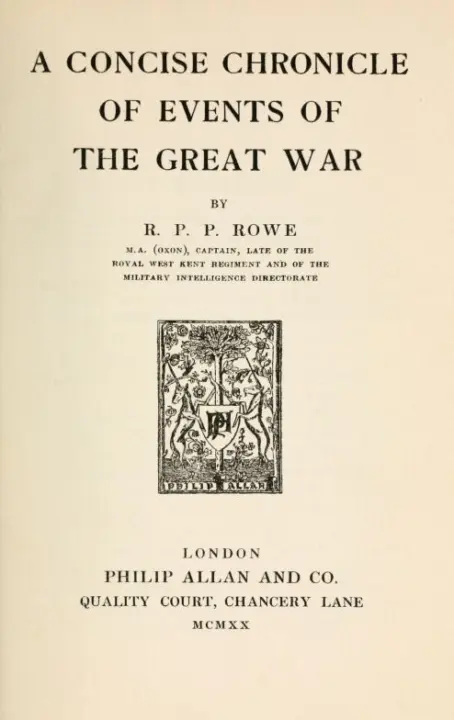
"A Concise Chronicle of Events of the Great War" by R. P. P. Rowe is a historical account written in the early 20th century. The book presents a detailed timeline of key events that transpired during World War I, beginning with the assassination of Archduke Franz Ferdinand and extending through various consequential military actions and diplomatic developments. It aims to serve as a concise and informative record of the war, utilizing authoritative sources to outline the battles and strategies involved. The opening of the chronicle establishes the groundwork for what follows, emphasizing the author's intent to provide a straightforward historical reference. Rowe clarifies the omission of maps due to practical limitations, but assures readers that the locations of key battles and events are accurately indicated. As the text transitions into the year-by-year chronology, it begins with pivotal incidents from 1914, starting with the assassination in Sarajevo, and then detailing the escalating tensions, declarations of war, and significant military engagements through a series of dates and events that create a comprehensive overview of the Great War's complex timeline.
Introduction adapted from the source catalogue; source summaries may be automatically generated.
Free to read · English · 67,463 words · No account needed
MAKE TIME FOR A GOOD BOOK
On by default. Untick to stop anonymous reading totals. Each page counts after 10 seconds in view. How this works.
Anonymous counting is on unless you have switched it off.
Gallipoli:--The evacuation of Suvla and Anzac begins (see Dec. 20,
1915, and Jan. 8, 1916).
Dec. 9 (Thur.)
The Bulgarians occupy Diakhova, Dibra, and Okrida.
Dec. 11 (Sat.)
Macedonia:--The French and British repel Bulgarian attacks with
heavy loss.
Persia:--The Russians occupy Hamadan after defeating the Persian
rebels.
Dec. 12 (Sun.)
Recruiting for the 'Derby' groups is closed in Great Britain.
The Franco-British forces are in position before Salonika.
The Bulgarians capture Doiran and Ghevgeli.
Mesopotamia:--A Turkish attack on Kut-el-Amara is repulsed.
Dec. 13 (Mon.)
Western Egypt:--In an action near Mersa Matruh an attack by Senussi
Arabs is repulsed.
Dec. 14 (Tues.)
It is announced that Sir H. Smith-Dorrien is appointed to Supreme Command in East Africa (see Feb. 10, 1916).
Dec. 15 (Wed.)
Resignation of Sir John French; Sir Douglas Haig succeeds him as British Commander-in-Chief in France.
Dec. 17 (Fri.)
The German light cruiser Bremen and a German torpedo boat are sunk in the Baltic by Allied submarines.
Albania:--Elbasan is taken by the Bulgarians.
Dec. 20 (Mon.)
The first 'Derby' groups are called up for service.
Gallipoli:--The evacuation of Anzac and Suvla is completed (see Dec.
8).
Albania:--Durazzo is occupied by the Italians.
Persia:--The Russians occupy Kum; this marks the end of the Persian
revolt.
Dec. 21 (Tues.)
Sir William Robertson is appointed Chief of the British Imperial General Staff (see Feb. 16, 1918).
The Cameroons:--Mangeles is occupied by the French.
Dec. 24 (Fri.)
The French liner Ville de Ciotat is torpedoed in the Mediterranean.
Dec. 25 (Sat.)
Western Egypt:--The main Senussi force is attacked and routed near
Mersa Matruh.
Mesopotamia:--Turkish attacks on Kut-el-Amara are repulsed.
Dec. 27 (Mon.)
Heavy fighting between the Russians and the Austrians on the
Bessarabia-Bukovina frontier.
Dec. 28 (Tues.)
The decision of the British Cabinet in favour of Compulsory Service
is announced.
The Indian Corps leaves France.
Dec. 29 (Wed.)
In a sea fight off Cattaro a French submarine and two Austrian
destroyers are sunk.
Dec. 30 (Thur.)
The P. & O. liner Persia is torpedoed in the Mediterranean.
Dec. 31 (Fri.)
H.M.S. Natal (cruiser) is blown up in Cromarty Firth by an
internal explosion.
Jan. 1 (Sat.)
The Russians gain successes on the Styr and the Strypa.
The Cameroons:--The British capture Jaunde (the capital of the
German colony).
Jan. 2 (Sun.)
The Russians approach Czernowitz.
The British passenger steamer Glengyle is sunk by a submarine in
the Mediterranean.
Jan. 4 (Tues.)
Lord Derby's report on the recruiting campaign in Great Britain is
issued.
Mesopotamia:--The Kut relieving force advances from Ali-el-Gharb.
Jan. 5 (Wed.)
The Military Service Bill that inaugurates conscription is introduced in the British House of Commons.
The Russians advance in the Bukovina.
Jan. 6 (Thur.)
Recruiting for the 'Derby' groups reopens in Great Britain.
Your reading position is saved on this browser. Take it to another device with a library code. Reading pages adapt to text, rather than matching a printed edition.
BEHIND THE BOOK
This eBook is for the use of anyone anywhere in the United States and most other parts of the world at no cost and with almost no restrictions whatsoever. You may copy it, give it away or re-use it under the terms of the Project Gutenberg License included with this eBook or online at www.gutenberg.org. If you are not located in the United States, you will have to check the laws of the country where you are located before using this eBook. Read the source licence.
The original source file, including credits and licence, is retained by this library. Request an original-format copy at no charge. Please include the book title and Project Gutenberg identifier #48525.
KEEP YOUR CURIOSITY GOING
Cécile Tormay

Moritz Busch
John L. Ransom
Frances Wright
Cécile Tormay

Mabel Potter Daggett