THE CLASSIC COLLECTION✦An outlaw’s diary: the CommuneCLASSIC FREE BOOKS
An outlaw’s diary: the Commune
Cécile Tormay
THE CLASSIC COLLECTION · 1920
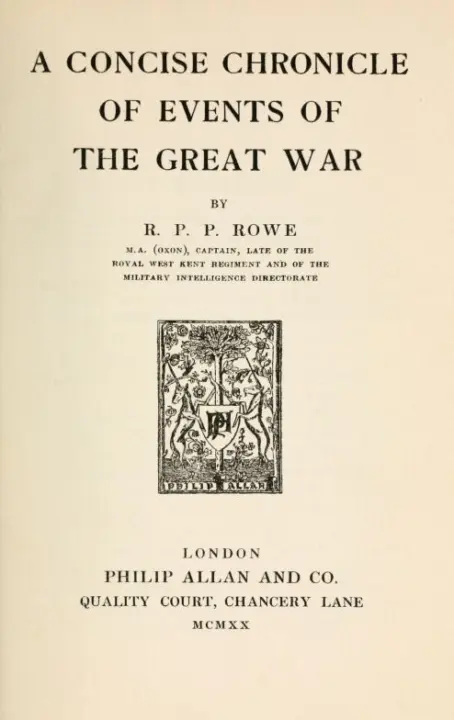
"A Concise Chronicle of Events of the Great War" by R. P. P. Rowe is a historical account written in the early 20th century. The book presents a detailed timeline of key events that transpired during World War I, beginning with the assassination of Archduke Franz Ferdinand and extending through various consequential military actions and diplomatic developments. It aims to serve as a concise and informative record of the war, utilizing authoritative sources to outline the battles and strategies involved. The opening of the chronicle establishes the groundwork for what follows, emphasizing the author's intent to provide a straightforward historical reference. Rowe clarifies the omission of maps due to practical limitations, but assures readers that the locations of key battles and events are accurately indicated. As the text transitions into the year-by-year chronology, it begins with pivotal incidents from 1914, starting with the assassination in Sarajevo, and then detailing the escalating tensions, declarations of war, and significant military engagements through a series of dates and events that create a comprehensive overview of the Great War's complex timeline.
Introduction adapted from the source catalogue; source summaries may be automatically generated.
Free to read · English · 67,463 words · No account needed
MAKE TIME FOR A GOOD BOOK
On by default. Untick to stop anonymous reading totals. Each page counts after 10 seconds in view. How this works.
Anonymous counting is on unless you have switched it off.
[1] At the outbreak of war: Prime Minister and Secretary for War (see Aug. 5), Mr. Asquith; Foreign Secretary, Sir E. Grey; First Lord of the Admiralty, Mr. Churchill; Chancellor of the Exchequer, Mr. Lloyd George; Secretary for India, Marquis of Crewe (see May 26, 1915).
Sir John Jellicoe assumes command of the British Home Fleets.
Aug. 5 (Wed.)
Liége is bombarded by the Germans.
Austria declares war on Russia.
Montenegro declares war on Austria.
Lord Kitchener is appointed Secretary of State for War in Great
Britain.
The Königin Luise, equipped as a German mine-layer, is sunk by the British Third Destroyer Flotilla (parent ship Amphion) off the Suffolk coast.
Aug. 6 (Thur.)
Fall of three of the forts of Liége.
H.M.S. Amphion (light cruiser) is sunk by a mine in the North Sea.
The Goeben and the Breslau escape at dusk from Messina and run
for the Dardanelles.
Aug. 7 (Fri.)
Fall of Liége; but its northern forts hold out (see Aug. 15).
A French reconnaissance into Alsace: Altkirch is captured.
The Russians invade East Prussia.
H.M.S. Gloucester (light cruiser) attacks and pursues the Goeben and the Breslau in the Mediterranean.
Aug. 8 (Sat.)
The French occupy Mulhausen, in Alsace.
A British and French force enters Togoland (see Aug. 26).
Aug. 9 (Sun.) (Heligoland ceded to Germany in 1890).
British troops land in France (disembarkation completed on August
16th).
German submarines attack a British light cruiser squadron: the U15
is sunk by the Birmingham.
Aug. 10 (Mon.)
France declares war on Austria.
The French evacuate Mulhausen, and retire in Alsace, but gain
successes in the Vosges.
Austria invades Russian Poland.
The Goeben and the Breslau reach the Dardanelles.
Aug. 11 (Tues.)
The Belgian army is defeated and falls back before the Germans.
A German reverse at Spincourt, in Lorraine.
Aug. 12 (Wed.)
Great Britain declares war on Austria.
Serbia invades Bosnia.
Aug. 13 (Thur.)
Austria invades Serbia (see Aug. 25).
Dar-es-Salaam (German East Africa) is shelled and raided by the British cruisers Astræa and Pegasus.
Aug. 14 (Fri.)
A Russian proclamation guarantees autonomy to Poland.
The Russians defeat the Austrians at Sokal.
Aug. 15 (Sat.)
Japan delivers an ultimatum to Germany, demanding the evacuation of
Kiao-Chau.
The last Liége forts are reduced.
East Africa:--The Germans occupy Taveta.
Aug. 16 (Sun.)
The disembarkation in France of the original British Expeditionary Force is completed, with Sir John French in supreme command (see Dec. 15, 1915), the First Corps being commanded by Sir D. Haig, the Second Corps by Sir James Grierson (see Aug. 17).
The Austrians capture Shabatz from the Serbians.
The Austrian light cruiser Zenta is sunk during a sweep up the
Adriatic by the Allied Fleets.
Aug. 17 (Mon.)
Your reading position is saved on this browser. Take it to another device with a library code. Reading pages adapt to text, rather than matching a printed edition.
BEHIND THE BOOK
This eBook is for the use of anyone anywhere in the United States and most other parts of the world at no cost and with almost no restrictions whatsoever. You may copy it, give it away or re-use it under the terms of the Project Gutenberg License included with this eBook or online at www.gutenberg.org. If you are not located in the United States, you will have to check the laws of the country where you are located before using this eBook. Read the source licence.
The original source file, including credits and licence, is retained by this library. Request an original-format copy at no charge. Please include the book title and Project Gutenberg identifier #48525.
KEEP YOUR CURIOSITY GOING
Cécile Tormay

Moritz Busch
John L. Ransom
Frances Wright
Cécile Tormay

Mabel Potter Daggett