THE CLASSIC COLLECTION✦An outlaw’s diary: the CommuneCLASSIC FREE BOOKS
An outlaw’s diary: the Commune
Cécile Tormay
THE CLASSIC COLLECTION · 1920
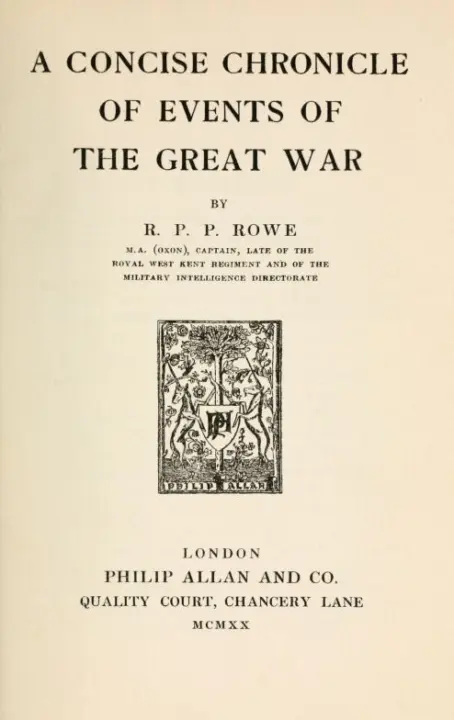
"A Concise Chronicle of Events of the Great War" by R. P. P. Rowe is a historical account written in the early 20th century. The book presents a detailed timeline of key events that transpired during World War I, beginning with the assassination of Archduke Franz Ferdinand and extending through various consequential military actions and diplomatic developments. It aims to serve as a concise and informative record of the war, utilizing authoritative sources to outline the battles and strategies involved. The opening of the chronicle establishes the groundwork for what follows, emphasizing the author's intent to provide a straightforward historical reference. Rowe clarifies the omission of maps due to practical limitations, but assures readers that the locations of key battles and events are accurately indicated. As the text transitions into the year-by-year chronology, it begins with pivotal incidents from 1914, starting with the assassination in Sarajevo, and then detailing the escalating tensions, declarations of war, and significant military engagements through a series of dates and events that create a comprehensive overview of the Great War's complex timeline.
Introduction adapted from the source catalogue; source summaries may be automatically generated.
Free to read · English · 67,463 words · No account needed
MAKE TIME FOR A GOOD BOOK
On by default. Untick to stop anonymous reading totals. Each page counts after 10 seconds in view. How this works.
Anonymous counting is on unless you have switched it off.
Gaub, a battle at, 4 Jl 5
Gauchet, Adm., succeeds Adm. du Fournet, 12 D 6
Gaulois sunk, 27 D 6
Gas, poison, first used by Germans, 22 Ap 5;
a second attack, 24 Ap 5;
a third attack, 2 My 5
Gavrelle, fighting at, 23 Ap 7, 26 Ap 7
Gaza, the 1st Battle of, 27 Mh 7;
the 2nd Battle of, 17 Ap 7;
fighting at, 14 Jl 7
Gazelle sunk, 25 Ja 5
Geddes, Sir E., apptd. Controller at the Admiralty, 14 My 7;
First Lord, 17 Jl 7
Genista sunk, 23 O 6
George, Mr. Ll., apptd. Minister of Munitions, 26 My 5;
Secretary for War, 6 Jl 6;
proposes reforms to Mr. Asquith, 1 D 6;
becomes Premier, 7 D 6
GERMANY: sends ultimatums to France and Russia, 31 Jl 4;
declares war on Russia, 1 Au 4;
invades France, Poland, and Luxemburg, 2 Au 4;
declares war on France, 3 Au 4;
invades Belgium, 3 Au 4;
invades Russia, 12-18 F 5;
declares a submarine blockade, 18 F 5;
institutes reprisals for Great Britain's treatment of submarine
prisoners, 12 Ap 5;
first uses poison gas, 22 Ap 5;
first uses liquid fire, 30 Jl 5;
declares right to sink merchant ships without warning, 27 Au 5;
declares war on Portugal, 10 Mh 6;
agrees with U.S.A. not to sink without warning, 4 My 6;
declares war on Roumania, 28 Au 6;
invades Roumania, 13 O 6;
makes Peace Proposals, 12 D 6;
which are received by British Foreign Office, 18 D 6;
replies to Mr. Wilson's Peace Note, 25 D 6;
the Allies reply to her Peace Proposals, 30 D 6;
Germany replies, 12 Ja 7;
announces unrestricted naval warfare, 31 Ja 7;
her intention to sink hospital ships made public, 31 Ja 7;
attempts to reopen negotiations with the U.S.A., 11 F 7;
meets with a refusal, 12 F 7;
proposes an Armistice with Russia, 8 Je 7;
her order to 'sink without trace' disclosed, 8 S 7;
discloses a mutiny in her Navy, 9 O 7;
captures islands in the Gulf of Riga, 12-20 O 7;
invades Esthonia, 21 O 7;
announces that she will treat with Bolshevists, 29 N 7;
signs an Armistice at Brest-Litovsk, 15 D 7;
it terminates and she invades Russia, 18 F 8;
outlines her Peace Terms with Russia, 21 F 8;
they are accepted, 24 F 8;
she occupies Reval and Pskoff, 25 F 8;
signs Peace at Brest-Litovsk, 2 Mh 8;
occupies Kieff, 3 Mh 8;
the Aland Islands, 5 Mh 8;
Odessa, 13 Mh 8;
Nikolaieff, 17 Mh 8;
offers Peace Terms to Belgium, 15 S 8;
sends a Note to Mr. Wilson, 4 O 8;
revolution breaks out, 4 N 8;
sends delegates to Foch, 6 N 8;
the Kaiser abdicates, 9 N 8;
she signs an Armistice with the Entente Powers, 11 N 8;
hands over her Navy, 21 N 8;
Ebert elected first President, 11 F 9;
Scheidemann becomes Premier, 12 F 9;
receives the Peace Terms, 7 My 9;
the Scheidemann Govt. resigns, 20 Je 9;
scuttles her Fleet, 21 Je 9;
Bauer becomes Premier, 21 Je 9;
National Assembly decides for signature of Peace Treaty, 21 Je 9;
signs it, 28 Je 9
Ghent, the 7th Division attacked at, 11 O 4;
occupied by Germans, 13 O 4;
reoccupied by Belgians, 11 N 8
Ghevgeli captured by Bulgarians, 12 D 5;
by Allies, 22 S 8
Ghurka, H.M.S., sunk, 8 F 7
Gibeon, a battle at, 28 Ap 5
Ginchy captured by British, 3-9 S 6
Giurgevo captured by Germans, 27 N 6
Your reading position is saved on this browser. Take it to another device with a library code. Reading pages adapt to text, rather than matching a printed edition.
BEHIND THE BOOK
This eBook is for the use of anyone anywhere in the United States and most other parts of the world at no cost and with almost no restrictions whatsoever. You may copy it, give it away or re-use it under the terms of the Project Gutenberg License included with this eBook or online at www.gutenberg.org. If you are not located in the United States, you will have to check the laws of the country where you are located before using this eBook. Read the source licence.
The original source file, including credits and licence, is retained by this library. Request an original-format copy at no charge. Please include the book title and Project Gutenberg identifier #48525.
KEEP YOUR CURIOSITY GOING
Cécile Tormay

Moritz Busch
John L. Ransom
Frances Wright
Cécile Tormay

Mabel Potter Daggett