
The World of Chance
William Dean Howells
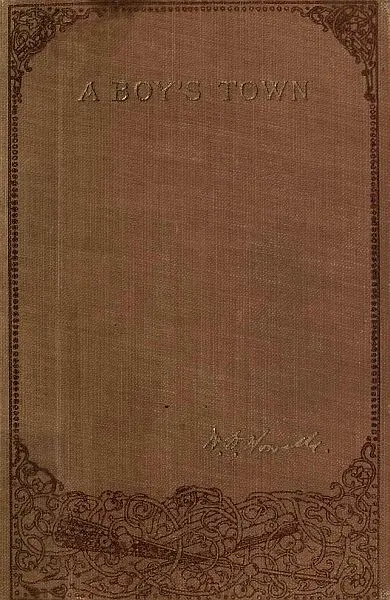
THE CLASSIC COLLECTION · 1890
"A Boy's Town" by William Dean Howells is a nostalgic novel written in the late 19th century. This work reflects on the innocence and complexity of boyhood as experienced through the eyes of the narrator, who draws on his childhood memories of a small town setting. The narrative seeks to capture the essence of boyhood adventures and the environment that shaped them." "At the start of the novel, the author introduces the concept of the "Boy's Town," emphasizing how the world appears to a boy aged between three and eleven. It paints a vivid picture of the setting—complete with rivers, canals, and plenty of outdoor adventures. The narrator recounts various experiences, much like a nostalgic reverie, recalling interactions with family, school life, and the myriad activities that occupied boys of his time, all while highlighting a certain innocence and misunderstanding inherent to childhood."
Introduction adapted from the source catalogue; source summaries may be automatically generated.
Free to read · English · 77,730 words · No account needed
MAKE TIME FOR A GOOD BOOK
On by default. Untick to stop anonymous reading totals. Each page counts after 10 seconds in view. How this works.
Anonymous counting is on unless you have switched it off.
My boy long remembered with horror and remorse his part in giving up to justice an unconscious offender, and seeing him pay for his transgression with his life. The boy was playing before his door, when a constable came by with his rifle on his shoulder, and asked him if he had seen any unmuzzled dogs about; and partly from pride at being addressed by a constable, partly from a nervous fear of refusing to answer, and partly from a childish curiosity to see what would happen, he said, "Yes; one over there by the pork-house." The constable whistled, and the poor little animal, which had got lost from the farmer it had followed to town, came running into sight round the corner of the pork-house, and sat up on its haunches to look about. It was a small red dog, the size of a fox, and the boy always saw it afterwards as it sat there in the gray afternoon, and fascinated him with its deadly peril. The constable swung his rifle quickly to his shoulder; the sharp, whiplike report came, and the dog dropped over, and its heart's blood flowed upon the ground and lay there in a pool. The boy ran into the house, with that picture forever printed in his memory. For him it was as if he had seen a fellow-being slain, and had helped to bring him to his death.
Whilst Tip was still in his prime the family of children was further enriched by the possession of a goat; but this did not belong to the whole family, or it was, at least nominally, the property of that eldest brother they all looked up to. I do not know how they came by the goat, any more than I know how they came by Tip; I only know that there came a time when it was already in the family, and that before it was got rid of it was a presence there was no mistaking. Nobody who has not kept a goat can have any notion of how many different kinds of mischief a goat can get into, without seeming to try, either, but merely by following the impulses of its own goatishness. This one was a nanny-goat, and it answered to the name of Nanny with an intelligence that was otherwise wholly employed in making trouble. It went up and down stairs, from cellar to garret, and in and out of all the rooms, like anybody, with a faint, cynical indifference in the glance of its cold gray eyes that gave no hint of its purposes or performances. In the chambers it chewed the sheets and pillow-cases on the beds, and in the dining-room, if it found nothing else, it would do its best to eat the table-cloth. Washing-day was a perfect feast for it, for then it would banquet on the shirt-sleeves and stockings that dangled from the clothes-line, and simply glut itself with the family linen and cotton. In default of these dainties, Nanny would gladly eat a chip-hat; she was not proud; she would eat a split-basket, if there was nothing else at hand. Once she got up on the kitchen-table, and had a perfect orgy with a lot of fresh-baked pumpkin-pies she found there; she cleaned all the pumpkin so neatly out of the pastry shells that, if there had been any more pumpkin left, they could have been filled up again, and nobody could have told the difference. The grandmother, who was visiting in the house at the time, declared to the mother that it would serve the father and the boys just right if she did fill these very shells up and give them to the father and the boys to eat. But I believe this was not done, and it was only suggested in a moment of awful exasperation, and because it was the father who was to blame for letting the boys keep the goat. The mother was always saying that the goat should not stay in the house another day, but she had not the heart to insist on its banishment, the children were so fond of it. I do not know why they were fond of it, for it never showed them the least affection, but was always taking the most unfair advantages of them, and it would butt them over whenever it got the chance. It would try to butt them into the well when they leaned down to pull up the bucket from the curb; and if it came out of the house, and saw a boy cracking nuts at the low flat stone the children had in the back-yard to crack nuts on, it would pretend that the boy was making motions to insult it, and before he knew what he was about it would fly at him and send him spinning head over heels. It was not of the least use in the world, and could not be, but the children were allowed to keep it till, one fatal day, when the mother had a number of other ladies to tea, as the fashion used to be in small towns, when they sat down to a comfortable gossip over dainty dishes of stewed chicken, hot biscuit, peach-preserves, sweet tomato-pickles, and pound-cake. That day they all laid off their bonnets on the hall-table, and the goat, after demurely waiting and watching with its faded eyes, which saw everything and seemed to see nothing, discerned a golden opportunity, and began to make such a supper of bonnet-ribbons as perhaps never fell to a goat's lot in life before. It was detected in its stolen joys just as it had chewed the ribbon of a best bonnet up to the bonnet, and was chased into the back-yard; but, as it had swallowed the ribbon without being able to swallow the bonnet, it carried that with it. The boy who specially owned the goat ran it down in a frenzy of horror and apprehension, and managed to unravel the ribbon from its throat, and get back the bonnet. Then he took the bonnet in and laid it carefully down on the table again, and decided that it would be best not to say anything about the affair. But such a thing as that could not be kept. The goat was known at once to have done the mischief; and this time it was really sent away. All the children mourned it, and the boy who owned it the most used to go to the house of the people who took it, and who had a high board fence round their yard, and try to catch sight of it through the cracks. When he called "Nanny" it answered him instantly with a plaintive "Baa!" and then, after a vain interchange of lamentations, he had to come away, and console himself as he could with the pets that were left him.
Your reading position is saved on this browser. Take it to another device with a library code. Reading pages adapt to text, rather than matching a printed edition.
William Dean Howells

William Dean Howells

William Dean Howells

William Dean Howells
BEHIND THE BOOK
This eBook is for the use of anyone anywhere in the United States and most other parts of the world at no cost and with almost no restrictions whatsoever. You may copy it, give it away or re-use it under the terms of the Project Gutenberg License included with this eBook or online at www.gutenberg.org. If you are not located in the United States, you will have to check the laws of the country where you are located before using this eBook. Read the source licence.
The original source file, including credits and licence, is retained by this library. Request an original-format copy at no charge. Please include the book title and Project Gutenberg identifier #28727.
KEEP YOUR CURIOSITY GOING
Coulson Kernahan

Maurice Baring
Frances Wright
Cécile Tormay

Frederic Jesup Stimson

W. H. P. (William Henry Pope) Jarvis