
The World of Chance
William Dean Howells
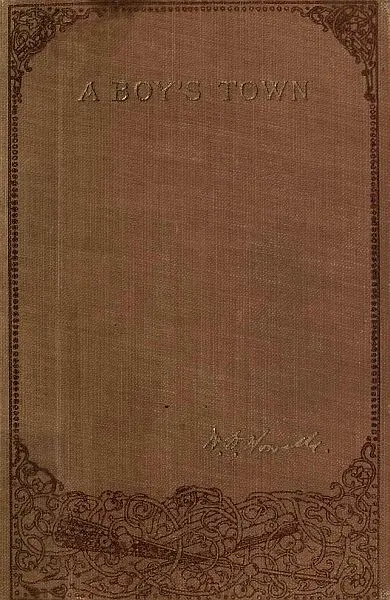
THE CLASSIC COLLECTION · 1890
"A Boy's Town" by William Dean Howells is a nostalgic novel written in the late 19th century. This work reflects on the innocence and complexity of boyhood as experienced through the eyes of the narrator, who draws on his childhood memories of a small town setting. The narrative seeks to capture the essence of boyhood adventures and the environment that shaped them." "At the start of the novel, the author introduces the concept of the "Boy's Town," emphasizing how the world appears to a boy aged between three and eleven. It paints a vivid picture of the setting—complete with rivers, canals, and plenty of outdoor adventures. The narrator recounts various experiences, much like a nostalgic reverie, recalling interactions with family, school life, and the myriad activities that occupied boys of his time, all while highlighting a certain innocence and misunderstanding inherent to childhood."
Introduction adapted from the source catalogue; source summaries may be automatically generated.
Free to read · English · 77,730 words · No account needed
MAKE TIME FOR A GOOD BOOK
On by default. Untick to stop anonymous reading totals. Each page counts after 10 seconds in view. How this works.
Anonymous counting is on unless you have switched it off.
AS the Boy's Town was, in one sense, merely a part of the boy, I think I had better tell something about my boy's family first, and the influences that formed his character, so that the reader can be a boy with him there on the intimate terms which are the only terms of true friendship. His great-grandfather was a prosperous manufacturer of Welsh flannels, who had founded his industry in a pretty town called The Hay, on the river Wye, in South Wales, where the boy saw one of his mills, still making Welsh flannels, when he visited his father's birthplace a few years ago. This great-grandfather was a Friend by Convincement, as the Quakers say; that is, he was a convert, and not a born Friend, and he had the zeal of a convert. He loved equality and fraternity, and he came out to America towards the close of the last century to prospect for these as well as for a good location to manufacture Welsh flannels; but after being presented to Washington, then President, at Philadelphia, and buying a tract of land somewhere near the District of Columbia, his phantom rolls a shadowy barrel of dollars on board ship at Baltimore, and sails back in the Flying Dutchman to South Wales. I fancy, from the tradition of the dollars, that he had made good affairs here with the stock of flannels he brought over with him; but all is rather uncertain about him, especially the land he bought, though the story of it is pretty sure to fire some descendant of his in each new generation with the wish to go down to Washington, and oust the people there who have unrightfully squatted on the ancestral property. What is unquestionable is that this old gentleman went home and never came out here again; but his son, who had inherited all his radicalism, sailed with his family for Boston in 1808, when my boy's father was a year old. From Boston he passed to one Quaker neighborhood after another, in New York, Virginia, and Ohio, setting up the machinery of woollen mills, and finally, after much disastrous experiment in farming, paused at the Boy's Town, and established himself in the drug and book business: drugs and books are still sold together, I believe, in small places. He had long ceased to be a Quaker, but he remained a Friend to every righteous cause; and brought shame to his grandson's soul by being an abolitionist in days when it was infamy to wish the slaves set free. My boy's father restored his self-respect in a measure by being a Henry Clay Whig, or a constitutional anti-slavery man. The grandfather was a fervent Methodist, but the father, after many years of scepticism, had become a receiver of the doctrines of Emanuel Swedenborg; and in this faith the children were brought up. It was not only their faith, but their life, and I may say that in this sense they were a very religious household, though they never went to church, because it was the Old Church. They had no service of the New Church, the Swedenborgians were so few in the place, except when some of its ministers stopped with us on their travels. My boy regarded these good men as all personally sacred, and while one of them was in the house he had some relief from the fear in which his days seem mostly to have been passed; as if he were for the time being under the protection of a spiritual lightning-rod. Their religion was not much understood by their neighbors of the Old Church, who thought them a kind of Universalists. But the boy once heard his father explain to one of them that the New Church people believed in a hell, which each cast himself into if he loved the evil rather than the good, and that no mercy could keep him out of without destroying him, for a man's love was his very self. It made his blood run cold, and he resolved that rather than cast himself into hell, he would do his poor best to love the good. The children were taught when they teased one another that there was nothing the fiends so much delighted in as teasing. When they were angry and revengeful, they were told that now they were calling evil spirits about them, and that the good angels could not come near them if they wished while they were in that state. My boy preferred the company of good angels after dark, and especially about bedtime, and he usually made the effort to get himself into an accessible frame of mind before he slept; by day he felt that he could look out for himself, and gave way to the natural man like other boys. I suppose the children had their unwholesome spiritual pride in being different from their fellows in religion; but, on the other hand, it taught them not to fear being different from others if they believed themselves right. Perhaps it made my boy rather like it.
Your reading position is saved on this browser. Take it to another device with a library code. Reading pages adapt to text, rather than matching a printed edition.
William Dean Howells

William Dean Howells

William Dean Howells

William Dean Howells
BEHIND THE BOOK
This eBook is for the use of anyone anywhere in the United States and most other parts of the world at no cost and with almost no restrictions whatsoever. You may copy it, give it away or re-use it under the terms of the Project Gutenberg License included with this eBook or online at www.gutenberg.org. If you are not located in the United States, you will have to check the laws of the country where you are located before using this eBook. Read the source licence.
The original source file, including credits and licence, is retained by this library. Request an original-format copy at no charge. Please include the book title and Project Gutenberg identifier #28727.
KEEP YOUR CURIOSITY GOING
Coulson Kernahan

Maurice Baring
Frances Wright
Cécile Tormay

Frederic Jesup Stimson

W. H. P. (William Henry Pope) Jarvis