
The World of Chance
William Dean Howells
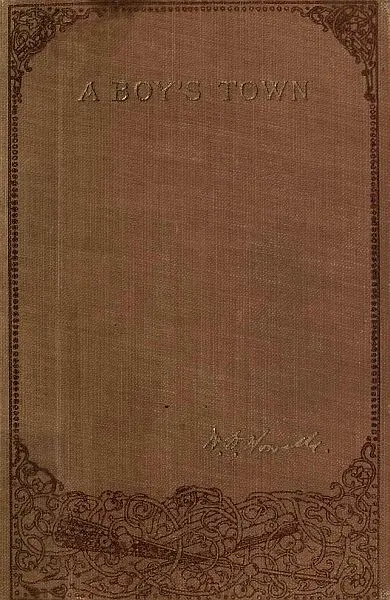
THE CLASSIC COLLECTION · 1890
"A Boy's Town" by William Dean Howells is a nostalgic novel written in the late 19th century. This work reflects on the innocence and complexity of boyhood as experienced through the eyes of the narrator, who draws on his childhood memories of a small town setting. The narrative seeks to capture the essence of boyhood adventures and the environment that shaped them." "At the start of the novel, the author introduces the concept of the "Boy's Town," emphasizing how the world appears to a boy aged between three and eleven. It paints a vivid picture of the setting—complete with rivers, canals, and plenty of outdoor adventures. The narrator recounts various experiences, much like a nostalgic reverie, recalling interactions with family, school life, and the myriad activities that occupied boys of his time, all while highlighting a certain innocence and misunderstanding inherent to childhood."
Introduction adapted from the source catalogue; source summaries may be automatically generated.
Free to read · English · 77,730 words · No account needed
MAKE TIME FOR A GOOD BOOK
On by default. Untick to stop anonymous reading totals. Each page counts after 10 seconds in view. How this works.
Anonymous counting is on unless you have switched it off.
ABOUT the time fate cursed him with a granted prayer in those boots, my boy was deep in the reading of a book about Grecian mythology which he found perpetually fascinating; he read it over and over without ever thinking of stopping merely because he had already been through it twenty or thirty times. It had pictures of all the gods and goddesses, demigods and heroes; and he tried to make poems upon their various characters and exploits. But Apollo was his favorite, and I believe it was with some hope of employing them in a personation of the god that he coveted those red-topped sharp-toed calf-skin boots. He had a notion that if he could get up a chariot by sawing down the sides of a store-box for the body, and borrowing the hind-wheels of the baby's willow wagon, and then, drawn by the family dog Tip at a mad gallop, come suddenly whirling round the corner of the school-house, wearing spangled circus-tights and bearing Apollo's bow and shaft, while a silken scarf which he had seen in a bureau-drawer at home blew gallantly out behind him, it would have a fine effect with the boys. Some of the fellows wished to be highway robbers and outlaws; one who intended to be a pirate afterwards got so far in a maritime career as to invent a steam-engine governor now in use on the seagoing steamers; my boy was content to be simply a god, the god of poetry and sunshine. He never realized his modest ambition, but then boys never realize anything; though they have lots of fun failing.
In the Boy's Town they had regular games and plays, which came and went in a stated order. The first thing in the spring as soon as the frost began to come out of the ground, they had marbles which they played till the weather began to be pleasant for the game, and then they left it off. There were some mean-spirited fellows who played for fun, but any boy who was anything played for keeps: that is, keeping all the marbles he won. As my boy was skilful at marbles, he was able to start out in the morning with his toy, or the marble he shot with, and a commy, or a brown marble of the Lowest value, and come home at night with a pocketful of white-alleys and blood-alleys, striped plasters find bull's-eyes, and crystals, clear and clouded. His gambling was not approved of at home, but it was allowed him because of the hardness of his heart, I suppose, and because it was not thought well to keep him up too strictly; and I suspect it would have been useless to forbid his playing for keeps, though he came to have a bad conscience about it before he gave it up. There were three kinds of games at marbles which the boys played: one with a long ring marked out on the ground, and a base some distance off, which you began to shoot from; another with a round ring, whose line formed the base; and another with holes, three or five, hollowed in the earth at equal distances from each other, which was called knucks. You could play for keeps in all these games; and in knucks, if you won, you had a shot or shots at the knuckles of the fellow who lost, and who was obliged to hold them down for you to shoot at. Fellows who were mean would twitch their knuckles away when they saw your toy coming, and run; but most of them took their punishment with the savage pluck of so many little Sioux. As the game began in the raw cold of the earliest spring, every boy had chapped hands, and nearly every one had the skin worn off the knuckle of his middle finger from resting it on the ground when he shot. You could use a knuckle-dabster of fur or cloth to rest your hand on, but it was considered effeminate, and in the excitement you were apt to forget it, anyway. Marbles were always very exciting, and were played with a clamor as incessant as that of a blackbird roost. A great many points were always coming up: whether a boy took-up or edged beyond the very place where his toy lay when he shot; whether he knuckled down, or kept his hand on the ground in shooting; whether, when another boy's toy drove one marble against another and knocked both out of the ring, he holloed "Fen doubs!" before the other fellow holloed "Doubs!" whether a marble was in or out of the ring, and whether the umpire's decision was just or not. The gambling and the quarrelling went on till the second-bell rang for school, and began again as soon as the boys could get back to their rings when school let out. The rings were usually marked on the ground with a stick, but when there was a great hurry, or there was no stick handy, the side of a fellow's boot would do, and the hollows for knucks were always bored by twirling round on your boot-heel. This helped a boy to wear out his boots very rapidly, but that was what his boots were made for, just as the sidewalks were made for the boys' marble-rings, and a citizen's character for cleverness or meanness was fixed by his walking round or over the rings. Cleverness was used in the Virginia sense for amiability; a person who was clever in the English sense was smart.
Your reading position is saved on this browser. Take it to another device with a library code. Reading pages adapt to text, rather than matching a printed edition.
William Dean Howells

William Dean Howells

William Dean Howells

William Dean Howells
BEHIND THE BOOK
This eBook is for the use of anyone anywhere in the United States and most other parts of the world at no cost and with almost no restrictions whatsoever. You may copy it, give it away or re-use it under the terms of the Project Gutenberg License included with this eBook or online at www.gutenberg.org. If you are not located in the United States, you will have to check the laws of the country where you are located before using this eBook. Read the source licence.
The original source file, including credits and licence, is retained by this library. Request an original-format copy at no charge. Please include the book title and Project Gutenberg identifier #28727.
KEEP YOUR CURIOSITY GOING
Coulson Kernahan

Maurice Baring
Frances Wright
Cécile Tormay

Frederic Jesup Stimson

W. H. P. (William Henry Pope) Jarvis