
The World of Chance
William Dean Howells
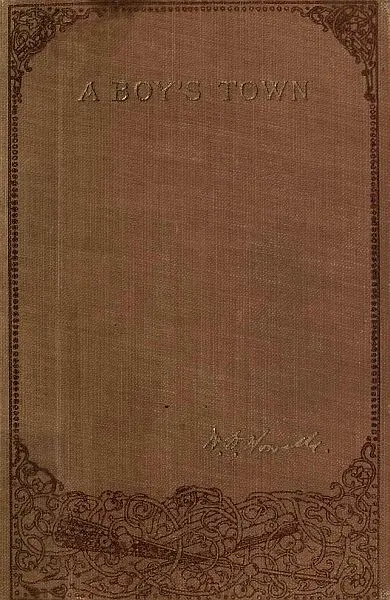
THE CLASSIC COLLECTION · 1890
"A Boy's Town" by William Dean Howells is a nostalgic novel written in the late 19th century. This work reflects on the innocence and complexity of boyhood as experienced through the eyes of the narrator, who draws on his childhood memories of a small town setting. The narrative seeks to capture the essence of boyhood adventures and the environment that shaped them." "At the start of the novel, the author introduces the concept of the "Boy's Town," emphasizing how the world appears to a boy aged between three and eleven. It paints a vivid picture of the setting—complete with rivers, canals, and plenty of outdoor adventures. The narrator recounts various experiences, much like a nostalgic reverie, recalling interactions with family, school life, and the myriad activities that occupied boys of his time, all while highlighting a certain innocence and misunderstanding inherent to childhood."
Introduction adapted from the source catalogue; source summaries may be automatically generated.
Free to read · English · 77,730 words · No account needed
MAKE TIME FOR A GOOD BOOK
On by default. Untick to stop anonymous reading totals. Each page counts after 10 seconds in view. How this works.
Anonymous counting is on unless you have switched it off.
Captain Riley's narrative of his shipwreck on the coast of Africa, and his captivity among the Arabs, was a book which my boy and his brother prized with a kind of personal interest, because their father told them that he had once seen a son of Captain Riley when he went to get his appointment of collector at Columbus, and that this son was named William Willshire Riley, after the good English merchant, William Willshire, who had ransomed Captain Riley. William Willshire seemed to them almost the best man who ever lived; though my boy had secretly a greater fondness for the Arab, Sidi Hamet, who was kind to Captain Riley and kept his brother Seid from ill-treating him whenever he could. Probably the boy liked him better because the Arab was more picturesque than the Englishman. The whole narrative was very interesting; it had a vein of sincere and earnest piety in it which was not its least charm, and it was written in a style of old-fashioned stateliness which was not without its effect with the boys.
Somehow they did not think of the Arabs in this narrative as of the same race and faith with the Arabs of Bagdad and the other places in the "Arabian Nights." They did not think whether these were Mohammedans or not; they naturalized them in the fairy world where all boys are citizens, and lived with them there upon the same familiar terms as they lived with Robinson Crusoe. Their father once told them that Robinson Crusoe had robbed the real narrative of Alexander Selkirk of the place it ought to have held in the remembrance of the world; and my boy had a feeling of guilt in reading it, as if he were making himself the accomplice of an impostor. He liked the "Arabian Nights," but oddly enough these wonderful tales made no such impression on his fancy as the stories in a wretchedly inferior book made. He did not know the name of this book, or who wrote it; from which I imagine that much of his reading was of the purblind sort that ignorant grown-up people do, without any sort of literary vision. He read this book perpetually, when he was not reading his "Greek and Roman Mythology;" and then suddenly, one day, as happens in childhood with so many things, it vanished out of his possession as if by magic. Perhaps he lost it; perhaps he lent it; at any rate it was gone, and he never got it back, and he never knew what book it was till thirty years afterwards, when he picked up from a friend's library-table a copy of "Gesta Romanorum," and recognized in this collection of old monkish legends the long-missing treasure of his boyhood. These stories, without beauty of invention, without art of construction or character, without spirituality in their crude materialization, which were read aloud in the refectories of mediaeval cloisters while the monks sat at meat, laid a spell upon the soul of the boy that governed his life. He conformed his conduct to the principles and maxims which actuated the behavior of the shadowy people of these dry-as-dust tales; he went about drunk with the fumes of fables about Roman emperors that never were, in an empire that never was; and, though they tormented him by putting a mixed and impossible civilization in the place of that he knew from his Goldsmith, he was quite helpless to break from their influence. He was always expecting some wonderful thing to happen to him as things happened there in fulfilment of some saying or prophecy; and at every trivial moment he made sayings and prophecies for himself, which he wished events to fulfil. One Sunday when he was walking in an alley behind one of the stores, he found a fur cap that had probably fallen out of the store-loft window. He ran home with it, and in his simple-hearted rapture he told his mother that as soon as he picked it up there came into his mind the words, "He who picketh up this cap picketh up a fortune," and he could hardly wait for Monday to come and let him restore the cap to its owner and receive an enduring prosperity in reward of his virtue. Heaven knows what form he expected this to take; but when he found himself in the store, he lost all courage; his tongue clove to the roof of his mouth, and he could not utter a syllable of the fine phrases he had made to himself. He laid the cap on the counter without a word; the storekeeper came up and took it in his hand. "What's this?" he said. "Why, this is ours," and he tossed the cap into a loose pile of hats by the showcase, and the boy slunk out, cut to the heart and crushed to the dust. It was such a cruel disappointment and mortification that it was rather a relief to have his brother mock him, and come up and say from time to time, "He who picketh up this cap picketh up a fortune," and then split into a jeering laugh. At least he could fight his brother, and, when he ran, could stone him; and he could throw quads and quoins, and pieces of riglet at the jour printers when the story spread to them, and one of them would begin, "He who picketh--"
Your reading position is saved on this browser. Take it to another device with a library code. Reading pages adapt to text, rather than matching a printed edition.
William Dean Howells

William Dean Howells

William Dean Howells

William Dean Howells
BEHIND THE BOOK
This eBook is for the use of anyone anywhere in the United States and most other parts of the world at no cost and with almost no restrictions whatsoever. You may copy it, give it away or re-use it under the terms of the Project Gutenberg License included with this eBook or online at www.gutenberg.org. If you are not located in the United States, you will have to check the laws of the country where you are located before using this eBook. Read the source licence.
The original source file, including credits and licence, is retained by this library. Request an original-format copy at no charge. Please include the book title and Project Gutenberg identifier #28727.
KEEP YOUR CURIOSITY GOING
Coulson Kernahan

Maurice Baring
Frances Wright
Cécile Tormay

Frederic Jesup Stimson

W. H. P. (William Henry Pope) Jarvis