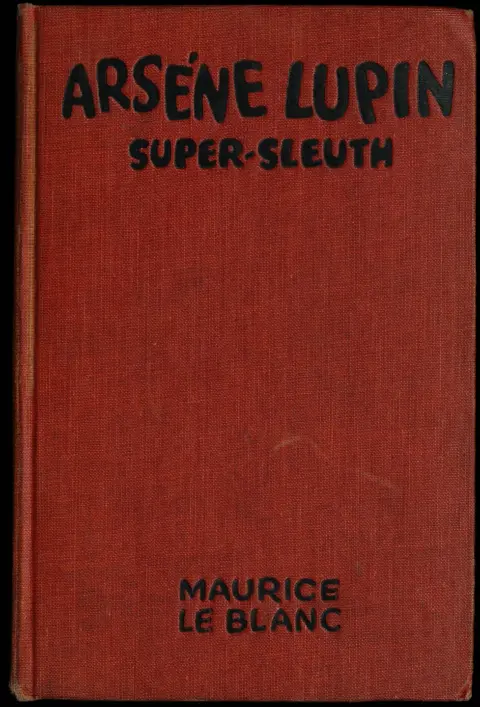
Arsène Lupin, super-sleuth
Maurice Leblanc
THE CLASSIC COLLECTION · 1910
"813" by Maurice Leblanc is a suspenseful detective novel written in the early 20th century. The story revolves around the enigmatic character Arsène Lupin, a gentleman burglar, as he engages in a thrilling game of cat and mouse with the authorities after committing a series of crimes, including a shocking murder. The novel introduces readers to a high-stakes world of intrigue, where Kesselbach, a wealthy man, becomes embroiled in a plot that threatens not only his life but also his ambitions. The opening of "813" sets a tense atmosphere with Mr. Kesselbach discovering that someone has invaded his hotel suite while he was away. Anxious and paranoid, he discusses strange occurrences with his secretary, Chapman, pointing out the peculiarities in their situation. When the mysterious Arsène Lupin makes his dramatic entrance, the tension escalates to a confrontation filled with twists and a daring heist, leaving readers breathless and eager to uncover the secrets surrounding Kesselbach's wealth and ambitions, as well as Lupin's true motives.
Introduction adapted from the source catalogue; source summaries may be automatically generated.
Free to read · English · 109,524 words · No account needed
MAKE TIME FOR A GOOD BOOK
On by default. Untick to stop anonymous reading totals. Each page counts after 10 seconds in view. How this works.
Anonymous counting is on unless you have switched it off.
"Through a secret passage which the rogues must have contrived to make
quite recently."
"And which would end, no doubt," said Gourel, "in Mrs. Kesselbach's
house."
"Yes, perhaps," said M. Lenormand, "perhaps . . . But I have another
idea."
They followed the circuit of the wall. It was a bright night; and, though their two forms were hardly distinguishable, they themselves could see enough to examine the stones of the walls and to convince themselves that no breach, however skilful, had been effected.
"A ladder, very likely?" suggested Gourel.
"No, because Gertrude is able to get out in broad daylight. A communication of the kind I mean can evidently not end out of doors. The entrance must be concealed by some building already in existence."
"There are only the four garden-houses," objected Gourel, "and they are
all inhabited."
"I beg your pardon: the third, the Pavillon Hortense, is not inhabited."
"Who told you so?"
"The porter. Mrs. Kesselbach hired this house, which is near her own, for fear of the noise. Who knows but that, in so doing, she acted under Gertrude's influence?"
He walked round the house in question. The shutters were closed. He lifted the latch of the door, on the off-chance; the door opened.
"Ah, Gourel, I think we've struck it! Let's go in. Light your lantern. . . . Oh, the hall. . . . the drawing-room . . . the dining-room . . . that's no use. There must be a basement, as the kitchen is not on this floor."
"This way, chief . . . the kitchen-stairs are here."
They went down into a rather large kitchen, crammed full of wicker-work garden-chairs and flower-stands. Beside it was a wash-house, which also served as a cellar, and which presented the same untidy sight of objects piled one on the top of the other.
"What is that shiny thing down there, chief?"
Gourel stooped and picked up a brass pin with a head made of an
imitation pearl.
"The pearl is quite bright still," said M. Lenormand, "which it would not be if it had been lying in this cellar long. Gertrude passed this way, Gourel."
Gourel began to demolish a great stack of empty wine-casks, writing desks and old rickety tables.
"You are wasting your time," said M. Lenormand. "If that is the way out, how would she have time first to move all those things and then to replace them behind her? Look, here is a shutter out of use, which has no valid reason for being fastened to the wall by that nail. Draw it back."
Gourel did so. Behind the shutter, the wall was hollowed out. By the light of the lantern they saw an underground passage running downwards.
Your reading position is saved on this browser. Take it to another device with a library code. Reading pages adapt to text, rather than matching a printed edition.
Maurice Leblanc
Maurice Leblanc
Maurice Leblanc

Maurice Leblanc
BEHIND THE BOOK
This eBook is for the use of anyone anywhere in the United States and most other parts of the world at no cost and with almost no restrictions whatsoever. You may copy it, give it away or re-use it under the terms of the Project Gutenberg License included with this eBook or online at www.gutenberg.org. If you are not located in the United States, you will have to check the laws of the country where you are located before using this eBook. Read the source licence.
The original source file, including credits and licence, is retained by this library. Request an original-format copy at no charge. Please include the book title and Project Gutenberg identifier #34758.
KEEP YOUR CURIOSITY GOING
Coulson Kernahan

Maurice Baring
Frances Wright
Cécile Tormay

Frederic Jesup Stimson

W. H. P. (William Henry Pope) Jarvis