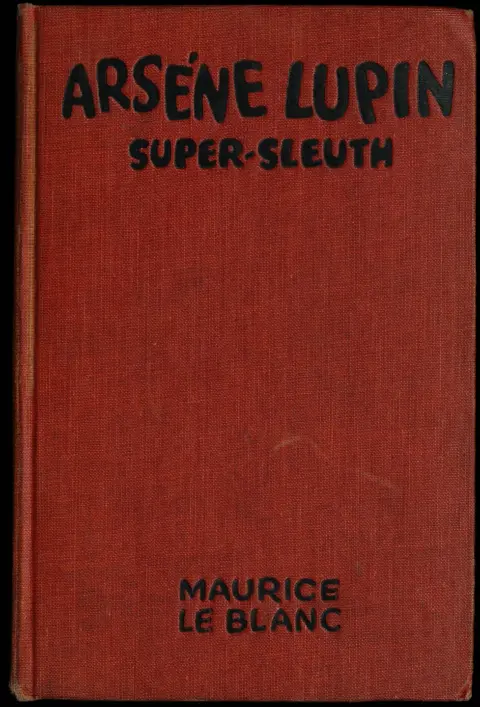
Arsène Lupin, super-sleuth
Maurice Leblanc
THE CLASSIC COLLECTION · 1910
"813" by Maurice Leblanc is a suspenseful detective novel written in the early 20th century. The story revolves around the enigmatic character Arsène Lupin, a gentleman burglar, as he engages in a thrilling game of cat and mouse with the authorities after committing a series of crimes, including a shocking murder. The novel introduces readers to a high-stakes world of intrigue, where Kesselbach, a wealthy man, becomes embroiled in a plot that threatens not only his life but also his ambitions. The opening of "813" sets a tense atmosphere with Mr. Kesselbach discovering that someone has invaded his hotel suite while he was away. Anxious and paranoid, he discusses strange occurrences with his secretary, Chapman, pointing out the peculiarities in their situation. When the mysterious Arsène Lupin makes his dramatic entrance, the tension escalates to a confrontation filled with twists and a daring heist, leaving readers breathless and eager to uncover the secrets surrounding Kesselbach's wealth and ambitions, as well as Lupin's true motives.
Introduction adapted from the source catalogue; source summaries may be automatically generated.
Free to read · English · 109,524 words · No account needed
MAKE TIME FOR A GOOD BOOK
On by default. Untick to stop anonymous reading totals. Each page counts after 10 seconds in view. How this works.
Anonymous counting is on unless you have switched it off.
"What! Your resignation! For a well-meaning remark which Monsieur le Préfet thinks fit to address to you and to which, for that matter, he attaches no importance whatever--do you, Delaume? No importance whatever--and there you go, taking offence! You must confess, my dear Lenormand, that you're devilish touchy! Come, put that bit of paper back in your pocket and let's talk seriously."
The chief detective sat down again, and Valenglay, silencing the prefect, who made no attempt to conceal his dissatisfaction, said:
"In two words, Lenormand, the thing is that Lupin's reappearance upon the scene annoys us. The brute has defied us long enough. It used to be funny, I confess, and I, for my part, was the first to laugh at it. But it's no longer a question of that. It's a question of murder now. We could stand Lupin, as long as he amused the gallery. But, when he takes to killing people, no!"
"Then what is it that you ask, Monsieur le Président?"
"What we ask? Oh, it's quite simple! First, his arrest and then his
head!"
"I can promise you his arrest, some day or another, but not his head."
"What! If he's arrested, it means trial for murder, a verdict of guilty,
and the scaffold."
"No!"
"And why not?"
"Because Lupin has not committed murder."
"Eh? Why, you're mad, Lenormand! The corpses at the Palace Hotel are so many inventions, I suppose! And the three murders were never committed!"
"Yes, but not by Lupin."
The chief spoke these words very steadily, with impressive calmness and conviction. The attorney and the prefect protested.
"I presume, Lenormand," said Valenglay, "that you do not put forward that theory without serious reasons?"
"It is not a theory."
"What proof have you?"
"There are two, to begin with, two proofs of a moral nature, which I at once placed before Monsieur le Juge d'Instruction and which the newspapers have laid stress upon. First and foremost, Lupin does not kill people. Next, why should he have killed anybody, seeing that the object which he set out to achieve, the theft, was accomplished and that he had nothing to fear from an adversary who was gagged and bound?"
"Very well. But the facts?"
"Facts are worth nothing against reason and logic; and, moreover, the facts also are on my side. What would be the meaning of Lupin's presence in the room in which the cigarette-case was discovered? On the other hand, the black clothes which were found and which evidently belonged to the murderer are not in the least of a size to fit Lupin."
"You know him, then, do you?"
Your reading position is saved on this browser. Take it to another device with a library code. Reading pages adapt to text, rather than matching a printed edition.
Maurice Leblanc
Maurice Leblanc
Maurice Leblanc
Maurice Leblanc
BEHIND THE BOOK
This eBook is for the use of anyone anywhere in the United States and most other parts of the world at no cost and with almost no restrictions whatsoever. You may copy it, give it away or re-use it under the terms of the Project Gutenberg License included with this eBook or online at www.gutenberg.org. If you are not located in the United States, you will have to check the laws of the country where you are located before using this eBook. Read the source licence.
The original source file, including credits and licence, is retained by this library. Request an original-format copy at no charge. Please include the book title and Project Gutenberg identifier #34758.
KEEP YOUR CURIOSITY GOING
Coulson Kernahan

Maurice Baring
Frances Wright
Cécile Tormay

Frederic Jesup Stimson

W. H. P. (William Henry Pope) Jarvis