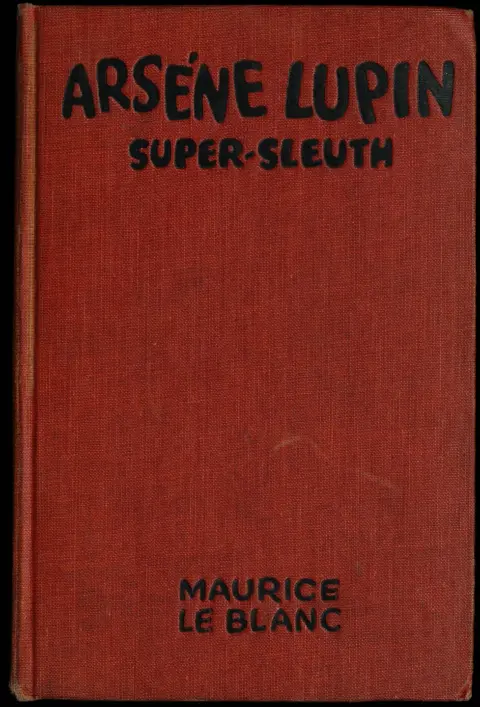
Arsène Lupin, super-sleuth
Maurice Leblanc
THE CLASSIC COLLECTION · 1910
"813" by Maurice Leblanc is a suspenseful detective novel written in the early 20th century. The story revolves around the enigmatic character Arsène Lupin, a gentleman burglar, as he engages in a thrilling game of cat and mouse with the authorities after committing a series of crimes, including a shocking murder. The novel introduces readers to a high-stakes world of intrigue, where Kesselbach, a wealthy man, becomes embroiled in a plot that threatens not only his life but also his ambitions. The opening of "813" sets a tense atmosphere with Mr. Kesselbach discovering that someone has invaded his hotel suite while he was away. Anxious and paranoid, he discusses strange occurrences with his secretary, Chapman, pointing out the peculiarities in their situation. When the mysterious Arsène Lupin makes his dramatic entrance, the tension escalates to a confrontation filled with twists and a daring heist, leaving readers breathless and eager to uncover the secrets surrounding Kesselbach's wealth and ambitions, as well as Lupin's true motives.
Introduction adapted from the source catalogue; source summaries may be automatically generated.
Free to read · English · 109,524 words · No account needed
MAKE TIME FOR A GOOD BOOK
On by default. Untick to stop anonymous reading totals. Each page counts after 10 seconds in view. How this works.
Anonymous counting is on unless you have switched it off.
Lupin looked at her long, with infinite emotion and anguish. A whole leaven of unknown feelings fermented within him. He had a longing to press that pretty girl to his breast, to kiss her and tell her how he respected and loved her. He remembered the mother, who died in the little village of Aspremont, who died of grief.
"Call her," said Victoire. "Why don't you call her?"
He sank into a chair and stammered:
"I can't. . . . I can't do it. . . . I have not the right. . . . It is impossible. . . . Let her believe me dead. . . . That is better. . . ."
He wept, his shoulders shaking with sobs, his whole being overwhelmed with despair, swollen with an affection that arose in him, like those backward flowers which die on the very day of their blossoming.
The old woman knelt down beside him and, in a trembling voice, asked:
"She is your daughter, is she not?"
"Yes, she is my daughter."
"Oh, my poor boy!" she said, bursting into tears. "My poor boy! . . ."
"To horse!" said the Emperor.
He corrected himself, on seeing the magnificent ass which they brought
him:
"To donkey, rather! Waldemar, are you sure this animal is quiet to ride
and drive?"
"I will answer for him as I would for myself, Sire," declared the count.
"In that case, I feel safe," said the Emperor, laughing. And, turning to the officers with him, "Gentlemen, to horse!"
The market-place of the village of Capri was crowded with sight-seers, kept back by a line of Italian carabiniers, and, in the middle, all the donkeys of the place, which had been requisitioned to enable the Emperor to go over that island of wonders.
"Waldemar," said the Emperor, taking the head of the cavalcade, "what do
we begin with?"
"With Tiberius's Villa, Sire."
They rode under a gateway and then followed a roughly-paved path, rising gradually to the eastern promontory of the island.
The Emperor laughed and enjoyed himself and good-humoredly chaffed the colossal Count von Waldemar, whose feet touched the ground on either side of the unfortunate donkey borne down under his weight.
In three-quarters of an hour, they arrived first at Tiberius's Leap, an enormous rock, a thousand feet high, from which the tyrant caused his victims to be hurled into the sea. . . .
The Emperor dismounted, walked up to the hand-rail and took a glance at the abyss. Then he went on foot to the ruins of Tiberius's Villa, where he strolled about among the crumbling halls and passages.
He stopped for a moment.
Your reading position is saved on this browser. Take it to another device with a library code. Reading pages adapt to text, rather than matching a printed edition.
Maurice Leblanc
Maurice Leblanc
Maurice Leblanc

Maurice Leblanc
BEHIND THE BOOK
This eBook is for the use of anyone anywhere in the United States and most other parts of the world at no cost and with almost no restrictions whatsoever. You may copy it, give it away or re-use it under the terms of the Project Gutenberg License included with this eBook or online at www.gutenberg.org. If you are not located in the United States, you will have to check the laws of the country where you are located before using this eBook. Read the source licence.
The original source file, including credits and licence, is retained by this library. Request an original-format copy at no charge. Please include the book title and Project Gutenberg identifier #34758.
KEEP YOUR CURIOSITY GOING
Coulson Kernahan

Maurice Baring
Frances Wright
Cécile Tormay

Frederic Jesup Stimson

W. H. P. (William Henry Pope) Jarvis