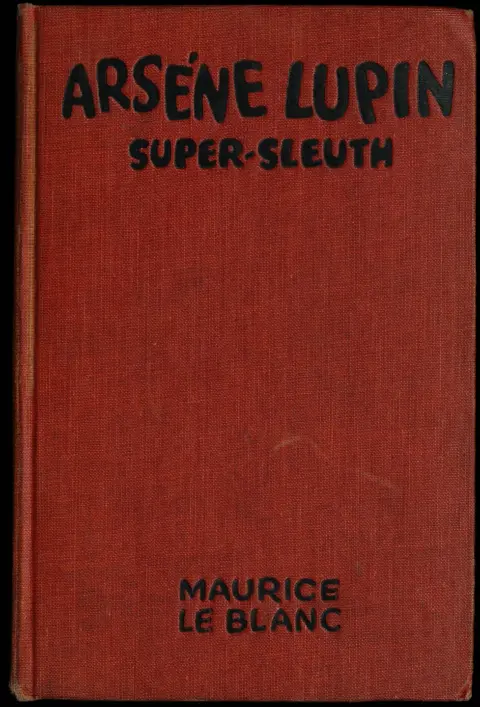
Arsène Lupin, super-sleuth
Maurice Leblanc
THE CLASSIC COLLECTION · 1910
"813" by Maurice Leblanc is a suspenseful detective novel written in the early 20th century. The story revolves around the enigmatic character Arsène Lupin, a gentleman burglar, as he engages in a thrilling game of cat and mouse with the authorities after committing a series of crimes, including a shocking murder. The novel introduces readers to a high-stakes world of intrigue, where Kesselbach, a wealthy man, becomes embroiled in a plot that threatens not only his life but also his ambitions. The opening of "813" sets a tense atmosphere with Mr. Kesselbach discovering that someone has invaded his hotel suite while he was away. Anxious and paranoid, he discusses strange occurrences with his secretary, Chapman, pointing out the peculiarities in their situation. When the mysterious Arsène Lupin makes his dramatic entrance, the tension escalates to a confrontation filled with twists and a daring heist, leaving readers breathless and eager to uncover the secrets surrounding Kesselbach's wealth and ambitions, as well as Lupin's true motives.
Introduction adapted from the source catalogue; source summaries may be automatically generated.
Free to read · English · 109,524 words · No account needed
MAKE TIME FOR A GOOD BOOK
On by default. Untick to stop anonymous reading totals. Each page counts after 10 seconds in view. How this works.
Anonymous counting is on unless you have switched it off.
He now ventured to touch her, to feel in her clothes. In an inside pocket were two pocket-books. He took one of them and opened it. He found first a letter signed by Steinweg, the old German. It contained the following lines:
"Should I die before being able to reveal the terrible
secret, let it be known that the murderer of my
friend Kesselbach is his wife, whose real name is
Dolores de Malreich, sister to Altenheim and sister to
Isilda.
"The initials L. and M. relate to her. Kesselbach never, in their private life, called his wife Dolores, which is the name of sorrow, but Letitia, which denotes joy. L. M.--Letitia de Malreich--were the initials inscribed on all the presents which he used to give her, for instance, on the cigarette-case which was found at the Palace Hotel and which belonged to Mrs. Kesselbach. She had contracted the smoking-habit on her travels.
"Letitia! She was indeed the joy of his life for four years, four years of lies and hypocrisy, in which she prepared the death of the man who loved her so well and who trusted her so whole-heartedly.
"Perhaps I ought to have spoken at once. I had not the
courage, in memory of my old friend Kesselbach, whose
name she bore.
"And then I was afraid. . . . On the day when I
unmasked her, at the Palais de Justice, I read my doom
in her eyes.
"Will my weakness save me?"
"Him also," thought Lupin, "him also she killed! . . . Why, of course, he knew too much! . . . The initials . . . that name, Letitia . . . the secret habit of smoking!"
And he remembered the previous night, that smell of tobacco in her room.
He continued his inspection of the first pocket-book. There were scraps of letters, in cipher, no doubt handed to Dolores by her accomplices, in the course of their nocturnal meetings. There were also addresses on bits of paper, addresses of milliners and dressmakers, but addresses also of low haunts, of common hotels. . . . And names . . . twenty, thirty names . . . queer names: Hector the Butcher, Armand of Grenelle, the Sick Man . . .
But a photograph caught Lupin's eye. He looked at it. And, at once, as though shot from a spring, dropping the pocket-book, he bolted out of the room, out of the chalet and rushed into the park.
He had recognized the portrait of Louis de Malreich, the prisoner at the
Santé!
Not till then, not till that exact moment did he remember: the execution was to take place next day.
And, as the man in black, as the murderer was none other than Dolores Kesselbach, Louis de Malreich's name was really and truly Leon Massier and he was innocent!
Your reading position is saved on this browser. Take it to another device with a library code. Reading pages adapt to text, rather than matching a printed edition.
Maurice Leblanc
Maurice Leblanc
Maurice Leblanc

Maurice Leblanc
BEHIND THE BOOK
This eBook is for the use of anyone anywhere in the United States and most other parts of the world at no cost and with almost no restrictions whatsoever. You may copy it, give it away or re-use it under the terms of the Project Gutenberg License included with this eBook or online at www.gutenberg.org. If you are not located in the United States, you will have to check the laws of the country where you are located before using this eBook. Read the source licence.
The original source file, including credits and licence, is retained by this library. Request an original-format copy at no charge. Please include the book title and Project Gutenberg identifier #34758.
KEEP YOUR CURIOSITY GOING
Coulson Kernahan

Maurice Baring
Frances Wright
Cécile Tormay

Frederic Jesup Stimson

W. H. P. (William Henry Pope) Jarvis