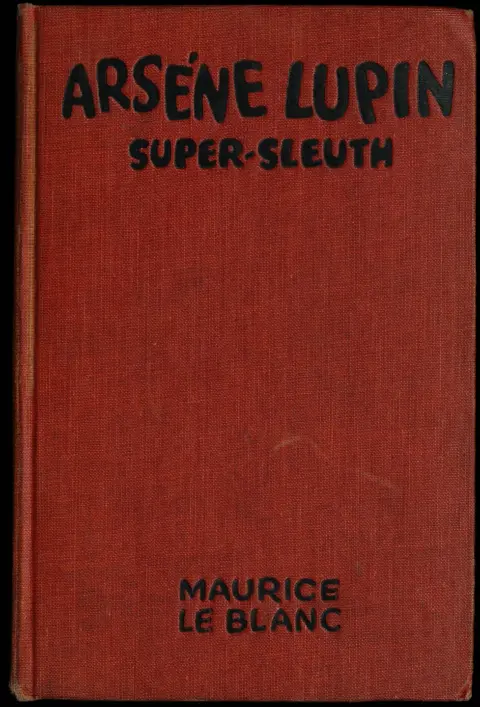
Arsène Lupin, super-sleuth
Maurice Leblanc
THE CLASSIC COLLECTION · 1910
"813" by Maurice Leblanc is a suspenseful detective novel written in the early 20th century. The story revolves around the enigmatic character Arsène Lupin, a gentleman burglar, as he engages in a thrilling game of cat and mouse with the authorities after committing a series of crimes, including a shocking murder. The novel introduces readers to a high-stakes world of intrigue, where Kesselbach, a wealthy man, becomes embroiled in a plot that threatens not only his life but also his ambitions. The opening of "813" sets a tense atmosphere with Mr. Kesselbach discovering that someone has invaded his hotel suite while he was away. Anxious and paranoid, he discusses strange occurrences with his secretary, Chapman, pointing out the peculiarities in their situation. When the mysterious Arsène Lupin makes his dramatic entrance, the tension escalates to a confrontation filled with twists and a daring heist, leaving readers breathless and eager to uncover the secrets surrounding Kesselbach's wealth and ambitions, as well as Lupin's true motives.
Introduction adapted from the source catalogue; source summaries may be automatically generated.
Free to read · English · 109,524 words · No account needed
MAKE TIME FOR A GOOD BOOK
On by default. Untick to stop anonymous reading totals. Each page counts after 10 seconds in view. How this works.
Anonymous counting is on unless you have switched it off.
"Yes, do as I say, my dear count," echoed Lupin, recovering his powers of chaff. "You know the ropes so well . . . all you have to do is to pull those of the clock . . . in turns . . . one, two . . . capital! . . . That's how they used to wind it up in the old days."
The pendulum, in fact, was started; and they heard its regular ticking.
"Now the hands," said Lupin. "Set them at a little before twelve . . . Don't move . . . Let me . . ."
He rose and walked to the face of the clock, standing two feet away, at most, with his eyes fixed, with every nerve attentive.
The twelve strokes sounded, twelve heavy, deep strokes.
A long silence. Nothing happened. Nevertheless, the Emperor waited, as though he were sure that something was going to happen. And Waldemar did not move, stood with wide-open eyes.
Lupin, who had stooped over the clock-face, now drew himself up,
muttering:
"That's it . . . I have it. . . ."
He went back to his chair and commanded:
"Waldemar, set the hands at two minutes to twelve again. Oh, no, old chap, not backwards! The way the hands go! . . . Yes, I know, it will take rather long . . . but it can't be helped."
All the hours struck and the half hours, up to half-past eleven.
"Listen, Waldemar," said Lupin.
And he spoke seriously, without jesting, as though himself excited and
anxious:
"Listen, Waldemar. Do you see on the face of the clock a little round dot marking the first hour? That dot is loose, isn't it? Put the fore-finger of your left hand on it and press. Good. Do the same with your thumb on the dot marking the third hour. Good. With your right hand, push in the dot at the eighth hour. Good. Thank you. Go and sit down, my dear fellow."
The minute-hand shifted, moved to the twelfth dot and the clock struck
again.
Lupin was silent and very white. The twelve strokes rang out in the
silence.
At the twelfth stroke, there was a sound as of a spring being set free. The clock stopped dead. The pendulum ceased swinging.
And suddenly, the bronze ornament representing a ram's head, which crowned the dial, fell forwards, uncovering a sort of little recess cut out of the stone wall.
In this recess was a chased silver casket.
Lupin took it and carried it to the Emperor:
"Would Your Imperial Majesty be so good as to open it yourself? The letters which you instructed me to look for are inside."
The Emperor raised the lid and seemed greatly astonished.
The casket was empty.
The casket was empty.
Your reading position is saved on this browser. Take it to another device with a library code. Reading pages adapt to text, rather than matching a printed edition.
Maurice Leblanc
Maurice Leblanc
Maurice Leblanc

Maurice Leblanc
BEHIND THE BOOK
This eBook is for the use of anyone anywhere in the United States and most other parts of the world at no cost and with almost no restrictions whatsoever. You may copy it, give it away or re-use it under the terms of the Project Gutenberg License included with this eBook or online at www.gutenberg.org. If you are not located in the United States, you will have to check the laws of the country where you are located before using this eBook. Read the source licence.
The original source file, including credits and licence, is retained by this library. Request an original-format copy at no charge. Please include the book title and Project Gutenberg identifier #34758.
KEEP YOUR CURIOSITY GOING
Coulson Kernahan

Maurice Baring
Frances Wright
Cécile Tormay

Frederic Jesup Stimson

W. H. P. (William Henry Pope) Jarvis