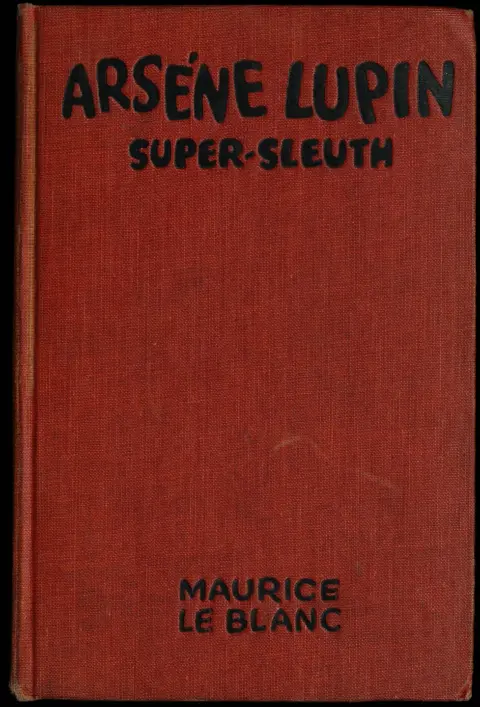
Arsène Lupin, super-sleuth
Maurice Leblanc
THE CLASSIC COLLECTION · 1910
"813" by Maurice Leblanc is a suspenseful detective novel written in the early 20th century. The story revolves around the enigmatic character Arsène Lupin, a gentleman burglar, as he engages in a thrilling game of cat and mouse with the authorities after committing a series of crimes, including a shocking murder. The novel introduces readers to a high-stakes world of intrigue, where Kesselbach, a wealthy man, becomes embroiled in a plot that threatens not only his life but also his ambitions. The opening of "813" sets a tense atmosphere with Mr. Kesselbach discovering that someone has invaded his hotel suite while he was away. Anxious and paranoid, he discusses strange occurrences with his secretary, Chapman, pointing out the peculiarities in their situation. When the mysterious Arsène Lupin makes his dramatic entrance, the tension escalates to a confrontation filled with twists and a daring heist, leaving readers breathless and eager to uncover the secrets surrounding Kesselbach's wealth and ambitions, as well as Lupin's true motives.
Introduction adapted from the source catalogue; source summaries may be automatically generated.
Free to read · English · 109,524 words · No account needed
MAKE TIME FOR A GOOD BOOK
On by default. Untick to stop anonymous reading totals. Each page counts after 10 seconds in view. How this works.
Anonymous counting is on unless you have switched it off.
"What time is it?"
"Twenty-five to ten."
He made a fresh effort; and it was evident that, in the midst of his torpor, his whole being was intent upon returning to life.
A clock struck ten.
He started and said:
"Let them carry me; let them carry me to the palace."
With the doctor's approval, Waldemar called his men and sent word to the Emperor. They laid Lupin on a stretcher and set out for the palace.
"The first floor," he muttered.
They carried him up.
"At the end of the corridor," he said. "The last room on the left."
They carried him to the last room, which was the twelfth, and gave him a chair, on which he sat down, exhausted.
The Emperor arrived: Lupin did not stir, sat looking, unconscious, with no expression in his eyes.
Then, in a few minutes, he seemed to wake, looked round him, at the walls, the ceilings, the people, and said:
"A narcotic, I suppose?"
"Yes," said the doctor.
"Have they found . . . the man?"
"No."
He seemed to be meditating and several times jerked his head with a thoughtful air: but they soon saw that he was asleep.
The Emperor went up to Waldemar:
"Order your car round."
"Oh? . . . But then, Sire . . . ?"
"Well, what? I am beginning to think that he is taking us in and that all this is merely play-acting, to gain time."
"Possibly . . . yes . . ." said Waldemar, agreeing.
"It's quite obvious! He is making the most of certain curious coincidences, but he knows nothing; and his story about gold coins and his narcotic are so many inventions! If we lend ourselves to his little game any longer, he'll slip out of your fingers. Your car, Waldemar."
The count gave his orders and returned. Lupin had not woke up. The Emperor, who was looking round the room, said to Waldemar:
"This is the Minerva room, is it not?"
"Yes, Sire."
"But then why is there an 'N' in two places?"
There were, in fact, two "N's," one over the chimneypiece, the other over an old dilapidated clock fitted into the wall and displaying a complicated set of works, with weights hanging lifeless at the end of their cords.
"The two 'N's' . . ." said Waldemar.
The Emperor did not listen to the answer. Lupin had moved again, opening his eyes and uttering indistinct syllables. He stood up, walked across the room and fell down from sheer weakness.
Then came the struggle, the desperate struggle of his brain, his nerves, his will against that hideous, paralyzing torpor, the struggle of a dying man against death, the struggle of life against extinction. And the sight was one of infinite sadness.
"He is suffering," muttered Waldemar.
Your reading position is saved on this browser. Take it to another device with a library code. Reading pages adapt to text, rather than matching a printed edition.
Maurice Leblanc
Maurice Leblanc
Maurice Leblanc

Maurice Leblanc
BEHIND THE BOOK
This eBook is for the use of anyone anywhere in the United States and most other parts of the world at no cost and with almost no restrictions whatsoever. You may copy it, give it away or re-use it under the terms of the Project Gutenberg License included with this eBook or online at www.gutenberg.org. If you are not located in the United States, you will have to check the laws of the country where you are located before using this eBook. Read the source licence.
The original source file, including credits and licence, is retained by this library. Request an original-format copy at no charge. Please include the book title and Project Gutenberg identifier #34758.
KEEP YOUR CURIOSITY GOING
Coulson Kernahan

Maurice Baring
Frances Wright
Cécile Tormay

Frederic Jesup Stimson

W. H. P. (William Henry Pope) Jarvis