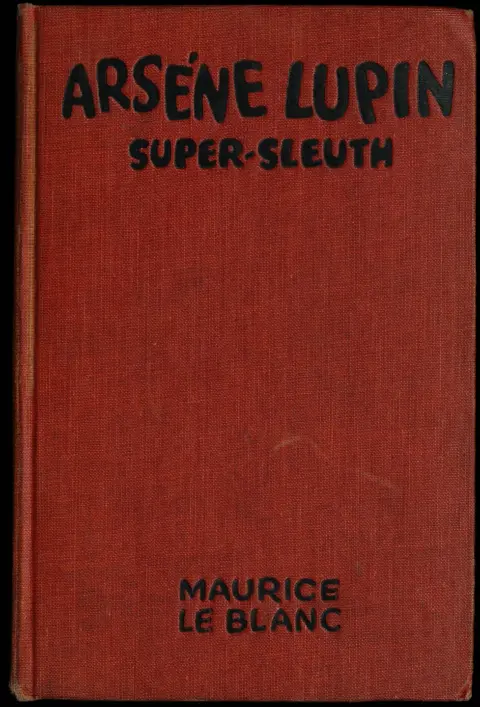
Arsène Lupin, super-sleuth
Maurice Leblanc
THE CLASSIC COLLECTION · 1910
"813" by Maurice Leblanc is a suspenseful detective novel written in the early 20th century. The story revolves around the enigmatic character Arsène Lupin, a gentleman burglar, as he engages in a thrilling game of cat and mouse with the authorities after committing a series of crimes, including a shocking murder. The novel introduces readers to a high-stakes world of intrigue, where Kesselbach, a wealthy man, becomes embroiled in a plot that threatens not only his life but also his ambitions. The opening of "813" sets a tense atmosphere with Mr. Kesselbach discovering that someone has invaded his hotel suite while he was away. Anxious and paranoid, he discusses strange occurrences with his secretary, Chapman, pointing out the peculiarities in their situation. When the mysterious Arsène Lupin makes his dramatic entrance, the tension escalates to a confrontation filled with twists and a daring heist, leaving readers breathless and eager to uncover the secrets surrounding Kesselbach's wealth and ambitions, as well as Lupin's true motives.
Introduction adapted from the source catalogue; source summaries may be automatically generated.
Free to read · English · 109,524 words · No account needed
MAKE TIME FOR A GOOD BOOK
On by default. Untick to stop anonymous reading totals. Each page counts after 10 seconds in view. How this works.
Anonymous counting is on unless you have switched it off.
Hope returned to him. He weighed his chances. They suddenly seemed to him real and formidable. The fact was going to happen as he had foreseen it happening and for the very reasons which he had expected. It was inevitable. . . .
Yes, inevitable. Unless, indeed, Shears discovered the hiding-place.
. . .
And again he thought of Shears; and again an immense sense of
discouragement overwhelmed him.
The last day. . . .
He woke late, after a night of bad dreams.
He saw nobody that day, neither the examining magistrate nor his
counsel.
The afternoon dragged along slowly and dismally, and the evening came, the murky evening of the cells. . . . He was in a fever. His heart beat in his chest like the clapper of a bell.
And the minutes passed, irretrievably. . . .
At nine o'clock, nothing. At ten o'clock, nothing.
With all his nerves tense as the string of a bow, he listened to the vague prison sounds, tried to catch through those inexorable walls all that might trickle in from the life outside.
Oh, how he would have liked to stay the march of time and to give
destiny a little more leisure!
But what was the good? Was everything not finished? . . .
"Oh," he cried, "I am going mad! If all this were only over . . . that would be better. I can begin again, differently. . . . I shall try something else . . . but I can't go on like this, I can't go on. . . ."
He held his head in his hands, pressing it with all his might, locking himself within himself and concentrating his whole mind upon one subject, as though he wished to provoke, as though he wished to create the formidable, stupefying, inadmissible event to which he had attached his independence and his fortune:
"It must happen," he muttered, "it must; and it must, not because I wish it, but because it is logical. And it shall happen . . . it shall happen. . . ."
He beat his skull with his fists; and delirious words rose to his lips.
. . .
The key grated in the lock. In his frenzy, he had not heard the sound of footsteps in the corridor; and now, suddenly, a ray of light penetrated into his cell and the door opened.
Three men entered.
Lupin had not a moment of surprise.
The unheard-of miracle was being worked; and this at once seemed to him natural and normal, in perfect agreement with truth and justice.
But a rush of pride flooded his whole being. At this minute he really received a clear sensation of his own strength and intelligence. . . .
"Shall I switch on the light?" asked one of the three men, in whom Lupin recognized the governor of the prison.
Your reading position is saved on this browser. Take it to another device with a library code. Reading pages adapt to text, rather than matching a printed edition.
Maurice Leblanc
Maurice Leblanc
Maurice Leblanc

Maurice Leblanc
BEHIND THE BOOK
This eBook is for the use of anyone anywhere in the United States and most other parts of the world at no cost and with almost no restrictions whatsoever. You may copy it, give it away or re-use it under the terms of the Project Gutenberg License included with this eBook or online at www.gutenberg.org. If you are not located in the United States, you will have to check the laws of the country where you are located before using this eBook. Read the source licence.
The original source file, including credits and licence, is retained by this library. Request an original-format copy at no charge. Please include the book title and Project Gutenberg identifier #34758.
KEEP YOUR CURIOSITY GOING
Coulson Kernahan

Maurice Baring
Frances Wright
Cécile Tormay

Frederic Jesup Stimson

W. H. P. (William Henry Pope) Jarvis