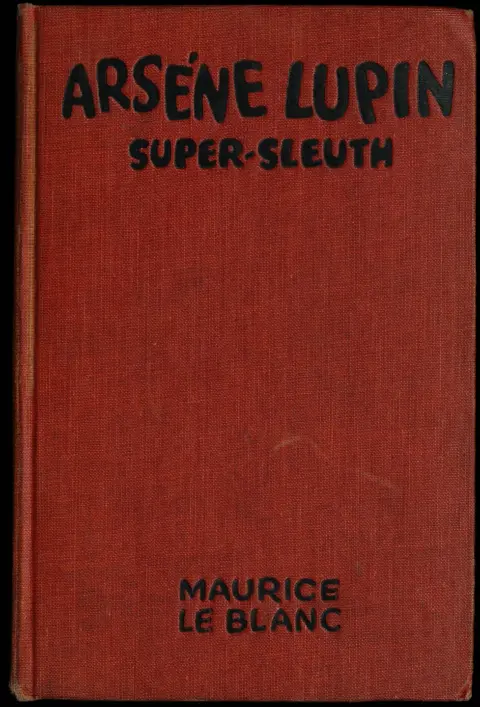
Arsène Lupin, super-sleuth
Maurice Leblanc
THE CLASSIC COLLECTION · 1910
"813" by Maurice Leblanc is a suspenseful detective novel written in the early 20th century. The story revolves around the enigmatic character Arsène Lupin, a gentleman burglar, as he engages in a thrilling game of cat and mouse with the authorities after committing a series of crimes, including a shocking murder. The novel introduces readers to a high-stakes world of intrigue, where Kesselbach, a wealthy man, becomes embroiled in a plot that threatens not only his life but also his ambitions. The opening of "813" sets a tense atmosphere with Mr. Kesselbach discovering that someone has invaded his hotel suite while he was away. Anxious and paranoid, he discusses strange occurrences with his secretary, Chapman, pointing out the peculiarities in their situation. When the mysterious Arsène Lupin makes his dramatic entrance, the tension escalates to a confrontation filled with twists and a daring heist, leaving readers breathless and eager to uncover the secrets surrounding Kesselbach's wealth and ambitions, as well as Lupin's true motives.
Introduction adapted from the source catalogue; source summaries may be automatically generated.
Free to read · English · 109,524 words · No account needed
MAKE TIME FOR A GOOD BOOK
On by default. Untick to stop anonymous reading totals. Each page counts after 10 seconds in view. How this works.
Anonymous counting is on unless you have switched it off.
There was one, for instance, which surpassed all the others in importance, and for which he had to employ all the resources of his genius. How was he to have a long, quiet conversation with old Steinweg? The necessity was immediate. In a few days, Steinweg would have recovered from his imprisonment, would receive interviews, might blab . . . to say nothing of the inevitable interference of the enemy, 'the other one.' And it was essential that Steinweg's secret, Pierre Leduc's secret, should be revealed to no one but Lupin. Once published, the secret lost all its value. . . .
The bolts grated, the key turned noisily in the lock.
"Ah, it's you, most excellent of jailers! Has the moment come for the last toilet? The hair-cut that precedes the great final cut of all?"
"Magistrate's examination," said the man, laconically.
Lupin walked through the corridors of the prison and was received by the municipal guards, who locked him into the prison-van.
He reached the Palais de Justice twenty minutes later. One of the
Doudevilles was waiting near the stairs. As they went up, he said to
Lupin:
"You'll be confronted to-day."
"Everything settled?"
"Yes."
"Weber?"
"Busy elsewhere."
Lupin walked into M. Formerie's room and at once recognized old Steinweg, sitting on a chair, looking ill and wretched. A municipal guard was standing behind him.
M. Formerie scrutinized the prisoner attentively, as though he hoped to draw important conclusions from his contemplation of him, and said:
"You know who this gentleman is?"
"Why, Steinweg, of course! . . ."
"Yes, thanks to the active inquiries of M. Weber and of his two officers, the brothers Doudeville, we have found Mr. Steinweg, who, according to you, knows the ins and outs of the Kesselbach case, the name of the murderer and all the rest of it."
"I congratulate you, Monsieur le Juge d'Instruction. Your examination
will go swimmingly."
"I think so. There is only one 'but': Mr. Steinweg refuses to reveal anything, except in your presence."
"Well, I never! How odd of him! Does Arsène Lupin inspire him with so much affection and esteem?"
"Not Arsène Lupin, but Prince Sernine, who, he says, saved his life, and M. Lenormand, with whom, he says, he began a conversation. . . ."
"At the time when I was chief of the detective-service," Lupin broke in. "So you consent to admit."
"Mr. Steinweg," said the magistrate, "do you recognize M. Lenormand?"
"No, but I know that Arsène Lupin and he are one."
"So you consent to speak?"
"Yes . . . but . . . we are not alone."
"How do you mean? There is only my clerk here . . . and the guard . . ."
Your reading position is saved on this browser. Take it to another device with a library code. Reading pages adapt to text, rather than matching a printed edition.
Maurice Leblanc
Maurice Leblanc
Maurice Leblanc

Maurice Leblanc
BEHIND THE BOOK
This eBook is for the use of anyone anywhere in the United States and most other parts of the world at no cost and with almost no restrictions whatsoever. You may copy it, give it away or re-use it under the terms of the Project Gutenberg License included with this eBook or online at www.gutenberg.org. If you are not located in the United States, you will have to check the laws of the country where you are located before using this eBook. Read the source licence.
The original source file, including credits and licence, is retained by this library. Request an original-format copy at no charge. Please include the book title and Project Gutenberg identifier #34758.
KEEP YOUR CURIOSITY GOING
Coulson Kernahan

Maurice Baring
Frances Wright
Cécile Tormay

Frederic Jesup Stimson

W. H. P. (William Henry Pope) Jarvis