THE CLASSIC COLLECTION✦A dead man’s diaryCLASSIC FREE BOOKS
A dead man’s diary
Coulson Kernahan
THE CLASSIC COLLECTION · 1888
"Little Helpers" by Margaret Vandegrift is a children’s novel written in the late 19th century. The story centers around a young boy named Johnny Leslie, who navigates the complexities of childhood independence, responsibility, and morality as he prepares to deliver a Fourth of July oration. Through his various adventures, including encounters with friends and lessons from his mother, the themes of inalienable rights and the importance of personal character begin to unfold. At the start of the tale, Johnny enthusiastically stands on a flour barrel, reciting his understanding of rights and freedom to a small audience that includes Tiny, a young girl, and his stuffed companion, Veronica. His mother's nurturing guidance leads him through discussions about rights, responsibilities, and the sometimes confusing nature of independence. The opening scenes set the stage for a humorous yet insightful exploration of Johnny's experiences, leading to mishaps such as a failed attempt at smoking and a bout of illness. This serves as the foundation for Johnny's growth, not just as a child, but as a thoughtful individual beginning to comprehend the nuances of moral choices and interpersonal relationships.
Introduction adapted from the source catalogue; source summaries may be automatically generated.
Free to read · English · 60,481 words · No account needed
MAKE TIME FOR A GOOD BOOK
On by default. Untick to stop anonymous reading totals. Each page counts after 10 seconds in view. How this works.
Anonymous counting is on unless you have switched it off.
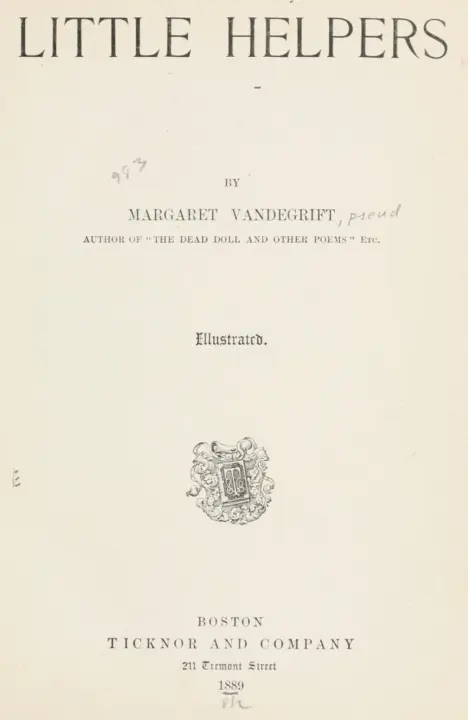
BY
MARGARET VANDEGRIFT
AUTHOR OF “THE DEAD DOLL AND OTHER POEMS” ETC.
Illustrated.
BOSTON
TICKNOR AND COMPANY
211 Tremont Street
1889
ELECTROTYPED BY
C. J. PETERS & SON, BOSTON,
U. S. A.
His name was Johnny Leslie, and he was standing on an empty flour barrel; in his hand was his United States History, and he was shouting at the top of his little voice,—
“All men are born free and equal, and endowed with certain
in-in-alienable rights, such as life, liberty, and the pursuit of
happiness.”
He stopped a minute to draw a long breath, and his audience, who was sitting in an easy position upon the upturned kitchen coal scuttle, with her oldest child in her arms, took the opportunity to ask meekly,—
“What does that dreadful long word mean, Johnny? I never heard of that kind of rights before.”
“You’ll know when you’re older, Tiny,” said Johnny, loftily, and he was going on with his oration, but the audience was not to be silenced in this easy manner, and persisted,—
“But I want to know right away, now! I don’t believe you know yourself,
Johnny Leslie!”
“Well, I don’t believe I do,” said Johnny, candidly, and in his own natural voice. “We might ask mamma, she’s up there at her window, I can see the back of her head. O mamma!”
There was no doubt about Mrs. Leslie’s hearing; if she had been in the top of the apple tree, at the foot of the garden, she could have heard that “O mamma!” perfectly well.
A pleasant face appeared where Johnny had seen the head, and a sweet
voice said, “O Johnny!”
“Mamma, what does in-a-li-en-able mean?” shouted the orator, still loudly enough for the top of the apple tree.
“I’ve the greatest mind in the world to drop my new ‘Webster’s Unabridged’ on your head, you wild Indian,” said Mrs. Leslie, holding the big dictionary threateningly, over the edge of the window-sill, and Johnny’s head. “Don’t you suppose I have any inalienable rights? And do you think I can even pursue my happiness, much less catch it, with all this hullaballoo under my window when I am trying to write a letter?”
“Well, mamma, Tiny and I would just as lief go to the barn,” replied Johnny, in a reasonable tone of voice, “if you’ll just please tell us first what that word means. You see, as Tiny’s asked me, maybe some of the boys might ask, and I ought to be able to tell them.”
Your reading position is saved on this browser. Take it to another device with a library code. Reading pages adapt to text, rather than matching a printed edition.
BEHIND THE BOOK
This eBook is for the use of anyone anywhere in the United States and most other parts of the world at no cost and with almost no restrictions whatsoever. You may copy it, give it away or re-use it under the terms of the Project Gutenberg License included with this eBook or online at www.gutenberg.org. If you are not located in the United States, you will have to check the laws of the country where you are located before using this eBook. Read the source licence.
The original source file, including credits and licence, is retained by this library. Request an original-format copy at no charge. Please include the book title and Project Gutenberg identifier #63793.
KEEP YOUR CURIOSITY GOING
Coulson Kernahan

Maurice Baring
Frances Wright
Cécile Tormay

Frederic Jesup Stimson

W. H. P. (William Henry Pope) Jarvis