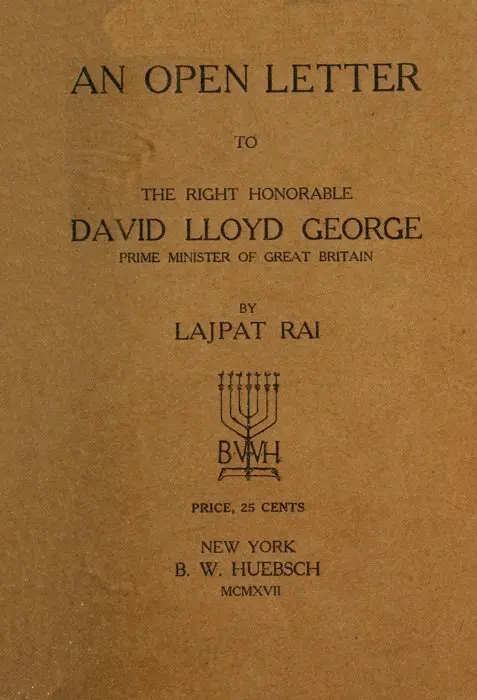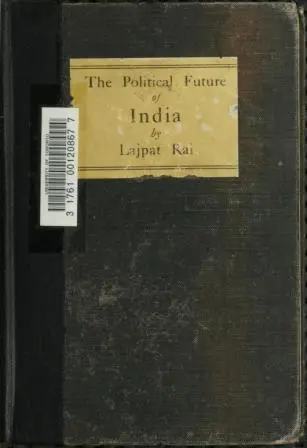
The Political Future of India
Lala Lajpat Rai
THE CLASSIC COLLECTION · 1916
"Young India" by Lala Lajpat Rai is a historical account written in the early 20th century. The book offers an interpretation and a detailed analysis of the nationalist movement in India during a time of significant political unrest under British rule. It aims to present the perspectives and aspirations of the Indian people in their pursuit of self-governance and freedom from colonial oppression. At the start of the book, the author provides a foreword that establishes his credentials as a prominent leader and advocate for Indian nationalism. Lajpat Rai expresses the deep-seated grievances of the Indian populace against British rule, highlighting the aspirations for self-government and the challenges faced by nationalist leaders. He emphasizes the necessity of understanding the Indian perspective, particularly in light of the misinformation propagated by foreign writers and the government. The foundation is set for a comprehensive exploration of the Indian Nationalist Movement, detailing the ongoing struggle for freedom, the political landscape, and the determination of the Indian people to achieve autonomy within the British Empire.
Introduction adapted from the source catalogue; source summaries may be automatically generated.
Free to read · English · 74,949 words · No account needed
MAKE TIME FOR A GOOD BOOK
On by default. Untick to stop anonymous reading totals. Each page counts after 10 seconds in view. How this works.
Anonymous counting is on unless you have switched it off.
“Constituting, as you do, a large body of the most highly educated Indians, you should, in the natural order of things, constitute also the most important source of all mental, moral, social, and political progress in India. Whether in the individual or the nation, all vital progress must spring from within, and it is to you, her most cultured and enlightened minds, her most favoured sons, that your country must look for the initiative. In vain may aliens, like myself, love India and her children, as well as the most loving of these; in vain may they, for her and their good, give time and trouble, money and thought; in vain may they struggle and sacrifice; they may assist with advice and suggestions; they may place their experience, abilities and knowledge at the disposal of the workers, but they lack the essential of nationality, and the real work must ever be done by the people of the country themselves.” “Scattered individuals, however capable and however well meaning, are powerless singly. What is needed is union, organisation and a well defined line of action; and to secure these an association is required, armed and organised with unusual care, having for its object to promote the mental, moral, social and political regeneration of the people of India. Our little army must be sui generis in discipline and equipment, and the question simply is, how many of you will prove to possess, in addition to your high scholastic attainments, the unselfishness, moral courage, self-control, and active spirit of benevolence which are essential in all who should enlist?”
Even truer and nobler are the sentiments in the final appeal which ended this letter and which runs thus:
“As I said before, you are the salt of the land. And if amongst even you, the élite, fifty men can not be found with sufficient power of self-sacrifice, sufficient love for and pride in their country, sufficient genuine and unselfish heartfelt patriotism to take the initiative, and if needs be, devote the rest of their lives to the cause, then there is no hope for India. Her sons must and will remain mere humble and helpless instruments in the hands of foreign rulers, for ‘they who would be free, themselves must strike the blow.’ And if even the leaders of thought are all either such poor creatures, or so selfishly wedded to personal concerns, that they dare not or will not strike a blow for their country’s sake, then justly and rightly are they kept down and trampled on, for they deserve nothing better. Every nation secures precisely as good a government as it merits. If you, the picked men, the most highly educated of the nation, can not, scorning personal ease and selfish ends, make a resolute struggle to secure freedom for yourselves and your country, a more impartial administration, a larger share in the management of your own affairs, then we, your friends, are wrong, and our adversaries right; then are Lord Ripon’s aspirations for your good, fruitless and visionary; then, at present, at any rate, all hopes of progress are at an end, and India truly neither lacks nor deserves any better government than she now enjoys. Only, if this be so, let us hear no more factious, peevish complaints that you are kept in leading strings, and treated like children, for you will have proved yourselves such. Men know how to act. Let there be no more complaints of Englishmen being preferred to you in all important offices, for if you lack that public spirit, that highest form of altruistic devotion that leads men to subordinate private ease to the public weal, that true patriotism that has made Englishmen what they are, then rightly are these preferred to you, and rightly and inevitably have they become your rulers. And rulers and taskmasters they must continue, let the yoke gall your shoulders ever so sorely, until you realise and stand prepared to act upon the eternal truth, whether in the case of individuals or nations, self-sacrifice and unselfishness are the only unfailing guides to freedom and happiness.”
Your reading position is saved on this browser. Take it to another device with a library code. Reading pages adapt to text, rather than matching a printed edition.
BEHIND THE BOOK
This eBook is for the use of anyone anywhere in the United States and most other parts of the world at no cost and with almost no restrictions whatsoever. You may copy it, give it away or re-use it under the terms of the Project Gutenberg License included with this eBook or online at www.gutenberg.org. If you are not located in the United States, you will have to check the laws of the country where you are located before using this eBook. Read the source licence.
The original source file, including credits and licence, is retained by this library. Request an original-format copy at no charge. Please include the book title and Project Gutenberg identifier #49329.
KEEP YOUR CURIOSITY GOING
Cécile Tormay

Moritz Busch
John L. Ransom
Frances Wright
Cécile Tormay

Mabel Potter Daggett