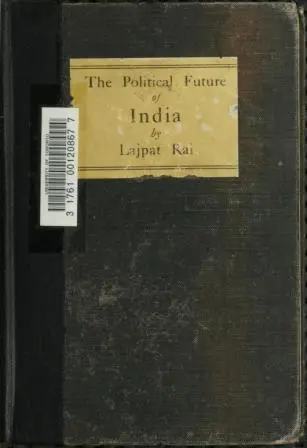
The Political Future of India
Lala Lajpat Rai
THE CLASSIC COLLECTION · 1916
"Young India" by Lala Lajpat Rai is a historical account written in the early 20th century. The book offers an interpretation and a detailed analysis of the nationalist movement in India during a time of significant political unrest under British rule. It aims to present the perspectives and aspirations of the Indian people in their pursuit of self-governance and freedom from colonial oppression. At the start of the book, the author provides a foreword that establishes his credentials as a prominent leader and advocate for Indian nationalism. Lajpat Rai expresses the deep-seated grievances of the Indian populace against British rule, highlighting the aspirations for self-government and the challenges faced by nationalist leaders. He emphasizes the necessity of understanding the Indian perspective, particularly in light of the misinformation propagated by foreign writers and the government. The foundation is set for a comprehensive exploration of the Indian Nationalist Movement, detailing the ongoing struggle for freedom, the political landscape, and the determination of the Indian people to achieve autonomy within the British Empire.
Introduction adapted from the source catalogue; source summaries may be automatically generated.
Free to read · English · 74,949 words · No account needed
MAKE TIME FOR A GOOD BOOK
On by default. Untick to stop anonymous reading totals. Each page counts after 10 seconds in view. How this works.
Anonymous counting is on unless you have switched it off.
“It is related that, in the absence of tangible enemies, some of our soldiery, who turned out on this occasion, butchered a number of unoffending camp-followers, servants, and others who were huddling together in vague alarm, near the Christian church-yard. No loyalty, no fidelity, no patient good service on the part of these good people could extinguish, for a moment, the fierce hatred which possessed our white soldiers against all who wore the dusky livery of the East.”--Kaye and Malleson’s Indian Mutiny, vol. II, p. 438.
[49] It should be noted that this visit took place during the present war and the observations recorded above were penned after the “unique” outburst of loyalty on the part of the Indians in connection with the Great War.
[50] A native term equivalent for Europeans.
[51] This is a native expression signifying the highest respect of the speaker towards one whom he considers his superior. Literally it means mother and father.
[52] I. e., like the English.
[53] In the interests of Lancashire goods.
[54] Mr. Ilbert was the Law member of the Council of the Governor General and the bill came to be named after him.
[55] Mr. Hume was an ex-secretary-of the Government of India who had
retired from service.
[56] Sir William Wedderburn is also a retired member of the Government
of Bombay, India.
[57] Sir Auckland Colvin was the Lieutenant Governor of the then North Western Provinces (now the United Province of Agra and Oudh).
[58] The quotations from Hume are taken out of W. Wedderburn’s Allan Octavian Hume, the parts enclosed in parenthesis are Wedderburn’s.
[59] These compliments have been renewed of late. The Congress held at Madras in 1914 was attended by the British Governor of the Presidency.
[60] Mr. Hume’s biography by Sir William Wedderburn, p. 62.
[61] Mr. Hume’s biography by Sir W. W., p. 63.
[62] Biography, p. 63.
[63] Swadeshi means country-made, and Swaraj means self-government or
self-rule.
[64] The Congress session held at Surat in December, 1907, ended in a split preceded by a disorderly meeting.
[65] Presided over by the Honourable Mr. G. K. Gokhale, a member of
the Viceroy’s Council.
[66] Swadeshi means the cult of home industries, i.e., the use of the articles made in the country.
[67] An eminent Bengalee writer.
[68] Moreover the keynote of these organisations was association and co-operation with Government, and not independent self-assertion.
[69] These are signs of mourning in India.
[70] An eminent nobleman and landlord of Bengal.
[71] India made goods.
[72] Wholesale piece goods merchants belonging to Upper India are known in Calcutta by that name.
[73] A ruling chief in the Bombay Presidency.
[74] In my opinion there has never been any time in human history when religion and morals were successfully divorced from politics, either in Ancient India or anywhere else.
Your reading position is saved on this browser. Take it to another device with a library code. Reading pages adapt to text, rather than matching a printed edition.
BEHIND THE BOOK
This eBook is for the use of anyone anywhere in the United States and most other parts of the world at no cost and with almost no restrictions whatsoever. You may copy it, give it away or re-use it under the terms of the Project Gutenberg License included with this eBook or online at www.gutenberg.org. If you are not located in the United States, you will have to check the laws of the country where you are located before using this eBook. Read the source licence.
The original source file, including credits and licence, is retained by this library. Request an original-format copy at no charge. Please include the book title and Project Gutenberg identifier #49329.
KEEP YOUR CURIOSITY GOING
Cécile Tormay

Moritz Busch
John L. Ransom
Frances Wright
Cécile Tormay

Mabel Potter Daggett