
Neka, the boy conjuror
Edward Stratemeyer
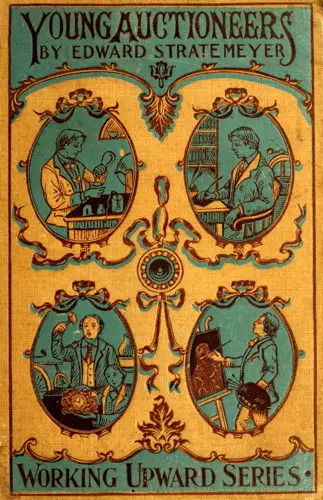
THE CLASSIC COLLECTION · 1897
"Youth Auctioneers; Or, The Polishing of a Rolling Stone" by Edward Stratemeyer is a juvenile fiction novel written in the late 19th century. The story revolves around Matt Lincoln, a homeless yet resourceful teenager who becomes involved with the world of auctioneering after a series of setbacks in his life, including the loss of family and financial stability. He forms a partnership with Andrew Dilks, a former assistant auctioneer, as they embark on an adventurous journey to sell goods and make a living on the road. At the start of the narrative, readers are introduced to Matt Lincoln attending an auction sale, where he witnesses an unfair accusation against a young lady named Ida Bartlett. This sets the stage for Matt's character as someone who stands up for what is right. Following the auction incident, Matt learns about the world of traveling auctioneers from Andrew Dilks, which sparks his interest in joining this business. The opening chapters delve into Matt's past, his determination to pursue a more promising future, and the challenges he faces as he attempts to carve out a place for himself in an unfamiliar profession. The action quickly escalates, including a dramatic encounter at the auction house and a fire at the stable, demonstrating Matt's courage and adaptability as he prepares to hit the road with his new partner.
Introduction adapted from the source catalogue; source summaries may be automatically generated.
Free to read · English · 59,347 words · No account needed
MAKE TIME FOR A GOOD BOOK
On by default. Untick to stop anonymous reading totals. Each page counts after 10 seconds in view. How this works.
Anonymous counting is on unless you have switched it off.
"Now, ladies and gentlemen, what am I offered for this elegant vase, imported direct from Italy, a most marvelous piece of workmanship, worth every cent of twenty-five dollars? Who will start it at five dollars? Start it at four? Start it at three? At two? At one dollar? What is that--fifty cents? Rather low, lady, but as I said before, these goods must be sold, regardless of the prices obtained. Fifty cents, it is! Fifty--fifty! Who will make it one dollar?"
"Sixty!"
"What, only sixty? Well, well, well! Never mind, the goods must go, and sixty cents is better than nothing. Sixty--sixty----"
"Seventy-five!"
"Eighty!"
"One dollar!"
"At last I am offered one dollar! Think of it! One dollar for a beautiful vase such as might well adorn the home of a Gould, or a Vanderbilt! But such is life. One dollar--one dollar----"
"One and a quarter!"
"One and a half!"
"One and a half is offered! Oh, what a shame, ladies and gentlemen; a paltry dollar and a half for an article worth, at the very lowest estimate, twenty-five dollars. Who makes it two dollars?"
"Two!"
"Two and a half!"
"Three!"
"Three and a quarter!"
"Three and a quar-- Ah, four dollars? Four dollars! Who says five? Going at four--at four--at four. Four and a half--four and a quarter--this is your last chance, remember. Did you say five, sir? No? Well, four it is, then. Going--going--the last chance, ladies and gentlemen! Going--going--gone, to the lady in the brown dress, Andrew, for four dollars!"
The scene was a small store on Nassau street near Fulton street, in New York City. Outside of the open doorway hung a red flag, indicative of an auction sale. The single window of the place was crowded with vases, imitation marble statues, plated tableware, and gorgeous lamps of highly-polished metal.
Among these articles was a sign in black letters on white cardboard
bearing these words:
ROYAL CONSIGNMENT AUCTION CO.,
Sales Daily from 10 A.M. to 3 P.M.
Inside, toward the rear, there was a small raised platform, and upon this stood the auctioneer, a tall, thin-faced man, with sharp black eyes, and rather a squeaky voice. To one side was his assistant, a much younger and much more pleasant-looking individual, who wrapped up the articles sold and collected for them.
It was between twelve and one o'clock in the day, and the auction store was crowded with business people, who, during their lunch-time, had dropped in to see what was going on, and, possibly, make a purchase. There were middle-aged business men, young clerks, and several young ladies, and all appeared interested in the mild excitement attending the disposal of the goods.
Your reading position is saved on this browser. Take it to another device with a library code. Reading pages adapt to text, rather than matching a printed edition.
Edward Stratemeyer

Edward Stratemeyer
Edward Stratemeyer

Edward Stratemeyer
BEHIND THE BOOK
This eBook is for the use of anyone anywhere in the United States and most other parts of the world at no cost and with almost no restrictions whatsoever. You may copy it, give it away or re-use it under the terms of the Project Gutenberg License included with this eBook or online at www.gutenberg.org. If you are not located in the United States, you will have to check the laws of the country where you are located before using this eBook. Read the source licence.
The original source file, including credits and licence, is retained by this library. Request an original-format copy at no charge. Please include the book title and Project Gutenberg identifier #31140.
KEEP YOUR CURIOSITY GOING
Coulson Kernahan

Maurice Baring
Frances Wright
Cécile Tormay

Frederic Jesup Stimson

W. H. P. (William Henry Pope) Jarvis