THE CLASSIC COLLECTION✦Stray Thoughts for GirlsCLASSIC FREE BOOKS
Stray Thoughts for Girls
Lucy Helen Muriel Soulsby
THE CLASSIC COLLECTION · 1898
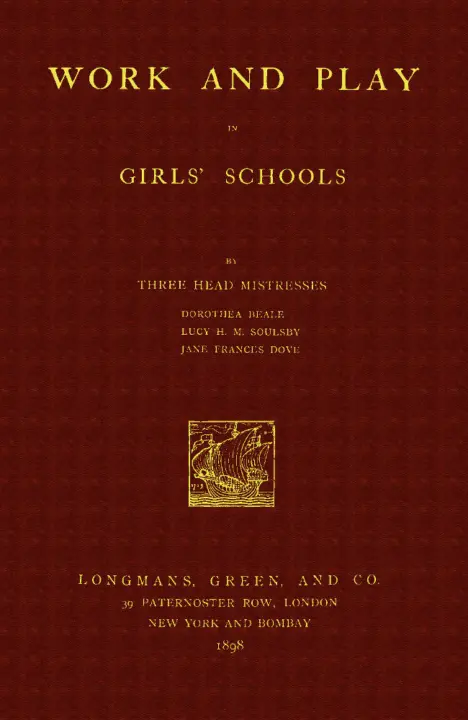
"Work and Play in Girls' Schools" by Dorothea Beale, Lucy H. M. Soulsby, and Jane Frances Dove is a practical manual for educators, written in the late 19th century. The book is constructed as a guide aimed primarily at teachers within girls' secondary schools, focusing on instructional methods, the organization of curricula, and the significance of school life in the holistic development of young women. The text likely addresses the themes of educational reform, emphasizing the importance of character development and intellectual growth during formative years. The opening of the book features a preface by Dorothea Beale, which outlines the intent to provide practical educational guidance while highlighting a collaborative effort between the contributors, all of whom have ties to the Cheltenham Ladies' College. Beale stresses the importance of intellectual and moral education, noting changes in educational ideals for girls over recent decades, as well as the necessity for teachers to continually evolve and adapt their strategies. The preface sets the stage for a structured discussion on various educational subjects, aiming to create a harmonious learning environment that respects the unique needs and potentials of female students.
Introduction adapted from the source catalogue; source summaries may be automatically generated.
Free to read · English · 115,666 words · No account needed
MAKE TIME FOR A GOOD BOOK
On by default. Untick to stop anonymous reading totals. Each page counts after 10 seconds in view. How this works.
Anonymous counting is on unless you have switched it off.
By DOROTHEA BEALE.
Multiplication is vexation,
Division is as bad,
The Rule of Three doth puzzle me,
And Practice drives me mad.
Never will such lines express the feelings of properly taught children.
It may be convenient to work out the process of teaching arithmetic on strictly psychological principles.
[Concrete teaching first.]
(1) From the concrete to the abstract. Let the children learn to count
with the actual things.
Once the teacher would have set the child down to a slate, taught it to count, and write down the figures, and work sums in addition and subtraction, and then to learn the multiplication table. Now the child has actual things--stones, coloured beads, sticks, bricks--anything but marbles (which one of H.M. Inspectors recommends) or things which run about freely. A box of china buttons, which cost only a few pence the gross, is perhaps best.
(2) Associate doing and knowing. Let the child add actual things: Mary has 3 buttons, Anna gives her 2, she now has 5.
(3) Put thoughts into words. Get the child to say exactly what addition is--“giving to”--and let her find out from words she already knows or may know, as donation, donor, etc., the meaning. The sign + for addition may also be given.
Similarly, subtraction ought to be actually performed by drawing away, and the word explained--its connection with drag, traction, tray, dray, etc. Thus the common fault of writing “substraction” may be avoided. It should be thought of as undoing addition. The signs - and = may now be given.
[Analysis of numbers.]
(4) We learn by analysis and synthesis, i.e., to see the parts in the whole, and the whole as made up of parts. It is very useful at this stage to get children to group numbers, to think of 2, e.g., as 1 + 1, of 3 as 1 + 1 + 1 and 1 + 2, of 8 as 1 + 7, 2 + 6, 3 + 5, 4 + 4, 2 + 2 + 2 + 2. This is much insisted on in Germany and America. In kindergartens there are many pictures which are used for grouping numbers, thus, e.g., a seven-branched candlestick.
We may give 7, as 3 + 1 + 3, as 1 + 2 + 2 + 2, as 1 + 6. This makes numbers, so to speak, easily fall into their constituents, which will be shown to be of use later. I knew a child who habitually thought of the written figures as picturing the number. Children might arrange the 9 digits in various ways, thus, giving also the written figures:--
· ·· ··· ···· ····· ······ ······· 1 2 3 4 5 6 7 ·+· ·+·· ·+··· ·+···· ·+····· ·+······ 1+1 1+2 1+3 1+4 1+5 1+6 2+2 2+3 2+4 2+5 etc.
At this stage the question would naturally arise why there are only 9 figures, and an historical digression could be conveniently made. I give a sketch of such a lesson before coming to more difficult and abstract things.
[Historical methods.]
Your reading position is saved on this browser. Take it to another device with a library code. Reading pages adapt to text, rather than matching a printed edition.
Lucy Helen Muriel Soulsby
BEHIND THE BOOK
This eBook is for the use of anyone anywhere in the United States and most other parts of the world at no cost and with almost no restrictions whatsoever. You may copy it, give it away or re-use it under the terms of the Project Gutenberg License included with this eBook or online at www.gutenberg.org. If you are not located in the United States, you will have to check the laws of the country where you are located before using this eBook. Read the source licence.
The original source file, including credits and licence, is retained by this library. Request an original-format copy at no charge. Please include the book title and Project Gutenberg identifier #65635.
KEEP YOUR CURIOSITY GOING

Charles G. (Charles Griffith) Ross
Hannah Webster Foster

Emily Lawless
Edwin Hamlin Carr

Charles De Lano Hine
Andrew Ure