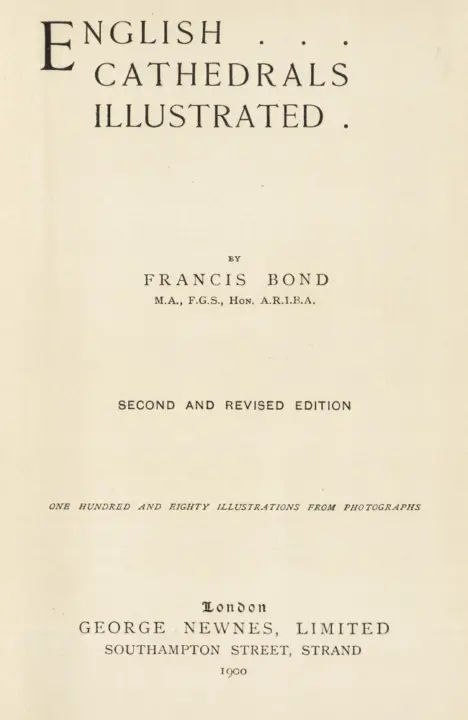
English Cathedrals Illustrated Second and Revised Edition
Francis Bond
THE CLASSIC COLLECTION · 1910
"Wood Carvings in English Churches" by Francis Bond is a historical account written in the early 20th century. The book explores the art of wood carving in English churches, focusing specifically on stalls, tabernacle work, bishops' thrones, and chancel chairs from the medieval period to the Renaissance. It aims to highlight the significance and beauty of these often-overlooked examples of ecclesiastical craftsmanship, offering insights into their design, construction, and historical context. At the start of the book, the author provides a preamble stressing the value of stallwork in English churches, noting its rarity compared to similar works in other countries, many of which have been lost to neglect or destruction. Bond describes the architectural and artistic features of stalls used by monks and canons during services, detailing their intricate design elements such as canopies, supports, and ornamentation. He aims not only to inform readers about the significance of these wood carvings but also to inspire pride in England's rich artistic heritage.
Introduction adapted from the source catalogue; source summaries may be automatically generated.
Free to read · English · 30,464 words · No account needed
MAKE TIME FOR A GOOD BOOK
On by default. Untick to stop anonymous reading totals. Each page counts after 10 seconds in view. How this works.
Anonymous counting is on unless you have switched it off.
[39] See also the illustration of the chair made c. 1545 for Dorothy
Mainwaring, page 123.
[40] See Willis and Clark, i. 516-522.
[41] Gotch's Early English Renaissance, 29, 254.
[42] Annales Caermoclenses, by James Stockdale; Ulverston, 1872, p. 76.
[43] Early Renaissance Architecture in England, 38.
[44] Annals of St Paul's, 447.
[45] Measured drawings of the stalls of St Paul's by Mr C. W. Baker appeared in the Building News, 1891, pages 108 and 358.
[46] The Renaissance woodwork ousted from Worcester cathedral by Sir Gilbert Scott found a resting-place in the church of Sutton Coldfield (R. A. D.).
[47] Willis' Canterbury Cathedral, 107.
[48] These are illustrated in Archæologia Cantiana, vol. xiii.
[49] York Fabric Rolls, 35, 248.
[50] Canon Savage's pamphlet, 369.
[51] Cutts' Parish Priests, 466.
[52] Gasquet's Parish Life in Mediæval England, 96.
[53] Gasquet, Parish Life in Mediæval England, 45.
[54] It is of course possible that both Alan de Alnewyk and Robert Constable sat in the chancel in surplice either as a member of a gild or of the choir.
[55] This, however, may have been for one of the choirmen or choristers.
[56] Reproduced in Gasquet, ibid., 47, from Didron.
[57] Wordsworth's Salisbury Ceremonies and Processions, 20.
[58] Inhibitions of Archbishop William of York in 1308 and 1312 in Rev. Dr Fowler's Memorials of Ripon Minster, Surtees Society, vol. 78.
[59] "South chancel" may mean "the chapel south of the chancel."
[60] Admirably edited by Mr Littlehales for the Early English Text Society;
vols. 20 and 24.
[61] At Hambleton (98) the chancel was remodelled, and the simple desks with linen pattern may be of that date. But the seats behind were never more than rough movable benches.--G. H. P.
[62] R. H. Murray on Ancient Church Fittings, 12.
[63] Mr T. Graham Jackson's Dalmatia: iii. 319, 427, 105: i. 272 and ii.
123.
[64] Stewart in Archæological Journal, xxxii. 18.
[65] Jones and Freeman's St David's, 90-93.
[66] Padre Garrucci in Proceedings of Society of Antiquaries, iv. 40, and illustrations in Vetusta Monumenta, vol. vi. The perspective sketch is by Carlo Fontana and is in the Royal Library at Windsor; the measured drawing is by Signor S. A. Scardonelli, and was made in 1784.
[67] Measured drawings of the Hereford chair by Mr W. H. Brierley appeared in the British Architect, xxiii. 114.
[68] Described by Dr Cox in English Church Furniture, p. 250.
[69] Shaw's Ancient Furniture, 31.
[70] Wiltshire Archæological Society's Magazine, vi. 147-149, quoted in English Church Furniture, 253.
[71] Archæologia Æliana, xvii. 47, and Proceedings of the Society of Antiquaries, xvii. 238. There are four similar chairs at Kilpeck.
[72] For descriptions and illustrations see Mr J. Hunter's "Edward the First's Spoliations in Scotland, A.D. 1296" in Arch. Journal, vol. xiii.; Mr W. Burges' paper in "Gleanings from Westminster Abbey," p. 121; and Mr Lethaby's Westminster, pp. 18, 265, 297.
[73] Henry Shaw's Ancient Furniture, Plate VI.
[74] Illustrated in Hone's Year Book, 143.
[75] Rev. Arthur Helps from Country Life, 12th March 1910.
[76] Communicated by Rev. R. M. Serjeantson
Your reading position is saved on this browser. Take it to another device with a library code. Reading pages adapt to text, rather than matching a printed edition.
BEHIND THE BOOK
This eBook is for the use of anyone anywhere in the United States and most other parts of the world at no cost and with almost no restrictions whatsoever. You may copy it, give it away or re-use it under the terms of the Project Gutenberg License included with this eBook or online at www.gutenberg.org. If you are not located in the United States, you will have to check the laws of the country where you are located before using this eBook. Read the source licence.
The original source file, including credits and licence, is retained by this library. Request an original-format copy at no charge. Please include the book title and Project Gutenberg identifier #43530.
KEEP YOUR CURIOSITY GOING
Cécile Tormay

Moritz Busch
John L. Ransom
Frances Wright
Cécile Tormay

Mabel Potter Daggett