Moving the Mountain
Charlotte Perkins Gilman
THE CLASSIC COLLECTION · 1898
"Women and Economics" by Charlotte Perkins Gilman is a book published in 1898. Gilman argues that women's economic dependence on men has stunted their development and harmed society. She challenges traditional notions of marriage, motherhood, and domestic life, proposing radical reforms like professionalizing housework and creating cooperative kitchens. Her central claim: women must achieve economic independence to transform themselves and improve civilization. The book became wildly popular, establishing Gilman as a leading voice in the women's movement virtually overnight.
Introduction adapted from the source catalogue; source summaries may be automatically generated.
Free to read · English · 78,963 words · No account needed
MAKE TIME FOR A GOOD BOOK
On by default. Untick to stop anonymous reading totals. Each page counts after 10 seconds in view. How this works.
Anonymous counting is on unless you have switched it off.
—— the cross-bred product of our, 332.
—— relation, permanence of, 301.
Married lovers economically apart, 219.
Marrow’s Food for infants, 196.
Mars, 192.
Martineau, Harriet, 53.
Martyrs, development of, 80.
Martyrs in proverb, 80.
—— men and women equal as, 147.
Masculine activity in obstetrics, 197.
Master, vices of the, 338.
Maternal duties, alleged requirements of, 19.
—— energy, the source of productive industry, 126.
—— instinct, unworthy of superstitious reverence, 194;
results of, 198.
—— passion a sex-distinction, 41.
—— sacrifice, as a means of benefiting the species, 191.
Maternalizing of man, 127.
Maternity. See Motherhood.
Matriolatry, 174, 176.
Measure of human motherhood, 190.
Men, progress of humanity accomplished by, 74.
—— forced by their needs to marriage, 300.
—— the better friendship of, 306.
—— the real players of games, 308.
Method of home life, is our present, the best?, 210.
Methods of motherhood, the old, 270.
Middle Ages, the serf in, 78.
—— tournament of, 111.
—— minds of, 161.
—— universities of, 285.
—— best social factor of, 326.
Milk, Pennywhistle’s Sterilized, 196.
“Mind, the female,” 149.
Minds of Greece, 161.
—— of the Middle Ages, 161.
Mingling on a human basis, 306.
Mining camp, New Englanders in a, 320.
Mischief-box, Pandora and the, 329.
Mistress, house, vs. house-servant, 211.
Mixed heredity, 330.
Mixture, English blood, an expression of fresh racial life, 147.
Modern examples of loyalty, 276.
Modification to motherhood, examples of, 19.
—— of woman to sex, 39.
—— to sex, instance of, 65.
Monarchism, passage from feudalism to, 206.
Moral development of humanity, the, 326.
—— impulse, woman a self-conscious centre of, 336.
—— progress, woman’s one-sided contribution to, 335.
—— sense, an exclusively social distinction, 319.
—— of woman, the large, 335.
Mother, economic status of, 16, 21.
—— working power of, 21.
—— instinct of, 175.
—— value of, 177.
—— duty of, 187.
—— criminal failure of, 197.
—— the new, 211.
—— and son, unnatural separation of, 268.
—— restricted sense of duty of, 277.
—— a bad baby-educator, 284.
—— as a social servant, 290.
—— her prerogative of nursing, 291.
—— our idea of the experienced, 293.
—— always an amateur, 293.
—— reasons for the inefficiency of the individual, 293.
—— result of servitude of, 334.
Mothers, lower, 180.
Motherhood not an exchangeable commodity, 15.
—— and economic production, 17.
—— alleged disabilities of, 18.
—— disadvantages of, 171.
—— deficiencies of human, 173.
—— a process of life, 178.
—— the pathology of human, 181.
—— educative, 183.
—— inefficient, 183.
—— standard of, 185.
—— in education, 185.
—— responsibilities of, 186.
—— improvement in, 186.
—— a right, 188.
—— and racial advance, 189.
—— idealism of, 189.
—— the measure of human, 190.
—— unpreparedness for, 192.
—— instinct and intelligence in, 195.
—— a responsible, 200.
—— facts as to human, 200.
—— training for, 202.
—— professions unsuitable to, 246.
—— old methods of, 270.
—— open to improvement, 271.
—— supplemented by education, 287.
—— false perspective taught by primitive, 289.
—— the truest, 290.
—— educative, a social function, 293.
—— organized, productive of a nobler world, 294.
Movement, the woman’s, 122, 139, 144, 146.
—— the labor, 138.
Natural institution, the feast a, 252.
—— selection, force of, 36.
—— the race developed by, 37.
Nature, woman’s place in (quot.), 171.
—— man’s dual, 332.
Necessities of the child, 301.
Need of each other, our growing, 305.
—— the social, 306.
Needs of the child, old and new, 271.
—— of individuals, further provision required for, 298.
—— men and women forced to marriage by their, 300.
Nerve, effect of constant impressions on a, 77.
New Englanders in mining camps, 320.
—— home, the, 314.
—— man, the, 316.
—— mother, the, 211.
—— social intercourse, the, 313.
Your reading position is saved on this browser. Take it to another device with a library code. Reading pages adapt to text, rather than matching a printed edition.
Charlotte Perkins Gilman
Charlotte Perkins Gilman
Charlotte Perkins Gilman
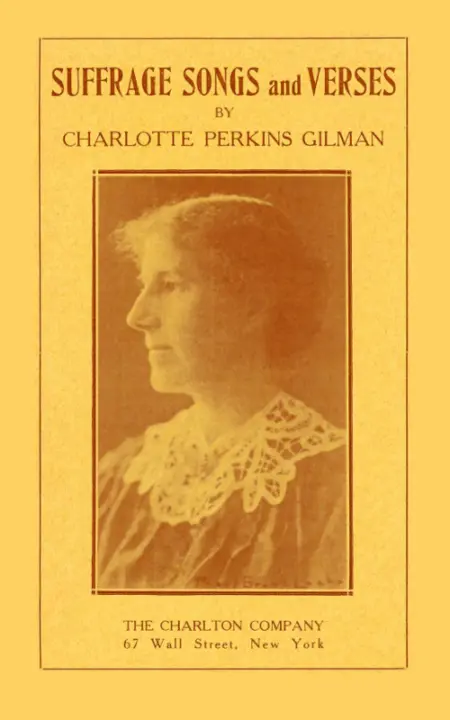
Charlotte Perkins Gilman
BEHIND THE BOOK
This eBook is for the use of anyone anywhere in the United States and most other parts of the world at no cost and with almost no restrictions whatsoever. You may copy it, give it away or re-use it under the terms of the Project Gutenberg License included with this eBook or online at www.gutenberg.org. If you are not located in the United States, you will have to check the laws of the country where you are located before using this eBook. Read the source licence.
The original source file, including credits and licence, is retained by this library. Request an original-format copy at no charge. Please include the book title and Project Gutenberg identifier #57913.
KEEP YOUR CURIOSITY GOING

Charles G. (Charles Griffith) Ross
Hannah Webster Foster

Emily Lawless
Edwin Hamlin Carr

Charles De Lano Hine
Andrew Ure