
Moving the Mountain
Charlotte Perkins Gilman

THE CLASSIC COLLECTION · 1898
"Women and Economics" by Charlotte Perkins Gilman is a book published in 1898. Gilman argues that women's economic dependence on men has stunted their development and harmed society. She challenges traditional notions of marriage, motherhood, and domestic life, proposing radical reforms like professionalizing housework and creating cooperative kitchens. Her central claim: women must achieve economic independence to transform themselves and improve civilization. The book became wildly popular, establishing Gilman as a leading voice in the women's movement virtually overnight.
Introduction adapted from the source catalogue; source summaries may be automatically generated.
Free to read · English · 78,963 words · No account needed
MAKE TIME FOR A GOOD BOOK
On by default. Untick to stop anonymous reading totals. Each page counts after 10 seconds in view. How this works.
Anonymous counting is on unless you have switched it off.
—— not always a true guide to conduct, 209.
—— maternal force of, 175.
—— efficacy of maternal, 194.
—— intelligence and, 195.
—— in feeding of children, 196.
—— results of maternal, 198.
Institution, chattel slavery a social, 78.
—— the feast a natural, 252.
Intelligence, instinct and, in motherhood, 195.
Intercourse, woman’s share in social, 295.
—— the true social, 302.
—— a wide individual, 303.
—— the new social, 313.
Interest, individual vs. social, 104–106.
—— community of, 114.
—— social, among women, 163.
Interests of cities, the larger social, 267.
Inter-human relations, our unsuccessful, 24.
Intruder, the servant an, 256.
Isolated individual profited by egoism, 325.
Jealousy of innovation in the home, 205.
Jellyby, Mrs., 163.
Jew, livelihood of, 4.
—— injustice of Christianity to the, 78.
Kindergarten, result of development of, 286.
King, loyalty to the, 275.
Kipling, Rudyard, 112.
—— quotation from, 112.
Kitchenless home, the, 267.
Knowledge, primitive notion of, 285.
Koran, the, 28.
Labor, division of, in housekeeping, 245.
—— movement, the, 138.
Lack of sex-value, failure to marry held a, 90.
Lady of Shalott, 87.
Lancelot, 87.
Large moral sense of woman, 335.
Law, a remarkable sociological, 80.
Laws, two, of brain action, 76.
Legitimate sex-competition, 113.
Life, the inevitable trend of, 73.
—— motherhood a process of, 178.
—— progress the duty of human, 207.
—— women entering on a more individual, 297.
Liking and custom in food, 250.
Limit to social progress, home a, 223.
Little Ellie, 87.
Living organisms, balance of power in, 59.
Lochinvar, 92.
Loneliness often a cause of insanity, 267.
Love, the course of true, 28.
—— the instinct of, 124.
—— the power of, 133.
—— the companionship of, 219.
—— the perfect, 300.
—— a necessary attraction, 325.
Lovers, married, economically apart, 219.
Lower animals, economic dependence among, 5, 6.
—— mothers, 180.
Loyalty, growth of the virtue of, 274.
—— the first principle of social existence, 274.
—— different phases of, 274.
—— to the father, 275.
—— to the king, 275.
—— modern examples of, 276.
—— to work, 276.
“Lynn, the Three Old Maids of,” 88.
Maid, the old, in proverb, 88.
“Maids, the Three Old, of Lynn,” 88.
Males, Nature’s experiments in, 130.
Mammalia, the order, resultant of primary sex-distinction, 35.
Mammalia, the habits of the order, 36.
Man the food supply of woman, 22.
—— the economic environment of woman, 38.
—— woman’s strongest modifying force, 38.
—— the choice of a young, 71.
—— “marriage makes a mouse of a,” 113.
—— the maternalizing of, 127.
—— a good family, 303.
—— the new, 316.
—— dual nature of, 332.
—— sovereignty of, due to accident of sex, 337.
—— young, in the city, 311.
—— visiting women, 311.
—— a new incentive for, 315.
Manhood, woman’s new estimate of true, 315.
Marriage, not a partnership, 10.
—— development of monogamous, 25, 95.
—— advantage of, to the race, 25.
—— moral qualities of, 25.
—— a lottery (quot.); 28.
—— attitude of a woman toward, 86.
—— of convenience, 92.
—— women to improve the race by, 92.
—— “makes a mouse of a man,” 113.
—— vs. collectivity, 115.
—— a sanctioned form of sex-union, 213.
—— and “the family,” 213.
—— vs. the family, 215.
—— development of, retarded by the family, 218.
—— increasing demand for true, 218.
—— not identical with home, 220.
—— bachelor apartments vs., 297.
—— human comfort not dependent on, 298.
—— without housekeeping, 299.
—— men and women forced by their needs to, 300.
—— value of the care of children to, 301.
—— social freedom before, 309.
—— social freedom after, 310.
—— friendship often destroyed by, 310.
Your reading position is saved on this browser. Take it to another device with a library code. Reading pages adapt to text, rather than matching a printed edition.
Charlotte Perkins Gilman

Charlotte Perkins Gilman

Charlotte Perkins Gilman
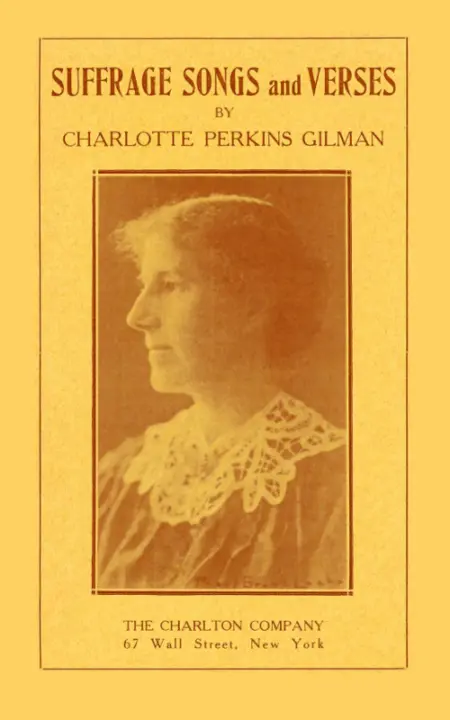
Charlotte Perkins Gilman
BEHIND THE BOOK
This eBook is for the use of anyone anywhere in the United States and most other parts of the world at no cost and with almost no restrictions whatsoever. You may copy it, give it away or re-use it under the terms of the Project Gutenberg License included with this eBook or online at www.gutenberg.org. If you are not located in the United States, you will have to check the laws of the country where you are located before using this eBook. Read the source licence.
The original source file, including credits and licence, is retained by this library. Request an original-format copy at no charge. Please include the book title and Project Gutenberg identifier #57913.
KEEP YOUR CURIOSITY GOING

Charles G. (Charles Griffith) Ross
Hannah Webster Foster

Emily Lawless
Edwin Hamlin Carr

Charles De Lano Hine
Andrew Ure