THE CLASSIC COLLECTION✦An outlaw’s diary: the CommuneCLASSIC FREE BOOKS
An outlaw’s diary: the Commune
Cécile Tormay
THE CLASSIC COLLECTION · 1900
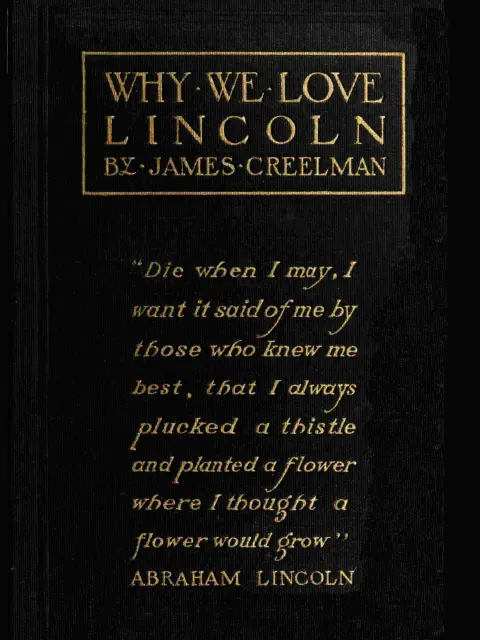
"Why We Love Lincoln" by James Creelman is a historical account written in the early 20th century. The book explores the profound admiration the American people hold for Abraham Lincoln, reflecting on his character, achievements, and the contexts of his life. It delves into the reasons behind the nation's enduring love for Lincoln, emphasizing his rise from humble beginnings to become a symbol of hope and integrity in American history. The opening of the work sets the stage for a vibrant celebration of Lincoln's legacy, particularly as the nation prepares to commemorate the centennial of his birth. It highlights Lincoln's unique ability to evoke deep affection, transcending mere political enthusiasm, contrasting him with other historical figures. The narrative introduces Lincoln's early life, from his impoverished upbringing and lack of formal education to his emergence as a self-taught, remarkably principled leader. This portrayal invites readers to reflect on Lincoln's character traits—simplicity, kindness, ambition, and justice—as key elements that resonate with the American spirit and contribute to the veneration of his memory.
Introduction adapted from the source catalogue; source summaries may be automatically generated.
Free to read · English · 25,697 words · No account needed
MAKE TIME FOR A GOOD BOOK
On by default. Untick to stop anonymous reading totals. Each page counts after 10 seconds in view. How this works.
Anonymous counting is on unless you have switched it off.
A month before the first vote for President was cast, Governor Gist, of South Carolina, addressed a secret circular to the other slave State governors saying, that if Lincoln were elected, which seemed almost certain, South Carolina would secede from the Union. The whole South was urged to join in this dismemberment of the republic.
The answers of the governors, even before the election had occurred, showed that it was not the intention of the slave States to submit to the rule of the majority, and that, already, armed resistance to the national authority was acceptable as the alternative to “the yoke of a black Republican President.”
If any secret voice of this germinating treason reached Lincoln at Springfield he kept it to himself.
But when his victory was assured by a majority that made the combined vote of his opponents seem insignificant, his continued silence in the midst of general rejoicing and boasting showed that he understood the gravity of the situation.
South Carolina withdrew from the Union, seizing custom houses, post
offices, arsenals and forts.
President Buchanan, old, weak and cowardly, promised to use no force against the rebels, but to leave everything to Congress. His Secretary of War, Mr. Floyd, of Virginia, was a traitor, secretly helping the slave States to arm against the general government. His Secretary of the Treasury, Mr. Cobb, of Georgia, also conspired with the disunionists, and finally resigned to take part in the rebellion. His Secretary of the Interior, Mr. Thompson, of Mississippi, actually acted as a rebel commissioner to spread the doctrine of secession while he was still in the Cabinet. The Assistant Secretary of State, Mr. Trescott, was another member of the great plot.
Within two months, Mississippi, Florida, Alabama, Georgia, Louisiana and Texas had followed South Carolina out of the Union. Forts, arsenals, post offices and custom houses were captured, the Stars and Stripes lowered, and the rebel flag hoisted.
Before Lincoln could be inaugurated, the seceded States had organized a Confederate government, with Jefferson Davis for President.
With treason in his Cabinet, and armed rebellion openly preached in Congress, the bewildered, rabbit-hearted Buchanan did nothing to defend the national sovereignty. He was no traitor--simply a poltroon, without character, convictions or courage enough to assert the plain powers of his office, and willing to shelter his cringing soul and dishonored responsibilities behind a paramount authority which he pretended to find in Congress.
Imagine Lincoln, sitting in far-away Springfield, helpless to act, while Buchanan permitted a foreign government to be set up within the United States, and promised to use no force against the rebels lest war might follow.
Your reading position is saved on this browser. Take it to another device with a library code. Reading pages adapt to text, rather than matching a printed edition.
BEHIND THE BOOK
This eBook is for the use of anyone anywhere in the United States and most other parts of the world at no cost and with almost no restrictions whatsoever. You may copy it, give it away or re-use it under the terms of the Project Gutenberg License included with this eBook or online at www.gutenberg.org. If you are not located in the United States, you will have to check the laws of the country where you are located before using this eBook. Read the source licence.
The original source file, including credits and licence, is retained by this library. Request an original-format copy at no charge. Please include the book title and Project Gutenberg identifier #65296.
KEEP YOUR CURIOSITY GOING
Cécile Tormay

Moritz Busch
John L. Ransom
Frances Wright
Cécile Tormay

Mabel Potter Daggett