THE CLASSIC COLLECTION✦Little Guzzy, and other storiesCLASSIC FREE BOOKS
Little Guzzy, and other stories
John Habberton
THE CLASSIC COLLECTION · 1881
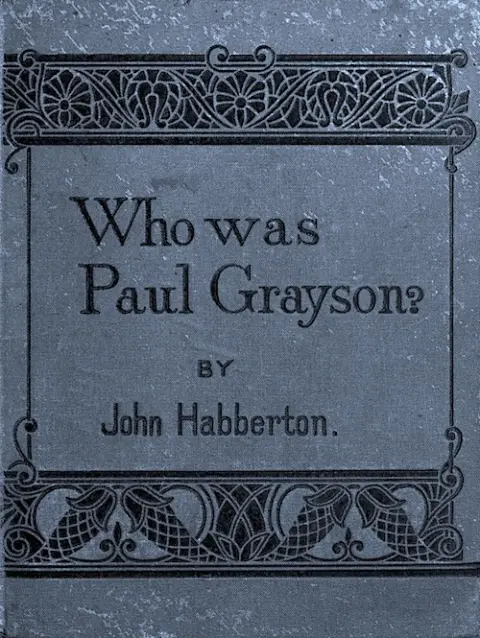
"Who Was Paul Grayson?" by John Habberton is a novel written in the late 19th century. The story unfolds around Paul Grayson, a new pupil at Mr. Morton’s Select School in the small village of Laketon, presenting themes of childhood curiosity, friendship, and the complexities of growing up. The narrative dives into the boys' perceptions, their speculation about Paul’s mysterious background, and the dynamics that develop in their interactions. At the start of the book, Paul Grayson arrives at the school, immediately capturing the attention and curiosity of his classmates, who are intrigued by his unfamiliarity and composure. As chatter among the boys unfolds about their new peer, they engage in playful speculation regarding his origins, wondering if he could be a foreign prince or an exceptional individual. Throughout the first chapter, Grayson navigates the social intricacies of school life, from making friends to dealing with envy and misunderstandings, all while the boys draw closer to unveiling the enigma of who he is. The introduction presents a rich foundation for themes of belonging and acceptance in youth, setting the stage for further developments in Grayson's character and story.
Introduction adapted from the source catalogue; source summaries may be automatically generated.
Free to read · English · 23,024 words · No account needed
MAKE TIME FOR A GOOD BOOK
On by default. Untick to stop anonymous reading totals. Each page counts after 10 seconds in view. How this works.
Anonymous counting is on unless you have switched it off.
“They first sew or tie them together with strings, and then they put pitch over the seams to make them water-tight.”
“Did you ever see the Indians race in birch canoes?” asked Sam.
“Oh yes, often,” Paul replied; “and they make fast time too, I can tell
you.”
“Did you ever race yourself?” asked Benny.
“No,” said Paul, “but I learned to paddle a canoe pretty well. I’d rather have a good row-boat, though, than any birch I ever saw. If you run one of them on a sharp stone, it may be cut open, unless it’s pretty new.”
“How do the Indians kill buffaloes?” asked Will Palmer.
“Why, just as white men do—they shoot them with rifles. Nearly all the Indians have rifles nowadays.”
This was very unromantic, most of the boys thought, for an Indian without bows and arrows could not be very different from a white man. Still, something wonderful would undoubtedly come before Paul was done talking.
“Are buffaloes really so terrible-looking as the story-papers say?”
asked Bert Sharp.
“Well, they don’t look exactly like pets,” said Paul. “A bull buffalo, in the winter season, when he has a full coat of hair, looks fiercer than a lion.”
“Do the Indians really kill or torture all the white people they catch?” asked Canning Forbes.
“I don’t know—I suppose so; but perhaps they’re not all as bad as some white people say.”
Canning shook his head encouragingly at Will Palmer: evidently this young Indian had a manly spirit, and was not going to have his people abused. There was a moment or two of silence, each boy wondering what next to ask. Finally, Napoleon Nott said,
“You’re a chief’s son, aren’t you?”
“What?” exclaimed Paul, so sharply that Notty dodged behind Will Palmer, and put his hand to his head as if to protect his scalp.
“I meant” said Notty, tremblingly—“I meant to ask what tribe you
belonged to.”
“I? What tribe? Notty, what are you talking about?”
Notty did not answer; so Paul looked around at the other boys, but they
also were silent.
“Notty,” said Paul, “what on earth are you thinking about? Do you imagine I’m an Indian?”
“I thought you were,” said Notty, very meekly; “and,” he continued, “so did all the other boys.”
“Well, that’s good,” said Paul, laughing heartily. “What made you think
so, fellows?”
“Benny told us,” explained Ned.
“Benny?” exclaimed Paul. “What put that fancy into your head?”
“I—I dreamed it,” said Benny, almost ready to cry for shame and
disappointment.
“And you told all the other boys?”
Your reading position is saved on this browser. Take it to another device with a library code. Reading pages adapt to text, rather than matching a printed edition.
John Habberton

John Habberton
John Habberton

John Habberton
BEHIND THE BOOK
This eBook is for the use of anyone anywhere in the United States and most other parts of the world at no cost and with almost no restrictions whatsoever. You may copy it, give it away or re-use it under the terms of the Project Gutenberg License included with this eBook or online at www.gutenberg.org. If you are not located in the United States, you will have to check the laws of the country where you are located before using this eBook. Read the source licence.
The original source file, including credits and licence, is retained by this library. Request an original-format copy at no charge. Please include the book title and Project Gutenberg identifier #52644.
KEEP YOUR CURIOSITY GOING
Coulson Kernahan

Maurice Baring
Frances Wright
Cécile Tormay

Frederic Jesup Stimson

W. H. P. (William Henry Pope) Jarvis