THE CLASSIC COLLECTION✦Little Guzzy, and other storiesCLASSIC FREE BOOKS
Little Guzzy, and other stories
John Habberton
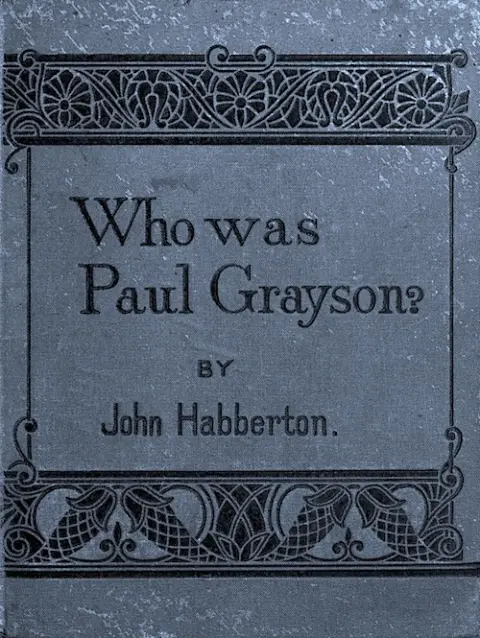
THE CLASSIC COLLECTION · 1881
"Who Was Paul Grayson?" by John Habberton is a novel written in the late 19th century. The story unfolds around Paul Grayson, a new pupil at Mr. Morton’s Select School in the small village of Laketon, presenting themes of childhood curiosity, friendship, and the complexities of growing up. The narrative dives into the boys' perceptions, their speculation about Paul’s mysterious background, and the dynamics that develop in their interactions. At the start of the book, Paul Grayson arrives at the school, immediately capturing the attention and curiosity of his classmates, who are intrigued by his unfamiliarity and composure. As chatter among the boys unfolds about their new peer, they engage in playful speculation regarding his origins, wondering if he could be a foreign prince or an exceptional individual. Throughout the first chapter, Grayson navigates the social intricacies of school life, from making friends to dealing with envy and misunderstandings, all while the boys draw closer to unveiling the enigma of who he is. The introduction presents a rich foundation for themes of belonging and acceptance in youth, setting the stage for further developments in Grayson's character and story.
Introduction adapted from the source catalogue; source summaries may be automatically generated.
Free to read · English · 23,024 words · No account needed
MAKE TIME FOR A GOOD BOOK
On by default. Untick to stop anonymous reading totals. Each page counts after 10 seconds in view. How this works.
Anonymous counting is on unless you have switched it off.
“I’m afraid you’ll have to ask some one else, then,” said Paul, with a laugh. “Try me on something easier.”
“Then how do you ride a wild horse without saddle or bridle?” asked
Benny.
“Worse and worse,” said Paul. “See here, Benny, have you been reading dime novels, and made up your mind to go West?”
“Not exactly,” said Benny; “but,” he continued, “I wouldn’t mind going West if I had some good safe fellow to go with—some one who has been there and knows all about it.”
“Well, I know enough about it to tell you to stay at home,” said Paul.
This was proof enough, thought Benny; so, although he was aching to ask Paul many other questions about Indian life, he hurried off to assure the other boys that it was all right—that Paul was an Indian, and no mistake. The consequence was that when Paul approached the school-house half of the boys advanced slowly to meet him, and then they clustered about him, and he became conscious of being looked at even more intently than on the day of his first appearance. He did not seem at all pleased by the attention; he looked rather angry, and then turned pale; finally he hurried upstairs into the school-room and whispered something to the teacher, at which Mr. Morton shook his head and patted Paul on the shoulder, after which the boy regained his ease and took his seat.
But at recess he again found himself the centre of a crowd, no member of which seemed to care to begin any sort of game. Paul stopped short, looked around him, frowned, and asked, “Boys, what is the matter with me?”
“Nothing,” replied Will Palmer.
“Then what are you all crowding around me for?”
No one answered for a moment, but finally Sam Wardwell said, “We want you to tell us stories.”
“Stories about Indians,” explained Ned Johnston.
Paul laughed. “You’re welcome to all I know,” said he; “but I don’t think they’re very interesting. Really, I can’t remember a single one that’s worth telling.”
This was very discouraging; but Canning Forbes, who was so smart that, although he was only fourteen years of age, he was studying mental philosophy, whispered to Will Palmer that people never saw anything interesting about their own daily lives.
“You can tell us something about birch canoes, can’t you?” asked Ned Johnston, by way of encouragement.
“Oh yes,” Paul replied; “they’re made out of bark, with hoops and strips of wood inside, to give them shape and make them strong.”
“How do they fasten up the ends?” asked Ned.
Your reading position is saved on this browser. Take it to another device with a library code. Reading pages adapt to text, rather than matching a printed edition.
John Habberton
John Habberton
John Habberton
John Habberton
BEHIND THE BOOK
This eBook is for the use of anyone anywhere in the United States and most other parts of the world at no cost and with almost no restrictions whatsoever. You may copy it, give it away or re-use it under the terms of the Project Gutenberg License included with this eBook or online at www.gutenberg.org. If you are not located in the United States, you will have to check the laws of the country where you are located before using this eBook. Read the source licence.
The original source file, including credits and licence, is retained by this library. Request an original-format copy at no charge. Please include the book title and Project Gutenberg identifier #52644.
KEEP YOUR CURIOSITY GOING
Coulson Kernahan

Maurice Baring
Frances Wright
Cécile Tormay

Frederic Jesup Stimson

W. H. P. (William Henry Pope) Jarvis