How Marcus Whitman Saved Oregon A True Romance of Patriotic Heroism Christian Devotion and Final Martyrdom
Oliver W. (Oliver Woodson) Nixon
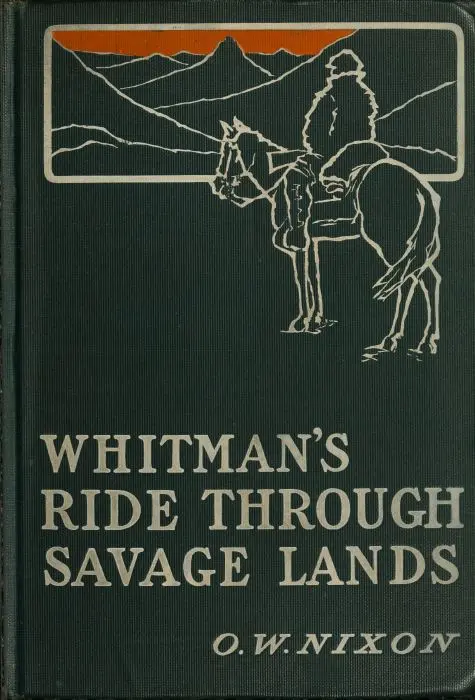
THE CLASSIC COLLECTION · 1905
"Whitman's Ride Through Savage Lands, with Sketches of Indian Life" by O. W. Nixon is a historical account written in the early 20th century. It chronicles the life and missions of Dr. Marcus Whitman, whose perilous journey through the wilderness played a significant role in the development of Oregon. The narrative intertwines real incidents from the lives of Whitman and the indigenous peoples, illuminating the broader themes of heroism, sacrifice, and cultural encounters at a pivotal time in American history. At the start of this work, the author sets the stage by discussing the significance of the Lewis and Clark expedition while introducing the context of Whitman’s later missions. The opening chapters paint a vivid picture of the American frontier landscape, showcasing Whitman’s determination to serve both the settlers and Indigenous communities. They describe the warmth of early interactions with Native tribes, the serious challenges faced by Whitman and his companions, and the fervent dedication to their cause rooted in spirituality and patriotism. The narrative captures both the hardships of travel and the explorers' reliance on cultural exchanges, notably illustrated through the story of Sacajawea, rendering a multifaceted view of the era.
Introduction adapted from the source catalogue; source summaries may be automatically generated.
Free to read · English · 40,853 words · No account needed
MAKE TIME FOR A GOOD BOOK
On by default. Untick to stop anonymous reading totals. Each page counts after 10 seconds in view. How this works.
Anonymous counting is on unless you have switched it off.
The Lewis and Clark Centenary Exposition in Portland. The Great
Captains. Their Guides, Hoe Noo Chee and Sacajawea (The
Bird-Woman).
A great Exposition of the arts and industries of the whole wide world is to be held this summer in the beautiful city of Portland, Oregon. It is to commemorate the grand achievement of a few brave men and one brave woman, who lived, labored, and conquered a century ago. At the call of their commander, they exiled themselves from home and friends; they crossed the wide deserts, climbed through gorges and peaks of the "great Stony Mountains," struggled through the pathless forests of giant firs, lived among wild beasts, and wilder men, until they reached the pathless Pacific Ocean--that was then but a waste of water, where great whales sported and the seals found abundance of food amid rocky shores and islands for safe homes. Now teeming multitudes inhabit the fertile plains; through the rugged mountains pass the great highways of the world--along the charted coast are many ports, where white-winged fleets lie at anchor and the great black freighters load and unload the commerce of many lands. But Portland still retains many of the old landmarks. The beautiful Columbia River still flows by it to the sea, forests are not far away, and "the everlasting hills" are about it, with their white-capped peaks piercing the sky.
A hundred years ago, a vast and unknown wilderness stretched from the Mississippi to the Pacific Ocean--it was a land of mystery of unknown extent. Millions of wild cattle that we call buffaloes roamed over its plains, wild beasts hid away in its mountain fastnesses, the beavers and otters built their homes along its rivers, and wild tribes of savage men made pitiless war upon each other, though not destitute of many noble traits of character. The young republic of United States had far more territory east of the Mississippi than they could manage or protect, so gave small care or thought to what lay beyond. But one thing they had learned, that, for their own safety from foreign aggression, and the protection of their commerce, they must gain possession and control of the great river. Thomas Jefferson, that wise and far-seeing statesman whose name and fame grow as the years go on, was President at that memorable time of great opportunities, and through his influence with Congress induced them to make the great Louisiana purchase, which gave to our government the Southern and Gulf states, the control of the Mississippi River, and, as Jefferson believed and claimed, the whole country to the Pacific Ocean. He had, perhaps, but little knowledge of its vastness or its value, but it has been said that his friend, the great naturalist Audubon, who wandered up and down the world searching out its wonders and beauties, had told him many things about the great western country. So he again appealed to Congress for an appropriation to send out an expedition to learn something of the nature and value of their new possessions. The pitiful sum of two thousand five hundred dollars was allowed. Captains Lewis and Clark of the United States army were selected to lead the expedition, and with them were sent a botanist, a geologist, an engineer, and some soldiers, who were required each to make a full report of their journey, which took three years to accomplish. It is significant of the indifference of the government in the matter that these reports were sent to Washington and were laid aside for several years when--through Jefferson's influence again--the captains' reports were handed over to Richard Biddle of Philadelphia, who made a brief abstract of them, constituting one small volume, that passed for many years as an account of the Lewis and Clark exploration, and it has not been until within the past three years that any genuine copy of these reports has ever been published. It is small wonder then that thirty years later Oregon remained an almost unknown and unclaimed country. The young captains and their company, full of enthusiasm for their work, made their preparations and purchased their supplies, mostly at their own expense, and left the last marks of civilization at St. Louis in the spring of 1804.
Your reading position is saved on this browser. Take it to another device with a library code. Reading pages adapt to text, rather than matching a printed edition.
Oliver W. (Oliver Woodson) Nixon
BEHIND THE BOOK
This eBook is for the use of anyone anywhere in the United States and most other parts of the world at no cost and with almost no restrictions whatsoever. You may copy it, give it away or re-use it under the terms of the Project Gutenberg License included with this eBook or online at www.gutenberg.org. If you are not located in the United States, you will have to check the laws of the country where you are located before using this eBook. Read the source licence.
The original source file, including credits and licence, is retained by this library. Request an original-format copy at no charge. Please include the book title and Project Gutenberg identifier #41942.
KEEP YOUR CURIOSITY GOING
Cécile Tormay

Moritz Busch
John L. Ransom
Frances Wright
Cécile Tormay

Mabel Potter Daggett