
The Writing of News A Handbook with Chapters on Newspaper Correspondence and Copy Reading
Charles G. (Charles Griffith) Ross
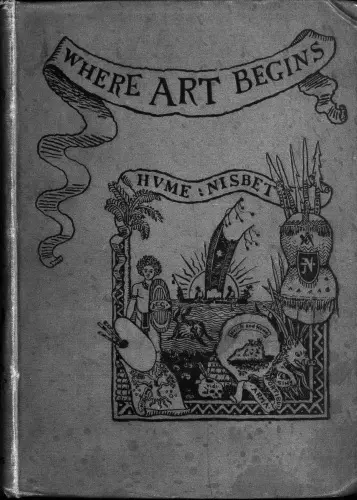
THE CLASSIC COLLECTION · 1892
"Where Art Begins" by Hume Nisbet is a treatise on the principles of art, specifically focusing on painting and photography, written in the late 19th century. The author shares insights from his experience as an artist and art teacher, discussing the relationship between practical techniques and the emotional resonance of art. Through a blend of theoretical reflections and practical guidance, the work aims to inspire both art students and enthusiasts to appreciate the profound influence of art on humanity and personal expression. The opening portion introduces Nisbet's contemplations on the nature and significance of art, framing it as a deeply emotional and universal experience that goes beyond mere aesthetics. He reflects on the journey of life through art, addressing its ingrained connection to human emotions and society. He articulates the transformative power of art in fostering charity and understanding. Additionally, he touches on the historical context of photography and painting, illustrating a personal narrative of his artistic development and early experiences with photography—a convergence point for technical skill and emotional expression.
Introduction adapted from the source catalogue; source summaries may be automatically generated.
Free to read · English · 93,334 words · No account needed
MAKE TIME FOR A GOOD BOOK
On by default. Untick to stop anonymous reading totals. Each page counts after 10 seconds in view. How this works.
Anonymous counting is on unless you have switched it off.
PRINTED BY
SPOTTISWOODE AND CO., NEW-STREET SQUARE
LONDON
[1] Only, not to the encouragement of lazy habits; at times (for the sake of practice) a painter ought to draw the most minute point-detail with the pencil, as a singer practises his scales; otherwise, for the object, the photo is most to be relied upon for truth in all, except in perspective.
[2] For an example of what I mean, see the effects in 'Choice Blends'
in 'The Idler'.
[3] See 'Specimen Days and Collects,' by Walt Whitman, page 306 of Collects. Want of room prevents me giving the specimen in full, and I dare not mutilate such a literary masterpiece.
[4] See 'Mary Queen of Scots,' by Bell--last scene.
[5] The snow scenes are exquisite, and one exhibited, of a camp fire with figures, a perfect triumph of misty refinement; the faces seen through the smoke particularly to be observed. I would also call the reader's attention to his cattle studies, and the printing done on rough hand-made paper--flat and like sepia and Indian-ink work, only far more refined than hand-work could be.
[6] Some days before the death of Millet, a stag was chased by hunters and dogs into a neighbour's garden and butchered before the dying man's gaze. 'I take it as an omen,' he said mournfully, and prepared for the earth-end.
[7] Esther i. 6.
[8] I have seen this picture since writing these remarks, but without changing my opinion concerning it.
[9] As a worker of broad effects, I lay myself open to be charged with bigotry when I condemn the pre-Raphaelites, and accept the risk.
[10] See Life and Nature Studies.
[11] I called attention to the marvellous medicinal virtues of this Eucalyptus-tree long before it was generally accepted by the Faculty. See 'Picturesque Australasia' and 'A Colonial Tramp,' &c.
[12] See 'A New Guinea Village,' p. 125.
[13] See Frontispiece: 'A New Zealand Fern Gully.'
[14] See also A Treatise on Wood Engraving, by Chatto & Jackson, p.
46.
[15] The same excuse applies to this present work.
[16] The numbers in this chapter are those of February 1892.
[17] George Paul Chalmers, an Edinburgh artist, is the only colourist who really followed Rembrandt in his method. He used sometimes to take sixty sittings to one portrait, and hardly ever finished any of his works, so fastidious was he; yet as far as he perfected he was very perfect as a colourist.
Typographical errors corrected by the etext transcriber:
thum-bhole=> thumb-hole {pg 68}
thes ame=> the same {pg 191}
Niccolo of Fuligno;=> by Niccolo of Fuligno; {pg 247}
No. 35, Titian; 'Mercury=> No. 35, by Titian; 'Mercury {pg 247}
Savage art, 102, 214-1=> Savage art, 102, 214-7 {pg index}
Your reading position is saved on this browser. Take it to another device with a library code. Reading pages adapt to text, rather than matching a printed edition.
BEHIND THE BOOK
This eBook is for the use of anyone anywhere in the United States and most other parts of the world at no cost and with almost no restrictions whatsoever. You may copy it, give it away or re-use it under the terms of the Project Gutenberg License included with this eBook or online at www.gutenberg.org. If you are not located in the United States, you will have to check the laws of the country where you are located before using this eBook. Read the source licence.
The original source file, including credits and licence, is retained by this library. Request an original-format copy at no charge. Please include the book title and Project Gutenberg identifier #45504.
KEEP YOUR CURIOSITY GOING
Charles G. (Charles Griffith) Ross
Hannah Webster Foster

Emily Lawless
Edwin Hamlin Carr

Charles De Lano Hine
Andrew Ure