THE CLASSIC COLLECTION✦Building the pacific railwayCLASSIC FREE BOOKS
Building the pacific railway
Edwin L. (Edwin Legrand) Sabin
THE CLASSIC COLLECTION · 1905
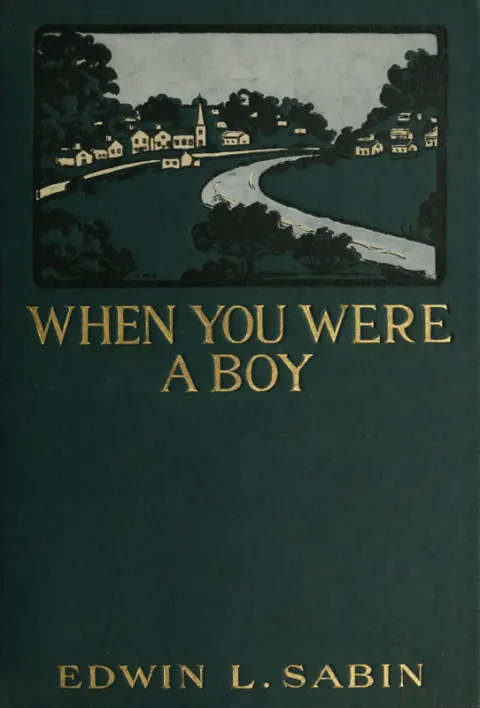
"When You Were a Boy" by Edwin L. Sabin is a nostalgic children's narrative written in the early 20th century. The text is likely a novel or a collection of intertwined stories centered around the experiences of boys during childhood, exploring themes of innocence, adventure, and the simplicity of pastimes like baseball and the circus. The main character, addressed as "you," engages with a cast of friends, including relatable figures such as Fat Day, Hen Schmidt, and Billy Lunt, who embody the essence of youthful camaraderie and imaginative play. The opening portion of the work introduces the reader to a lively scene where the main character joins friends in forming a baseball team, the North Stars. The camaraderie is palpable as they organize their lineup, discuss their uniforms, and anticipate an upcoming match against the Second-street kids. The sense of competition, childhood rivalry, and the spirit of playfulness is highlighted as the boys navigate the trials of their baseball game, culminating in moments filled with excitement and disappointment. The narrative captures the essence of boyhood adventures, from the thrill of playing sports to the simplicity of the friendships formed during these formative years.
Introduction adapted from the source catalogue; source summaries may be automatically generated.
Free to read · English · 42,358 words · No account needed
MAKE TIME FOR A GOOD BOOK
On by default. Untick to stop anonymous reading totals. Each page counts after 10 seconds in view. How this works.
Anonymous counting is on unless you have switched it off.
The next gate is yours. You are glad. You are tired—so tired—so very limp and tired—and so hungry!
’TWAS the day of the picnic—the Baptist picnic. You yourself were not, by family persuasion, a member of that denomination, but the Schmidts, next door, were, and by the grace of Hen, your crony, you were enabled to gain admittance, upon occasion, into the Baptist ’bus.
The ’bus was not scandalized. You had been in it before, as Methodist, Congregationalist, Unitarian—what not. So had Hen. Only a few little girls were shocked, and gazed at you disdainfully.
“You ain’t a Baptist!” they accused.
“Neither’s Blanche Davis!” you retorted, carrying the debate into the enemy’s country. “I guess I’ve got as much right here as she has!”
“I came with Lucy Barrett,” informed Blanche, primly.
“An’ I come with Hen Schmidt. His father’s a deacon, too!” you asserted.
“Oh, he ain’t—is he, Mr. Jones? He ain’t—is he?” appealed the little
girls, shrilly.
Mr. Jones, beaming with long-suffering, Sunday-school-superintendent good humor, obligingly halted.
“Henry Schmidt’s father ain’t a deacon, is he?”
“Yes, I believe so,” affirmed Mr. Jones, pleasantly.
Thus you valiantly maintained your position—and Hen’s.
When you and Hen had pantingly arrived at the rendezvous you had found yourselves in the midst of baskets and bustle. The baskets gave forth fascinating, mysterious clinks. In your individual capacity of guest you had brought no basket of your own, but you had helped Hen carry down the Schmidt contribution, and you knew of what it spake and smelled, and you had peeked in under the cover. Besides, Hen had told you, in detail.
Clad in necessarily stout shoes, but quite superfluously clean waists, you and he, with the basket between, had hastened to the place of assembly.
Other boys appeared. Poor indeed was that wight who could not rake up a Baptist friend—particularly if his own church gave picnics. Therefore, behold, as at the millennium, the creeds of your world united to-day under one flag—which happened to be the Baptist.
Snoopie Mitchell, of course, was there. Snoopie usually went fishing or skating on Sunday; but at picnic-time and Christmas even he did not deny the comforts of the church.
“Hello!” you said.
“Hello!” said Snoopie nonchalantly. “Aw, you kids are too late!”
Snoopie never was too late. He had the instincts of the ranging shark, and, moreover, perfect freedom to obey them.
“Why?” demanded you and Hen breathlessly.
“They took it away. Gee! Two freezers bigger’n me!”
“More’n the Methodists had?” you inquired eagerly.
Your reading position is saved on this browser. Take it to another device with a library code. Reading pages adapt to text, rather than matching a printed edition.
Edwin L. (Edwin Legrand) Sabin

Edwin L. (Edwin Legrand) Sabin

Edwin L. (Edwin Legrand) Sabin

Edwin L. (Edwin Legrand) Sabin
BEHIND THE BOOK
This eBook is for the use of anyone anywhere in the United States and most other parts of the world at no cost and with almost no restrictions whatsoever. You may copy it, give it away or re-use it under the terms of the Project Gutenberg License included with this eBook or online at www.gutenberg.org. If you are not located in the United States, you will have to check the laws of the country where you are located before using this eBook. Read the source licence.
The original source file, including credits and licence, is retained by this library. Request an original-format copy at no charge. Please include the book title and Project Gutenberg identifier #58165.
KEEP YOUR CURIOSITY GOING
Coulson Kernahan

Maurice Baring
Frances Wright
Cécile Tormay

Frederic Jesup Stimson

W. H. P. (William Henry Pope) Jarvis