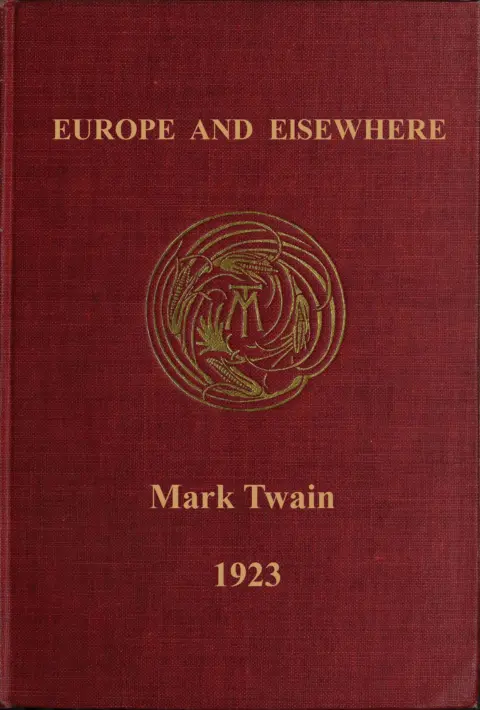
Europe and elsewhere
Mark Twain
THE CLASSIC COLLECTION · 1917
"What Is Man? and Other Essays" by Mark Twain is a collection of essays and philosophical dialogues written in the late 19th century. The essays explore profound inquiries into human nature, morality, and the influences that shape our thoughts and behaviors. The opening dialogue focuses on a conversation between an Old Man and a Young Man, wherein they debate whether human beings are merely machines driven by external influences, leading to a discussion about personal merit and the essence of free will. The beginning of this work sets the stage for Twain’s exploration of existential questions and the concept of man as a machine. The Old Man argues that individuals do not create their thoughts or actions independently; instead, they are influenced and shaped by their experiences and environment, likening humanity's state to that of a complex engine rather than free-thinking beings. He discusses the origins of opinions and virtues, suggesting that every impulse—whether for noble or selfish reasons—is ultimately aimed at appeasing one's inner self. This establishes a provocative premise that invites readers to reflect on the essence of their own motives and the nature of human existence.
Introduction adapted from the source catalogue; source summaries may be automatically generated.
Free to read · English · 96,904 words · No account needed
MAKE TIME FOR A GOOD BOOK
On by default. Untick to stop anonymous reading totals. Each page counts after 10 seconds in view. How this works.
Anonymous counting is on unless you have switched it off.
Chaucer was the father of English pottery.
Chaucer was a bland verse writer of the third century.
Chaucer was succeeded by H. Wads. Longfellow an American Writer. His writings were chiefly prose and nearly one hundred years elapsed.
Shakspere translated the Scriptures and it was called St. James because
he did it.
In the middle of the chapter I find many pages of information concerning Shakespeare’s plays, Milton’s works, and those of Bacon, Addison, Samuel Johnson, Fielding, Richardson, Sterne, Smollett, De Foe, Locke, Pope, Swift, Goldsmith, Burns, Cowper, Wordsworth, Gibbon, Byron, Coleridge, Hood, Scott, Macaulay, George Eliot, Dickens, Bulwer, Thackeray, Browning, Mrs. Browning, Tennyson, and Disraeli—a fact which shows that into the restricted stomach of the public-school pupil is shoveled every year the blood, bone, and viscera of a gigantic literature, and the same is there digested and disposed of in a most successful and characteristic and gratifying public-school way. I have space for but a trifling few of the results:
Lord Byron was the son of an heiress and a drunken man.
Wm. Wordsworth wrote the Barefoot Boy and Imitations on Immortality.
Gibbon wrote a history of his travels in Italy. This was original.
George Eliot left a wife and children who mourned greatly for his
genius.
George Eliot Miss Mary Evans Mrs. Cross Mrs. Lewis was the greatest female poet unless George Sands is made an exception of.
Bulwell is considered a good writer.
Sir Walter Scott Charles Bronte Alfred the Great and Johnson were the
first great novelists.
Thomas Babington Makorlay graduated at Harvard and then studied law, he was raised to the peerage as baron in 1557 and died in 1776.
Here are two or three miscellaneous facts that may be of value, if
taken in moderation:
Homer’s writings are Homer’s Essays Virgil the Aenid and Paradise lost some people say that these poems were not written by Homer but by another man of the same name.
A sort of sadness kind of shone in Bryant’s poems.
Holmes is a very profligate and amusing writer.
When the public-school pupil wrestles with the political features of the Great Republic, they throw him sometimes:
A bill becomes a law when the President vetoes it.
The three departments of the government is the President rules the world, the governor rules the State, the mayor rules the city.
The first conscientious Congress met in Philadelphia.
The Constitution of the United States was established to ensure
domestic hostility.
Truth crushed to earth will rise again. As follows:
The Constitution of the United States is that part of the book at the
end which nobody reads.
Your reading position is saved on this browser. Take it to another device with a library code. Reading pages adapt to text, rather than matching a printed edition.
BEHIND THE BOOK
This eBook is for the use of anyone anywhere in the United States and most other parts of the world at no cost and with almost no restrictions whatsoever. You may copy it, give it away or re-use it under the terms of the Project Gutenberg License included with this eBook or online at www.gutenberg.org. If you are not located in the United States, you will have to check the laws of the country where you are located before using this eBook. Read the source licence.
The original source file, including credits and licence, is retained by this library. Request an original-format copy at no charge. Please include the book title and Project Gutenberg identifier #70.
KEEP YOUR CURIOSITY GOING

David Patterson (Spirit) Hatch

David Patterson (Spirit) Hatch

David Patterson (Spirit) Hatch
Coulson Kernahan

Ralph Waldo Emerson

Maurice Baring