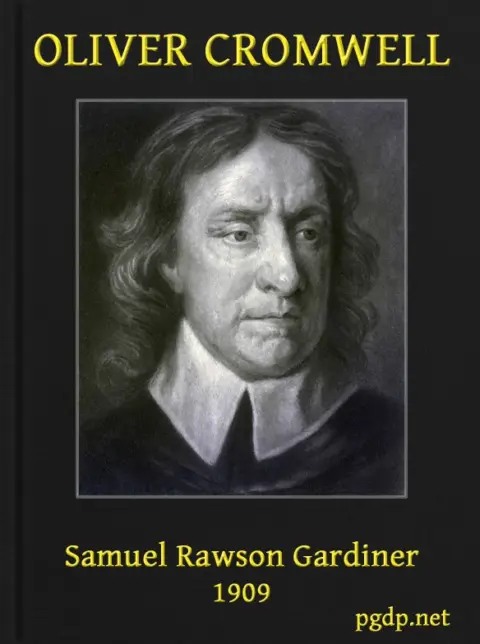
Oliver Cromwell
Samuel Rawson Gardiner
THE CLASSIC COLLECTION · 1897
"What Gunpowder Plot Was" by Samuel Rawson Gardiner is a historical account written in the late 19th century. The book examines the infamous Gunpowder Plot of 1605, challenging traditional narratives and exploring the motivations behind the conspiracy to blow up the British Parliament. Gardiner engages with various historical evidences and interpretations, particularly focusing on the claims made by Father Gerard regarding the conspirators' supposed manipulation by government officials. The opening of the text sets the stage for an in-depth analysis of the historical controversy surrounding the Gunpowder Plot. Gardiner begins by referencing Father Gerard’s examination of evidence asserting the plot was fabricated by the Earl of Salisbury for political gain. He discusses Gerard's conclusions, noting their implications on Catholic perceptions and the subsequent penalties they suffered following the event. Gardiner moves to critique Gerard's approach and the reliability of various sources, hinting at a meticulous inquiry into the established narrative while arguing for a thorough exploration of historical documents to discover the truth behind this pivotal moment in British history.
Introduction adapted from the source catalogue; source summaries may be automatically generated.
Free to read · English · 71,803 words · No account needed
MAKE TIME FOR A GOOD BOOK
On by default. Untick to stop anonymous reading totals. Each page counts after 10 seconds in view. How this works.
Anonymous counting is on unless you have switched it off.
[290] The Saturday or Sunday after the octave of Corpus Christi, i.e., June 8 or 9, old style, which seems to have been used, as the same day is described as being about the beginning of Trinity Term, which began on May 31.
[291] Garnet's Declaration, March 9.--Hist. Rev., July 1888 pp.
510-517.
[292] The letter is printed in Tierney's Dodd, iv. App. cix., where there is an argument in a note to show that the part from which I am about to quote came from a later letter. For my purpose the date is immaterial.
[293] Garnet's Declaration, March 9.--Hist. Rev., July 1888, pp.
510-517.
[294] Garnet's Declaration, March 10. Hist. Rev., July 1888, p. 517.
[295] The author of Sir Everard Digby's life writes:--"I fully admit that if Father Garnet was weak, his weakness was owing to an excess of kindheartedness and a loyalty to his friends that bordered on extravagance." (The Life of a Conspirator, by 'One of his Descendants,' p. 134.) It will be noticed that I am inclined to go further than this.
[296] In addition to what has been already said, a letter from the Nuncio at Brussels to Dr. Gifford, written on July 22/Aug. 1, 1604, may be quoted. He says that the Pope 'paratissimum esse ea omnia pro sua in Catholicos authoritate facere quae Serenissimae suae Majestati securitatem suae personae, et status procurare possunt, eosque omnes e regno evocare quos sua Majestas rationabiliter judicaverit regno et statui [MS. statuti] suo noxios fore.'--Tierney's Dodd, App. No. 5.
Aldobrandino, Cardinal, report by the Nuncio at Paris to, 151
Bancroft, Archbishop, informs Salisbury that Percy had ridden towards
Croydon, 23
Banishment of the priests, 160
Barlow, Bishop, mistaken reference to a book of, 84
Barneby, reports to the Nuncio at Paris, 153
Bartlet, George, said to have stated that Catesby visited Salisbury
House, 11
Bates, Thomas, arrest of, 47;
examination of, 179;
value of the evidence of, 182-189;
charge brought against Greenway by, 189
Baynham, Sir Edmund, mission of, 195
Brewer, Mr. H. W., author of a conjectural view of the neighbourhood of the old House of Lords, 93
Brick, softer in 1605 than at present, 97
Bright, Mrs., evidence of, 28.
See Skinner, Mrs.
Buck, Master, alleged statement by, 7
Bufalo, del, see Nuncio in Paris
Capon, William, mistakes the position of Percy's house, 77; worthlessness of the evidence of, 107
Catesby, Robert, said to visit Salisbury, 11;
cannot have given information, 121;
informs Greenway of the plot, 177;
his relations with Garnet, 192
Cecil, Sir Robert, corresponds with James on toleration, 143-148; forwards James's reply to the Nuncio's overtures, 156; has no motive for inventing Gunpowder Plot, 160. See Cranborne, Viscount, and Salisbury, Earl of
Your reading position is saved on this browser. Take it to another device with a library code. Reading pages adapt to text, rather than matching a printed edition.
Samuel Rawson Gardiner
Samuel Rawson Gardiner
BEHIND THE BOOK
This eBook is for the use of anyone anywhere in the United States and most other parts of the world at no cost and with almost no restrictions whatsoever. You may copy it, give it away or re-use it under the terms of the Project Gutenberg License included with this eBook or online at www.gutenberg.org. If you are not located in the United States, you will have to check the laws of the country where you are located before using this eBook. Read the source licence.
The original source file, including credits and licence, is retained by this library. Request an original-format copy at no charge. Please include the book title and Project Gutenberg identifier #34606.
KEEP YOUR CURIOSITY GOING
Cécile Tormay

Moritz Busch
John L. Ransom
Frances Wright
Cécile Tormay

Mabel Potter Daggett