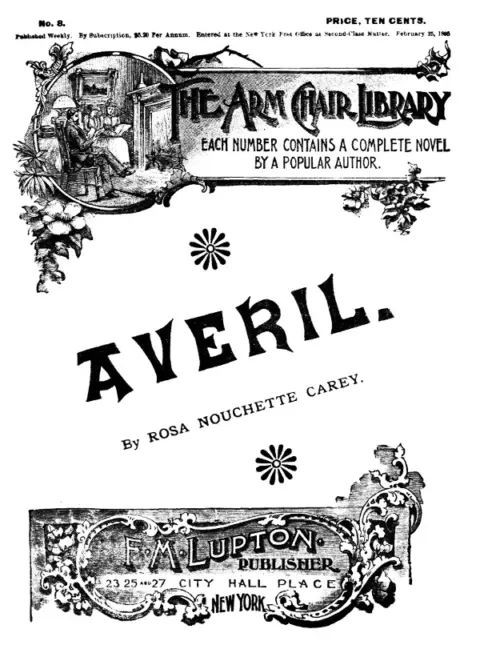
Averil
Rosa Nouchette Carey
THE CLASSIC COLLECTION · 1890
"Wee Wifie" by Rosa Nouchette Carey is a novel written in the late 19th century. The story appears to revolve around themes of love, sacrifice, and social expectations as it introduces complex relationships among its characters, particularly focusing on Margaret Ferrers and her interactions with those around her, including her brother Raby and potential love interest Hugh Redmond. At the start of the novel, readers are introduced to a tranquil, picturesque setting and a thoughtful woman named Margaret, who is portrayed in a grave and serious light. Margaret's internal contemplation is interrupted by the lively activities of village life, hinting at her connection to a deeper narrative involving her family and relationship dynamics. The opening sections introduce elements of familial duty and sacrifice, particularly with the insights shared by Catharine, the lodge-keeper, about Margaret's relationship with Hugh Redmond, whose heart seems to be at the center of unfolding drama and heartbreak tied to social expectations and personal choices.
Introduction adapted from the source catalogue; source summaries may be automatically generated.
Free to read · English · 137,389 words · No account needed
MAKE TIME FOR A GOOD BOOK
On by default. Untick to stop anonymous reading totals. Each page counts after 10 seconds in view. How this works.
Anonymous counting is on unless you have switched it off.
"Not call you what?" in genuine astonishment. "Why, are you not my Wee Wifie? I think it is the best possible name I could find for you; is it not pretty enough for your ladyship?"
"Yes, but it is so childish and will make people smile, and Aunt Griselda would be shocked, and--" but here she broke off, flushed and looking much distressed.
"Nay, give me all your reasons," said Hugh, kindly. "I can not know all that is in my little wife's heart yet."
But Hugh, as he said this, sighed involuntarily, as he thought how little he cared to trace the workings of that innocent young mind.
The gentleness of his tone gave Fay courage.
"I don't know, of course--at least I forget--but I am really sure that--that--'The Polite Match-Maker' would not consider it right."
"What?" exclaimed Hugh, opening his eyes wide and regarding Fay with
amazement.
"'The Polite Match-Maker,' dear," faltered Fay, "the book that Aunt Griselda gave me to study when I was engaged, because she said that it contained all the necessary and fundamental rules for well-bred young couples. To be sure she smiled, and said it was a little old-fashioned; but I was so anxious to learn the rules perfectly that I read it over three or four times."
"And 'The Polite Match-Maker' would not approve of Wee Wifie, you think?" and Sir Hugh tried to repress a smile.
"Oh, I am sure of it," she returned, seriously; "the forms of address
were so different."
"Give me an example, then, or I can hardly profit by the rule."
Fay had no need to consider, but she hesitated for all that. She was never sure how Hugh would take things when he had that look on his face. She did not want him to laugh at her.
"Of course it is old-fashioned, as Aunt Griselda says; but I know the 'Match-Maker' considered 'Honored Wife,' or 'Dearest Madame,' the correct form of address." And as Hugh burst out laughing, she continued, in a slightly injured tone--"Of course I know that people do not use those terms now, but all the same, I am sure Aunt Griselda would not think Wee Wifie sufficiently respectful,"--and here Fay looked ready to cry--"and though the book is old-fashioned she said many of the rules were excellent."
"But, Fay," remonstrated her husband, "does it not strike you that the rules must be obsolete, savoring of the days of Sir Charles Grandison and Clarissa Harlowe? Pshaw!" with a frown, "I forgot I was gauging a child's intellect. Well," turning to her, "what is your busy little mind hatching now?"
Your reading position is saved on this browser. Take it to another device with a library code. Reading pages adapt to text, rather than matching a printed edition.
Rosa Nouchette Carey
Rosa Nouchette Carey
Rosa Nouchette Carey
Rosa Nouchette Carey
BEHIND THE BOOK
This eBook is for the use of anyone anywhere in the United States and most other parts of the world at no cost and with almost no restrictions whatsoever. You may copy it, give it away or re-use it under the terms of the Project Gutenberg License included with this eBook or online at www.gutenberg.org. If you are not located in the United States, you will have to check the laws of the country where you are located before using this eBook. Read the source licence.
The original source file, including credits and licence, is retained by this library. Request an original-format copy at no charge. Please include the book title and Project Gutenberg identifier #28717.
KEEP YOUR CURIOSITY GOING
Coulson Kernahan

Maurice Baring
Frances Wright
Cécile Tormay

Frederic Jesup Stimson

W. H. P. (William Henry Pope) Jarvis