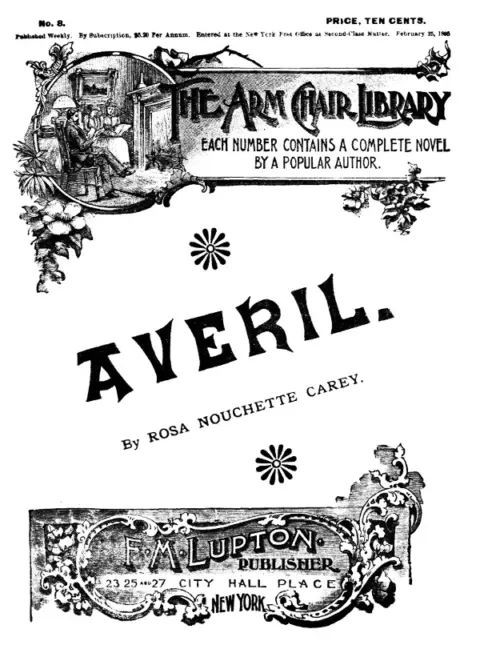
Averil
Rosa Nouchette Carey
THE CLASSIC COLLECTION · 1890
"Wee Wifie" by Rosa Nouchette Carey is a novel written in the late 19th century. The story appears to revolve around themes of love, sacrifice, and social expectations as it introduces complex relationships among its characters, particularly focusing on Margaret Ferrers and her interactions with those around her, including her brother Raby and potential love interest Hugh Redmond. At the start of the novel, readers are introduced to a tranquil, picturesque setting and a thoughtful woman named Margaret, who is portrayed in a grave and serious light. Margaret's internal contemplation is interrupted by the lively activities of village life, hinting at her connection to a deeper narrative involving her family and relationship dynamics. The opening sections introduce elements of familial duty and sacrifice, particularly with the insights shared by Catharine, the lodge-keeper, about Margaret's relationship with Hugh Redmond, whose heart seems to be at the center of unfolding drama and heartbreak tied to social expectations and personal choices.
Introduction adapted from the source catalogue; source summaries may be automatically generated.
Free to read · English · 137,389 words · No account needed
MAKE TIME FOR A GOOD BOOK
On by default. Untick to stop anonymous reading totals. Each page counts after 10 seconds in view. How this works.
Anonymous counting is on unless you have switched it off.
Day unto day her dainty hands
Make life's soil'd temples clean,
And there's a wake of glory where
Her spirit pure hath been.
At midnight through that shadow land
Her living face doth gleam,
The dying kiss her shadow, and
The dead smile in her dream.
A little later, Jean, honest woman, suffered an electric shock. She was brushing out baby Hugh's curls, that had been disordered by the walk, when she thought she heard Mrs. St. Clair's footsteps, only it was over-quick like, as she remarked later, "like a bairn running up the stairs," but she fairly shook with surprise when the door opened, and a rosy, dimpled, smiling creature stood before her.
"Give me the baby, Jean, quick--no, never mind his sash, he looks beautiful. My husband has come, and he wants to see him. Yes, my boy! Father has come"--nearly smothering him with kisses, which baby Hugh returned by mischievous grabs at her hair.
"Ech, sirs," began Jean, turning very red; but before she could give vent to her surprise, a big, grand-looking man suddenly entered the old-fashioned room, and took mother and child in his arms before her very eyes.
Jean vanished precipitately, and Mrs. Duncan found her an hour afterward, basting the fowls with a skewer, while the iron ladle lay at her feet, and with a stony, impassive expression on her face which always meant strong disapproval with Jean.
"Well, Jean," remarked her mistress cheerily, while her white curls bobbed with excitement, "have you heard the news, my woman? That pretty creature has got her husband, and he is as fine a man as one could ever set eyes on, and that is all a mistake about his not wanting her--a parcel of childish rubbish.
"Hoots, lass," as Jean remained glum and silent, and only picked up the iron spoon with a toss of her head, "you do not look overpleased, and yet we are bidden to rejoice with them that do rejoice. Why, he is a baronet, Jean, and as rich as Croesus, and she is Lady Redmond, bless her dear heart! Why, I went into the nursery just now, and it was just a lovely sight, as I told Fergus. The bairn had been pulling at her hair, and down it came, a tumbling golden-brown mass over her shoulders like the pictures of a woman-angel, and she just laughed in her sonsie way, and tried to gather it up, only Sir Hugh stopped her. 'Let it be, Fay, you look beautiful so,' he says, worshiping her with his eyes. Oh, it was good to hear him; and then he looks up and sees me, and such a smile comes to his face. Oh, we understood each other." But to all this Jean apparently turned a deaf ear, only when her mistress had finished, but not a moment before, she answered, crossly, how was the tea-supper to be ready for the gentry if folks hindered her with their clavers, at which hint Mrs. Duncan, judging which way the wind blew, prudently withdrew.
Your reading position is saved on this browser. Take it to another device with a library code. Reading pages adapt to text, rather than matching a printed edition.
Rosa Nouchette Carey
Rosa Nouchette Carey
Rosa Nouchette Carey
Rosa Nouchette Carey
BEHIND THE BOOK
This eBook is for the use of anyone anywhere in the United States and most other parts of the world at no cost and with almost no restrictions whatsoever. You may copy it, give it away or re-use it under the terms of the Project Gutenberg License included with this eBook or online at www.gutenberg.org. If you are not located in the United States, you will have to check the laws of the country where you are located before using this eBook. Read the source licence.
The original source file, including credits and licence, is retained by this library. Request an original-format copy at no charge. Please include the book title and Project Gutenberg identifier #28717.
KEEP YOUR CURIOSITY GOING
Coulson Kernahan

Maurice Baring
Frances Wright
Cécile Tormay

Frederic Jesup Stimson

W. H. P. (William Henry Pope) Jarvis